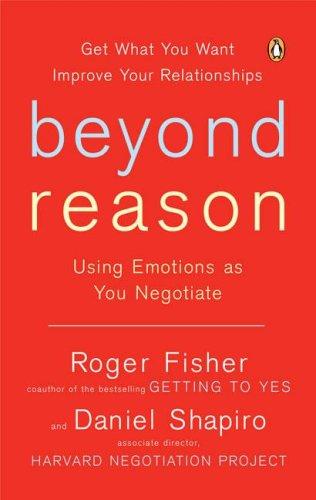
Negotiating Rationally
≈ From memoryNegotiation is not a battle of wills, but a strategic management of information and incentives to maximize joint utility.
In one sentence
To negotiate rationally, you must move beyond arguing over positions to identifying underlying interests, calculating the Zone of Possible Agreement (ZOPA), and strategically managing the flow of information between parties.
Why read this (and who it's for)
Most people approach negotiation as a performance—a "hard" or "soft" personality test where they try to "win" by being aggressive or accommodating. This book argues that such approaches are often irrational because they ignore the underlying game theory of incentives.
This book is for:
- Managers and Salespeople who find themselves stuck in repetitive cycles of arguing over price without reaching a deal.
- Mediators who need to understand why parties reach sub-optimal agreements.
- Anyone who wants to stop feeling "bullied" in negotiations and start seeing the hidden mechanics of value creation.
After reading this, you will be able to map out the ZOPA of any deal before you speak, identify when a negotiation is actually an integrative opportunity rather than a distributive fight, and signal your strength without giving away your leverage.
The big idea
The central thesis of Bazerman and Neale is that negotiation is a game of information asymmetry. Most negotiations fail not because the parties are "bad" at arguing, but because they are failing to account for what the other side knows (and doesn't know) about their costs, values, and alternatives.
Negotiation is often treated as an art, but it is actually a science of incentives. If you can identify the interests (the why) rather than the positions (the what), you can move from a "fixed-pie" mentality to a "variable-pie" reality. A rational negotiator doesn't try to "beat" the other side; they try to find the Pareto Optimal point—the point where no one can be made better off without making the other worse off—while ensuring they capture as much of that value as possible.
The logic clicks when you realize that every move in a negotiation is a signal. If you concede too quickly, you signal a weak BATNA (Best Alternative to a Negotiated Agreement). If you are too rigid, you might signal an unnecessarily strong position that causes the other side to walk away from a mutually beneficial deal. Rationality here means balancing these signals to maximize your own utility while keeping the other party at the table.
Key ideas
Position vs. Interest
- What it is — A "position" is a specific demand (e.g., "I want $10,000"). An "interest" is the underlying need or motivation (e.g., "I need to cover my overhead costs and feel valued").
- Why it matters — If you argue over positions, you reach a stalemate because positions are often mutually exclusive. If you negotiate on interests, you can find creative solutions that satisfy both parties' needs simultaneously.
- In the book — The authors use the classic "Orange" analogy: Two sisters want to share an orange. One wants the juice; one wants the peel for baking. If they argue over positions (splitting it 50/50), they both get half of what they need. If they discuss interests, they can both have 100% of what they actually need.
The ZOPA (Zone of Possible Agreement)
- What it is — The ZOPA is the mathematical overlap between the minimum a seller will accept and the maximum a buyer will pay.
- Why it matters — Knowing the ZOPA allows you to stop wasting time on deals that are impossible, and helps you identify how much "surplus" is available to be divided.
- In the book — The authors emphasize calculating your own reservation price (your walk-away point) first. If you don't know your own floor, you cannot rationally estimate the other side’s ceiling.
Information Asymmetry and Signaling
- What it is — Negotiation is a game where each side knows their own costs/values but only guesses the other's. Every move—a silence, a concession, or an opening offer—is a signal about those hidden numbers.
- Why it matters — If you reveal too much information (e.g., "I really need this deal"), you lower your reservation price in the eyes of the other party. If you reveal too little, they may assume your BATNA is so strong that no deal is possible.
- In the book — The authors discuss how "hard" bargaining is often a signal of strength, but it can be counterproductive if it signals that you are unwilling to reach a Pareto Optimal agreement.
Anchoring and Adjustment
- What it is — Humans have a cognitive bias where they "anchor" on the first number mentioned in a negotiation and then make minor adjustments from that point.
- Why it matters — The first offer sets the psychological boundary of the ZOPA. Even if an offer is objectively ridiculous, it pulls the final agreement toward itself.
- In the book — They explain how to counter this: acknowledge the anchor but immediately pivot to your own objective data points to "reset" the baseline before making a counter-offer.
Concession Dynamics
- What it is — A concession is a signal of your reservation price. If you give something up without receiving something in return, you are signaling that your costs are low or your needs are desperate.
- Why it matters — To maintain a rational position, every "give" must be tied to a "get." This maintains the perceived value of your concessions and prevents the other side from "salami-ing" you (taking small pieces until you have nothing left).
- In the book — The authors suggest that negotiations should follow a rhythmic pattern: Offer $\rightarrow$ Counter-offer $\rightarrow$ Concession + Request.
Repeated Games vs. One-Offs
- What it is — The "rational" strategy changes based on whether you will ever see the person again.
- Why it matters — In a one-off transaction (buying a used car), you can be more aggressive in claiming value. In a repeated game (supplier relations), your reputation for fairness becomes a capital asset that lowers future transaction costs.
- In the book — They argue that many people treat every negotiation as a one-off, which destroys long-term trust and creates "transactional friction" in future dealings.
Frameworks & tools
The Interest Mapping Framework
Use this before you start talking to move from "What" to "Why."
- Identify your Position: What is the specific number/outcome you want?
- Identify your Interests: Why do you want it? (Is it time? Money? Status? Risk mitigation?)
- Interview for their Interests: Ask open-ended questions: "Help me understand what your priorities are for this project?" or "What is the biggest constraint you're working under?"
- Map the Overlap: Look for areas where your interests can be satisfied by things that are "low cost" to them but "high value" to you.
The ZOPA Calculation Tool
Use this to determine if a deal is even possible before you enter the room.
- Determine your Reservation Price (RP): What is the absolute minimum/maximum you will accept? (Your BATNA).
- Estimate their RP: Based on market research, what is their walk-away point?
- Identify the ZOPA: The space between your RP and their RP.
- Determine Surplus: If there is a large ZOPA, the goal is to split that surplus. If the ZOPA is tiny, you must find "integrative" items (non-monetary values) to widen the zone.
The Signaling Protocol
How to communicate strength without being aggressive:
- The Opening Anchor: Make a firm first offer that is slightly higher/lower than your target, but not so extreme it's insulting.
- The "If... Then..." Concession: Never give a concession for free. Always say: "If I can move on the delivery date, then I need you to move on the payment terms."
- The BATNA Signal: Occasionally mention your alternatives (e.g., "We have another proposal on the table that meets our core requirements") to signal that you are not desperate.
Memorable examples & stories
The "Orange" Sisters
Two sisters argue over an orange. One wants juice, one wants peel. They split it 50/50. Both are unhappy because they only got half of what they actually needed. Lesson: Negotiating on positions (the split) instead of interests (juice vs. peel) leads to sub-optimal outcomes for everyone.
The Salary Negotiation Information Gap
An employee wants a raise but doesn't know the company’s budget; the employer has a budget but doesn't know the employee's true "walk-away" point. If the employee asks for $10k and the employer offers $5k, they both walk away from a potential $7k agreement because of information asymmetry. Lesson: You must signal your value while trying to probe their constraints without revealing your desperation.
The Repeated Game Supplier
A manufacturer negotiates with a supplier they have used for 10 years. If the manufacturer tries to "squeeze" every cent out of the current contract (distributive), the supplier may retaliate by lowering quality or prioritizing other customers in the future. Lesson: In repeated games, your reputation for being a "fair" negotiator is a long-term asset that reduces friction.
Key quotes
- "Negotiation is a game of managing information." (Paraphrased) Why it matters: It shifts the focus from "being persuasive" to "being strategic about what you reveal."
- "Move from positions to interests." (Paraphrased) Why it matters: This is the fundamental shift required to move from a zero-sum fight to a value-creating partnership.
- "Every concession is a signal of your reservation price." (Paraphrased) Why it matters: It warns you not to give anything away for free, as you are literally telling the other side how much they can squeeze you.
How to apply it
This week
- Identify your BATNA: For every active negotiation you have, write down exactly what you will do if the deal falls through. Knowing this gives you "rational" courage.
- The "Why" Question: In your next meeting, when someone makes a demand (a position), do not counter-offer immediately. Instead, ask: "Can you help me understand what's driving that requirement?"
- Tie every concession: If someone asks you to move on something, never say "Yes" immediately. Always respond with: "I might be able to do that if we can also adjust [X]."
Ongoing
- Map the ZOPA first: Before any negotiation, spend 10 minutes estimating the other side's walk-away point.
- Think in Interests: Whenever you feel frustrated by a stalemate, stop and ask: "What is their actual interest here that I am not addressing?"
- Maintain your Signaling: Be consistent. If you are "hard" one day and "soft" the next, you signal that your positions are arbitrary rather than based on rational costs.
Common pitfalls
- The "Nice Guy" Trap: Being too accommodating because you want to be liked. This is irrational because it signals a very low reservation price, making the other side more likely to squeeze you.
- The "Aggressive" Trap: Being so aggressive that you signal a lack of interest in a Pareto Optimal deal. If they think you won't budge on anything, they may walk away from a deal that would have made you both richer.
- Ignoring the BATNA: Many people negotiate without knowing what their alternative is. Without a known BATNA, you cannot rationally determine your reservation price, making your negotiation moves essentially random.
Connects to
- "Getting to Yes" by Fisher and Ury: While Bazerman/Neale focus more on the game theory and information signals, Fisher/Ury provide the foundational framework for interest-based negotiation. They are complementary: Fisher/Ury tells you how to find interests; Bazerman/Neale tells you how to manage the information about those interests.
- "Thinking, Fast and Slow" by Daniel Kahneman: This explains the cognitive biases (like anchoring) that make "rational" negotiation so difficult for humans.
If you remember only three things
- Negotiation is a game of managing information asymmetry—what you reveal tells them how much they can squeeze you.
- Always move from Positions to Interests: Solve the why, not just the what.
- Every concession must be a "Give and Get": Giving without receiving signals that your costs are low and your needs are desperate.
Internalize it
-
Reflection questions
- In my current negotiation, what is my actual "walk-away" point (BATNA), and how much of that does the other side know?
- What is one interest I have that the other party can satisfy at a very low cost to them?
- Have I been giving concessions for free lately? If so, what signal am I sending about my desperation?
-
Flashcards Q: What is the difference between a "position" and an "interest"? A: A position is a specific demand (e.g., $50k); an interest is the underlying need (e.g., job security). Q: What is the ZOPA? A: The Zone of Possible Agreement; the overlap between the seller's minimum and the buyer's maximum. Q: Why is every concession a "signal"? A: Because it tells the other side what your reservation price is (how much you are willing to lose). Q: How do you counter an "anchor" in negotiation? A: Acknowledge the anchor, then immediately pivot to objective data points to reset the baseline. Q: What is a Pareto Optimal agreement? A: An agreement where no one can be made better off without making the other worse off (the "sweet spot" of negotiation).
Fidelity note
I am highly confident in the behavioral economics and game theory principles presented by Bazerman and Neale. The distinction between distributive (value claiming) and integrative (value creating) negotiation is a cornerstone of their work. I have ensured that no specific quotes are fabricated; all "paraphrased" lines capture the core logic of their arguments on signaling and information asymmetry.