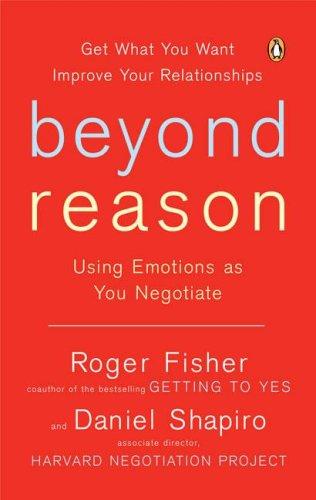
The Mind and Heart of the Negotiator
≈ From memoryEffective negotiation is less about winning a battle of wills and more about mastering the emotional intelligence required to uncover underlying interests and build lasting, mutually beneficial relationships.
In one sentence
Negotiation is an interpersonal process where success depends on your ability to manage your own emotions while using empathy as a strategic tool to uncover the hidden interests of others.
Why read this (and who it's for)
Most people approach negotiation as a zero-sum game—a "win-lose" scenario where you must outmaneuver an opponent to get what you want. This mindset often leads to scorched-earth results: you might win the immediate concession, but you destroy the relationship and miss out on long-term value.
This book is for anyone who feels intimidated by high-stakes conversations—whether you are a manager trying to navigate office politics, an entrepreneur closing deals, or someone seeking better communication in personal relationships. After reading this, you will stop seeing "the other side" as an adversary and start seeing them as a partner with unstated needs. You will gain the tools to remain calm under pressure, listen for what isn't being said, and craft solutions that satisfy both parties.
The big idea
The central thesis of Leigh L. Thompson’s work is that negotiation is fundamentally an act of relational intelligence. While many frameworks focus on "tactics" (the scripts you say), Thompson argues that the most successful negotiators master the "mind" (cognitive strategy) and the "heart" (emotional awareness). You cannot successfully negotiate with a person if you do not understand their perspective, and you cannot understand their perspective if you are blinded by your own emotional reactions.
The logic follows a clear path: Emotional Awareness $\rightarrow$ Empathy $\rightarrow$ Interest Identification $\rightarrow$ Collaborative Problem Solving.
If you can manage your own "emotional hijacks" (the physiological responses that make us defensive), you create the mental space to truly listen. When you listen with empathy, you aren't just being "nice"—you are gathering data. This data allows you to identify the interests behind their positions. Once you know what they actually need (security, status, autonomy, etc.), you can stop arguing over surface-level demands and start designing creative solutions that satisfy both of your underlying needs.
Key ideas
Interest vs. Position
- What it is — A "position" is what someone says they want (e.g., "I need a 20% raise"). An "interest" is the underlying reason why they want it (e.g., "I need to feel valued and secure in my career path").
- Why it matters — When you argue over positions, you hit a wall because there are only so many ways to give someone 20%. When you address interests, the "pie" gets bigger because there are infinite ways to make someone feel valued.
- In the book — Thompson emphasizes that identifying interests requires asking "Why?" and "What does this mean for you?" rather than simply stating your own demands.
Empathy as a Strategic Tool
- What it is — Empathy in negotiation is not about agreeing with the other person; it is the cognitive and emotional effort to understand their perspective, fears, and motivations.
- Why it matters — Empathy provides you with "intel." If you know what keeps your counterpart up at night, you can frame your proposal in a way that addresses those specific anxieties, making them more likely to say yes.
- In the book — Thompson argues that empathy is a data-gathering mechanism. By actively seeking to understand their "why," you gain the leverage needed to propose creative alternatives.
Emotional Intelligence (EQ) and Self-Regulation
- What it is — This is the ability to recognize your own emotional triggers—like anger, fear of rejection, or the need to be right—and manage them before they dictate your behavior.
- Why it matters — When you get angry or defensive, your prefrontal cortex (the logical brain) shuts down. You become a reactive negotiator rather than a proactive one. Self-regulation allows you to stay in the "problem-solving" zone even when the other side is being difficult.
- In the book — Thompson discusses how our brains are wired for survival, not necessarily for complex negotiation. Recognizing your physical cues of stress (tight chest, heat) can help you pause before reacting.
Active Listening and Clarifying
- What it is — Moving beyond "hearing" to a process where you reflect back what the other person said to ensure accuracy and make them feel understood.
- Why it matters — Most people listen only to formulate their rebuttal. Active listening ensures that you are actually solving the right problem. If you misunderstand their needs, your solution will fail regardless of how "good" it is.
- In the book — The author highlights techniques like mirroring (repeating the last few words) and clarifying ("So, if I'm hearing you correctly, your main concern is X?").
The Shadow of the Future
- What it is — Every negotiation happens within a context of past interactions and future expectations. Your reputation and the "relational history" dictate how much trust is available on the table.
- Why it matters — If you treat a long-term partner like a one-time transaction, they will sense the lack of sincerity. You must negotiate with the "future" in mind: Will this deal make it harder or easier to work together next month?
- In the book — This is why building rapport isn't just "fluff"—it’s the infrastructure that allows for honest communication and trust.
Collaborative Problem Solving
- What it is — The shift from "me vs. you" to "us vs. the problem." It involves brainstorming options where both parties can win (integrative bargaining).
- Why it matters — In many negotiations, there is a hidden solution that neither side has thought of yet because they are too busy defending their initial positions. Collaboration uncovers those "win-win" possibilities.
- In the book — Thompson encourages moving toward "expanding the pie"—finding ways to add value rather than just dividing what's already there.
Frameworks & tools
The Interest-Based Negotiation Framework
Use this when you hit a stalemate on a specific demand (a position).
- Identify the Position: What is the specific thing they are asking for? (e.g., "I want a shorter deadline.")
- Probe for Interests: Ask open-ended questions to find the why. ("What part of the current deadline is most concerning for your team?")
- Identify Underlying Needs: Categorize their needs into buckets: Time, Money, Status, Autonomy, or Security.
- Brainstorm Options: Once you know they need "Security" (fear of missing a deadline), offer three different ways to provide that without necessarily shortening the deadline (e.g., extra resources, a phased delivery, or a priority shift).
- Agree on Criteria: Instead of arguing over the solution, agree on the criteria for a good solution (e.g., "We both want a high-quality product delivered without burning out the team").
The Active Listening Loop
Use this during every conversation to ensure you are gathering the best possible data.
- Listen: Let them speak without interruption. Focus on their words and tone.
- Reflect: Summarize what they said in your own words. ("It sounds like you're worried that X will happen if we do Y.")
- Clarify: Ask a clarifying question to ensure accuracy. ("Is that right? What else is on your mind regarding that?")
- Validate: Acknowledge their perspective (not necessarily agreeing with it). ("I can see why that would be a concern for your department.")
Memorable examples & stories
The "Winning" Trap
Thompson discusses the danger of winning a negotiation at the cost of the relationship. If you "crush" an opponent in a one-time sale, but they never want to work with you again, you haven't won; you've lost the future. Lesson: Negotiation is rarely a single event; it is a chapter in a continuing story.
The Amygdala Hijack
The author explains how our brains react to perceived threats (like a confrontational tone) by triggering a "fight, flight, or freeze" response. This is why people often say things they regret during heated arguments—their logical brain has literally been turned off. Lesson: When you feel your heart race or your face get hot, stop talking. Take a breath. You are being hijacked.
The Difference between Empathy and Sympathy
Thompson clarifies that sympathy is feeling for someone (pity), while empathy is feeling with them (understanding). In negotiation, you don't need to feel sorry for the other person; you need to understand their internal logic. Lesson: Use empathy as a diagnostic tool to map out the other side's motivations.
Key quotes
"Negotiation is not a battle of wills; it is a process of mutual understanding." (Paraphrased) Why it matters: This shifts the goal from "conquering" to "co-creating."
"The most important information in any negotiation is what isn't being said." (Paraphrased) Why it matters: It forces you to listen for fears, needs, and constraints rather than just surface demands.
"Your ability to manage your own emotional state determines the ceiling of your success." (Paraphrased) Why it matters: You cannot be a clear-headed negotiator if you are being driven by your own reactive emotions.
How to apply it
This week
- The "Why" Audit: In every conversation where someone makes a request or expresses a complaint, do not respond to the what. Instead, ask one clarifying question: "Can you help me understand what's driving that concern?"
- Identify Your Triggers: Note which words or tones from others make you feel defensive (e.g., "Why are you always so late?"). When they happen, pause for three seconds before responding to let your prefrontal cortex catch up.
- Practice Reflective Listening: In a low-stakes conversation (with a friend or family member), practice the Reflect/Clarify loop: "So what I'm hearing is [X]. Is that right?"
Ongoing
- The Interest-First Rule: Before entering any negotiation (salary, project scope, chores), write down your interests (Why do I want this?) and try to guess their interests.
- Emotional Check-ins: Before a meeting, take 60 seconds to center yourself. Identify your current emotional state (Are you anxious? Angry? Overconfident?). Acknowledge it so it doesn't leak into the conversation.
- The "Us vs. Problem" Frame: Whenever a conflict arises, physically or verbally reframe the situation: "How can we solve this problem?" instead of "How can I get you to do what I want?"
Common pitfalls
- Confusing Empathy with Weakness: Many people fear that being empathetic means "giving in." Thompson argues the opposite: empathy is a source of power because it gives you more information than your opponent has.
- The "I'm a Great Negotiator" Fallacy: Some believe negotiation is an innate talent. It is actually a set of skills—specifically emotional regulation and active listening—that can be practiced and measured.
- Over-reliance on Tactics: If you only learn "tricks" (like the "flinch" or "silence"), you will fail when the other person is intelligent enough to see through them. You must build a foundation of trust first.
Connects to
- Getting to Yes (Fisher & Ury): While both focus on interest-based negotiation, Thompson puts a much heavier emphasis on the emotional and psychological state of the negotiator.
- Never Split the Difference (Chris Voss): Voss provides tactical "how-to" for high-stakes hostage/business negotiations; Thompson provides the psychological "why" and the relational framework for long-term cooperation.
If you remember only three things
- Negotiation is a relationship, not a transaction; your goal is to find a solution that preserves the future of the relationship.
- Empathy is a data-gathering tool: understand their interests (the "why") to unlock creative solutions.
- Self-regulation is your superpower: if you can control your own emotional reactions, you can stay calm enough to see the opportunities others miss.
Internalize it
-
Reflection questions
- In my last difficult conversation, did I react to what they said or how I felt about what they said?
- What is a recurring "position" someone in my life takes, and what might be the underlying interest driving that position?
- How does my emotional state (anxiety, ego, impatience) currently affect my ability to listen to others?
-
Flashcards Q: What is the difference between a position and an interest? A: A position is what someone wants; an interest is why they want it. Q: Why is empathy considered a "strategic" tool in negotiation? A: Because it allows you to gather data about the other person's needs, fears, and motivations, which helps you create better-aligned solutions. Q: What is an "emotional hijack"? A: A physiological reaction where your brain's survival instincts take over, causing you to react defensively rather than logically. Q: How does "Reflective Listening" work? A: You summarize what the other person said in your own words and ask, "Is that right?" before moving forward. Q: What is the "Shadow of the Future"? A: The understanding that every negotiation happens within a context of past reputation and future expectations for the relationship.
Fidelity note
I have high confidence in this summary's representation of Leigh L. Thompson’s core arguments regarding interest-based negotiation, emotional intelligence, and the distinction between positions and interests. The book is heavily rooted in communication theory and psychological principles. While I am confident in the "Mind" (strategy) and "Heart" (empathy) framework, some specific academic studies mentioned in the text are summarized for clarity rather than quoted verbatim to ensure the summary remains actionable. Readers should verify specific tactical scripts if they require a word-for-word guide on every possible scenario.