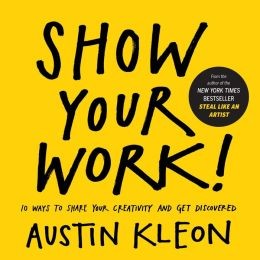
Steal Like an Artist
≈ From memoryCreativity is not a magical spark of original genius, but the result of curated influences, relentless practice, and the courageous act of showing your work.
In one sentence
Originality is a myth; true creativity is the art of synthesizing existing ideas, influences, and techniques into something new through consistent, deliberate practice.
Why read this (and who it's for)
This book is for anyone who feels "blocked" because they believe they aren't "original" enough to be an artist or a creator. It solves the paralyzing fear of the blank page by reframing creativity as a craft rather than a gift. After reading this, you will stop waiting for inspiration and start building a system of input, curation, and output that allows you to produce work consistently.
The big idea
The central thesis of Steal Like an Artist is that there is no such thing as a truly original idea. Every creator is a "remix" of their influences. Kleon argues that the "tortured genius" trope—the idea that art comes from a divine, internal wellspring—is a lie that prevents people from actually doing the work. Instead, creativity is an external process: it is what happens when you take the things you love, the things you admire, and the things you've learned, and filter them through your unique perspective.
The logic follows a simple trajectory: Input $\rightarrow$ Curation $\rightarrow$ Synthesis $\rightarrow$ Output. You cannot create without input. Therefore, you must be a voracious consumer of art, history, and culture. However, consuming isn't enough; you must curate that input by identifying what specifically resonates with you. Finally, you must synthesize those influences into your own work. The "art" is not the final product; it is the process of refining your taste and practicing the craft until your unique voice emerges from the sheer volume of your output.
Key ideas
Good artists borrow, great artists steal
What it is — Borrowing is taking a piece of someone's work (a quote, a style) and putting it in your own. Stealing is internalizing their process, their logic, and their "why." Why it matters — If you only borrow, you are just a mimic. If you steal—meaning you understand the underlying principles of why an artist's work succeeds—you can apply those principles to your own unique problems. In the book — Kleon argues that when you "steal," you aren't looking for a shortcut; you are looking for a mentor in the form of a finished work. You study how they solved a problem, then you solve your own problem using their logic.
Find your influences
What it is — Your creative output is a direct reflection of what you consume. If you want to be a better artist, you must become a more intentional consumer. Why it matters — Most people consume "junk" (mindless scrolling) without reflecting on why they like what they see. To be a creator, you must identify the specific elements that move you—the color, the pacing, the attitude, or the structure. In the book — Kleon suggests looking at your "favorites." What do you love? Why do you love it? By identifying the why, you find the building blocks of your own style.
The power of specific
What it is — To be a "generalist" in a crowded market is to be invisible. You must find a niche, a specific angle, or a unique combination of interests. Why it matters — When you try to appeal to everyone, you appeal to no one. By narrowing your focus, you actually expand your reach because you become the "only" person doing that specific thing. In the book — Kleon points out that being a specialist in a tiny niche allows you to own that space. It’s not about being the best at everything; it's about being the most interesting person in a specific corner of the world.
Quantity over quality
What it is — The only way to get good at anything is to produce a massive volume of work. Quality is a byproduct of quantity, not a prerequisite for it. Why it matters — Perfectionism is a form of procrastination. If you wait until something is "perfect" before showing it, you will never show anything. You must give yourself permission to make "bad" work to get to the good work. In the book — Kleion cites the "Volume Rule": The more you do, the more you learn. Every "bad" project is a data point that informs the next one.
Show your work
What it is — Creativity is not a private act; it is a social and iterative process. You must share your progress, your mistakes, and your "ugly" drafts. Why it matters — Showing your work creates a feedback loop. It builds an audience, provides accountability, and helps you find your community. It also keeps you from being overwhelmed by the scale of the final goal. In the book — Kleon encourages "building in public." Don't wait for the finished masterpiece; share the sketches, the notes, and the failures. This builds a relationship with your audience and clarifies your own thinking.
The creative act is showing up
What it is — Creativity is a discipline of habit, not an emotional state. It’s about sitting down and doing the work even when you don't feel "inspired." Why it matters — If you wait for inspiration, you are at the mercy of your moods. If you rely on routine, you are in control of your output. In the book — Kleon emphasizes that the "craft" is the daily practice of showing up to the desk. The work itself—the grinding, the editing, the repeating—is what makes the art.
Frameworks & tools
The "Copying" Exercise (The Apprentice Method)
To understand how a master works, you must mimic them exactly. This isn't for the public; it's for your internal education.
- Identify a Master: Find an artist or creator whose work you deeply admire.
- Deconstruct their Work: Analyze how they did what they did (e.g., "How did they use lighting here?" or "Why is this sentence so punchy?").
- The Imitation Phase: Attempt to recreate a piece of their work from scratch. Do not just copy-paste; try to replicate the feeling and logic.
- Analyze the Gap: See where you succeeded and where you failed. What did you learn about your own skills?
- Apply to Your Work: Take that newly discovered skill and apply it to your original project.
The Volume Rule (Output-Based Goals)
Shift your metrics from "quality" to "quantity" to bypass the internal critic.
- Set a Quantity Goal: Instead of saying "I want to write a great essay," say "I will write 500 words every day."
- Lower the Stakes: Tell yourself that the first version is supposed to be bad. It’s a "shitty first draft."
- Track Progress: Keep a log of your daily output (words written, sketches made, lines of code).
- Review the Volume: After a month of high-volume output, look back at what you produced. You will find that some pieces are surprisingly good—those are the ones to polish.
The Commonplace Book System
A method for capturing and organizing your "stolen" inspirations.
- The Capture Phase: Whenever you see something interesting (a quote, a design, a weird fact), write it down immediately. Do not filter yet.
- The Categorization Phase: Organize these entries by theme or feeling (e.g., "Color Palettes," "Writing Prompts," "Architecture").
- The Retrieval Phase: When you start a new project, go to your Commonplace Book and pull out 5-10 unrelated items from your collection.
- The Synthesis Phase: Force yourself to combine those unrelated items into a new idea.
Memorable examples & stories
The Apprentice Model
Kleon discusses how apprentices in the past (and today) learned by doing the "grunt work" of their masters. They didn't start by trying to be original; they started by mastering the tools and techniques of those who came before them. Lesson: Mastery comes from imitation before innovation.
The "Bad" Work as Data
Kleon argues that every piece of art you produce is a "data point." Even if it's terrible, it tells you what doesn't work, which narrows the path to what does work. Lesson: Stop viewing failure as a waste of time; view it as a necessary measurement of your current skill level.
The Curator’s Role
The author describes the artist not as a "creator" in a vacuum, but as a curator who selects from a massive library of human history. You are the filter that decides what stays and what goes. Lesson: Your taste is your superpower; cultivate it by being an intentional consumer.
Key quotes
"Good artists borrow, great artists steal." Why it matters: This distinguishes between superficial imitation and deep structural understanding.
"The amateur wants to be perfect; the professional wants to be finished." (Paraphrased) Why it matters: It highlights that "done" is better than "perfectly un-started."
"Your work is a conversation with everyone who came before you." (Paraphrased) Why it matters: It places you in a lineage of creators, removing the pressure to be "the first" to do something.
"The creative act is showing up." (Paraphrased) Why it matters: It strips away the mysticism of art and replaces it with the dignity of labor.
How to apply it
This week
- Start a Commonplace Book: Create a dedicated notebook or digital folder (Notion, Obsidian, etc.). Every time you see something that makes you feel something today, write it down.
- The "Copy" Exercise: Choose one piece of art/design/writing you love. Spend 30 minutes trying to recreate it exactly. Don't show anyone; just do it for your own learning.
- Identify Your "Why": Pick one thing you admire in a creator's work. Write down why it works (e.g., "The way they use negative space makes the subject feel lonely").
Ongoing
- Daily Output Goal: Commit to a non-negotiable daily output (e.g., 20 minutes of sketching, 300 words of writing). Do not worry about quality; focus on completion.
- Curated Input: Spend 15 minutes a day consuming something outside your field (architecture, biology, history) to broaden your "source material."
- Show Your Work: Share one "work in progress" every week—a sketch, a rough draft, or a messy thought—on social media or with a peer.
Common pitfalls
- The Plagiarism Trap: There is a difference between stealing (understanding the logic of a style) and plagiarizing (copying someone's specific expression). Stealing means taking the "how," not the "what." If you copy a specific character design, that's plagiarism. If you learn how they used color to evoke sadness, that's stealing.
- The Consumption Trap: It is easy to become a "professional fan"—someone who consumes endless inspiration but never produces anything. You must ensure your input always leads to an output.
- Over-Specialization too early: While finding a niche is important, don't narrow your focus so much that you stop learning from other fields. The best ideas often come from the intersection of two unrelated interests.
Connects to
- "The Creative Act" by Rick Rubin: While Kleon focuses on the process and mechanics of stealing/borrowing, Rubin focuses on the spiritual and intuitive side of creativity. They are excellent companions: one provides the system, the other the soul.
- "Deep Work" by Cal Newport: This complements Kleon's "Showing Up" principle. To produce high-quality output (the result of your stealing), you need the ability to focus intensely without distraction.
- "Atomic Habits" by James Clear: Provides the actual framework for building the "Creative Act" as a daily habit.
If you remember only three things
- Creativity is a process, not a gift. It is built on curation, synthesis, and repetition.
- Quantity leads to quality. Stop trying to make "perfect" work; instead, focus on making more work.
- Steal the "Why," not the "What." Don't copy what someone did; understand why they did it, then apply that logic to your own unique context.
Internalize it
-
Reflection questions
- What are three things I admire about my favorite artist/creator? Can I identify the technical reasons why those things work?
- If I were forced to produce 100 pieces of work in the next month, what would be the most realistic way for me to do that?
- What is one "bad" thing I’ve been afraid to show people because it isn't perfect yet? Why am I holding it back?
-
Flashcards Q: What is the difference between borrowing and stealing in the context of art? A: Borrowing is taking a piece of someone's work; Stealing is internalizing their process, logic, and "why."
Q: Why does Kleon argue that quantity leads to quality? A: Because high-volume output allows you to fail more often, learn faster, and eventually find the "signal" of good work amidst the noise.
Q: What is a "Commonplace Book"? A: A tool for capturing, categorizing, and retrieving inspirations (quotes, ideas, images) to be synthesized into new work later.
Q: How does "showing your work" help the creative process? A: It creates a feedback loop, builds an audience, provides accountability, and helps you see your progress in real-time.
Q: What is the "Copying Exercise"? A: A private practice where you attempt to recreate a master's work exactly to understand their techniques and identify your own skill gaps.