Keep Going
≈ From memoryCreativity is not a gift of genius, but a result of consistent, messy, and intentional practice built on the foundation of showing up.
In one sentence
Creativity is a craft of persistence where the "work" is the process of showing up, iterating, and building a body of work, rather than waiting for a lightning strike of inspiration.
Why read this (and who it's for)
This book is for the "stuck" creative—the person who feels they lack a "spark," the perfectionist who refuses to publish until it's flawless, and the professional who feels overwhelmed by the sheer scale of their ambitions. It solves the paralysis of the "blank page" by reframing creativity as a logistical and habitual system. After reading, you will be able to stop waiting for motivation and start building a sustainable system for producing, sharing, and refining your work.
The big idea
Austin Kleon argues that the greatest enemy of creativity isn't a lack of talent; it is the "inner critic" and the paralyzing weight of our own expectations. We often view creative work as a mystical, solitary act of "making," but Kleon argues that it is actually a series of logistical choices: what you choose to look at, what you choose to practice, and what you choose to share.
The core logic is that output is the only way to find out what you are capable of. You cannot think your way into a masterpiece; you must build your way there. By focusing on the process (the "keeping going") rather than the product (the "becoming famous"), you bypass the fear of failure. The book posits that a "good" creative life is built by accumulating small wins, building a "commonplace" of ideas, and treating your creative practice like a professional apprenticeship.
Key ideas
The Creative Act is a Process, Not a Result
What it is: Creativity is the act of showing up and doing the work, regardless of the immediate quality of the output. It is a muscle that requires repetition. Why it matters: If you only value the finished product, you will be paralyzed by the fear of producing something mediocre. If you value the act of producing, you can create every day. In the book: Kleon emphasizes that "the work is the way you find out what you can do." He encourages readers to see the "messy middle" as the actual laboratory where growth happens.
The Power of the Commonplace
What it is: A "commonplace" is a repository of ideas, quotes, images, and inspirations that you collect over time. It is your external brain. Why it matters: You cannot create from a vacuum. You need a library of "ingredients" to pull from when you sit down to work. In the book: He suggests keeping a physical or digital notebook where you store everything that interests you—not just "good" ideas, but everything that sparks a tiny bit of curiosity.
The Importance of "Copying" (The Apprentice Model)
What it is: Learning by imitation is the fundamental way humans acquire skills. You must find mentors and "steal" their techniques before you can develop your own voice. Why it matters: Originality is a myth of the finished product. Every "original" idea is a remix of things the artist has seen, heard, and practiced. In the book: Kleon argues that you should find "masters" in your field and deconstruct their work. Don't just admire them; analyze how they did what they did.
The "Show Your Work" Philosophy
What it is: Sharing your process, your failures, and your "ugly" drafts is the only way to build a community and find your audience. Why it matters: If you only show the polished result, you remain isolated. By showing the work, you invite others into the journey and find collaborators. In the book: He advocates for "public practice." Share the "how-to" and the "why" behind your projects to build a connection with your audience.
The "Average" Trap
What it is: The fear of being "average" stops people from starting. You must be willing to be a beginner and produce "bad" work to eventually become great. Why it matters: Perfectionism is a defense mechanism against the vulnerability of being a beginner. You have to be willing to be bad before you can be good. In the book: Kleon encourages readers to "embrace the suck." The only way out is through the period of being a novice.
The Creative Environment
What it is: Your surroundings and the people you spend time with dictate your creative output. Why it matters: Creativity is a social and environmental act. If you are surrounded by people who don't value your work, it will be harder to sustain. In the book: He suggests curating your "creative neighborhood"—both physical and digital—to include people who push you and environments that inspire you.
The "Keep Going" Mentality
What it is: The ultimate goal is persistence. It is the ability to maintain a steady pace over a long period of time. Why it matters: Talent is a multiplier, but consistency is the base. A steady, "boring" practice beats a sporadic burst of "genius" every time. In the book: This is the title's namesake. It’s about the stamina to keep producing even when the novelty wears off.
Frameworks & tools
The "Commonplace" System
Use this to build your creative reservoir.
- Capture: Every time you see a beautiful design, a clever line of text, or a unique solution to a problem, write it down.
- Categorize: Organize by theme (e.g., "Typography," "Color Theory," "Leadership").
- Review: Once a week, look through your notes. Ask: "How can I apply this to my current project?"
- Synthesize: When you start a new project, go to your Commonplace and pull 3-5 unrelated ideas to see how they can collide.
The Apprentice Method
Use this to master a new skill.
- Identify a Master: Find someone who is doing what you want to do.
- Deconstruct: Don't just look at their work; look at their process. What tools do they use? What is their rhythm?
- Copy: Try to recreate their work exactly. This isn't for publication; it's for "muscle memory."
- Iterate: Once you can replicate their style, start introducing your own "mutations" into the work.
The "Show Your Work" Workflow
Use this to build an audience and find your voice.
- Document the Process: Take a photo of your messy desk, a screenshot of a failed iteration, or a note about a problem you solved today.
- Share the "Why": Don't just show the "What." Explain the thought process behind the choice.
- Be Vulnerable: Share the mistakes. People connect with the struggle, not just the victory.
- Engage: Respond to the comments and questions. This is a conversation, not a broadcast.
Memorable examples & stories
The "Master" of the Craft
Kleon discusses how every great artist began as a student who copied their teachers. By understanding that "originality" is a byproduct of deep study, the reader can lower the stakes of starting. Lesson: Don't wait for a unique idea; start by mastering the basics of someone else's.
The Importance of the "Messy Middle"
He describes the period of a project where the initial excitement has faded and the finish line is nowhere in sight. This is where most people quit. Lesson: Success is found in the ability to endure the "boring" middle of a project.
The "Creative Neighborhood"
Kleon talks about how our environment shapes our output. If you are the only person in your circle who cares about your craft, it will be harder to stay inspired. Lesson: Curate your community to include people who will hold you accountable and inspire you.
Key quotes
"The work is the way you find out what you can do." Why it matters: It shifts the focus from 'What can I make?' to 'What can I do today?'
"Originality is a myth of the finished product." (Paraphrased) Why it matters: It removes the pressure to be a "genius" and allows you to be a "student."
"Show your work. Share your process." (Paraphrased) Why it matters: It turns a solitary act into a communal one, providing both feedback and motivation.
"Creativity is a craft of persistence." (Paraphrased) Why it matters: It defines creativity as a marathon, not a sprint.
How to apply it
This week
- Start a Commonplace: Create a dedicated notebook or a folder on your phone. Spend 10 minutes a day recording one thing that inspired you.
- Identify one "Master": Find a designer or creator you admire. Find one specific thing they did (a color choice, a layout, a tone of voice) and try to replicate it in a small practice piece.
- Share one "Ugly" thing: Post a work-in-progress, a sketch, or a "failed" idea on social media or to a trusted friend. Get comfortable with being seen before you're "finished."
Ongoing
- The 1% Rule: Aim to produce 1% of a project every day. Whether it's 500 words, one sketch, or one line of code, the goal is to never break the chain of showing up.
- The "Process over Product" Audit: Every time you feel frustrated by a lack of "inspiration," ask yourself: "What is the next physical action I can take?" (e.g., "Open the software," "Sketch three circles").
- Curate your inputs: Actively seek out "creative neighbors"—podcasts, newsletters, or communities that celebrate the process of making.
Common pitfalls
- The "Inspiration" Trap: Many readers might still try to wait for a "feeling" before they start. Kleon argues that the feeling of inspiration often comes after you start working, not before.
- Over-consumption: There is a risk of spending so much time in the "Commonplace" or watching "Masters" that you never actually produce anything. Consumption must always serve production.
- The "Expert" Fallacy: Don't let the fear of not being an "expert" stop you from sharing. The point of "Showing Your Work" is to be a learner in public.
Connects to
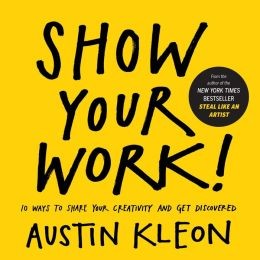
- "Show Your Work!" by Austin Kleon: The predecessor to this book, focusing specifically on the public-facing side of the creative process.
- "Deep Work" by Cal Newport: Complements the "practice" aspect by providing the cognitive framework for how to actually focus on the craft.
- "The War of Art" by Steven Pressfield: A spiritual cousin that addresses the internal resistance (the "Artist's Block") that Kleon's practical systems help to overcome.
If you remember only three things
- Output is the only way to find out what you can do. Stop thinking, start doing.
- Build a Commonplace. Your creativity is fueled by the library of ideas you collect over time.
- Show your work. Sharing the messy, imperfect process is how you build a community and find your voice.
Internalize it
-
Reflection questions
- What is the "messy middle" of my current project, and what is one small action I can take today to move through it?
- Who is a "Master" in my field that I can study? What specific part of their process can I replicate this week?
- What is one thing I’ve been afraid to share because it isn't "perfect" yet? Why is that fear holding me back?
- How can I better curate my "creative neighborhood" to ensure I am surrounded by people who encourage my growth?
-
Flashcards Q: What is a "Commonplace"? A: A repository of ideas, quotes, and inspirations used to fuel creative work. Q: Why is "copying" important in the creative process? A: Because all "original" work is a remix of what we've learned; copying is how we build the necessary muscle memory. Q: What is the primary goal of "Showing Your Work"? A: To build a community, find a voice, and turn a solitary act into a public, collaborative process. Q: How does Kleon define "Creativity"? A: As a craft of persistence and a result of showing up, rather than a mysterious spark of genius. Q: What should you do when you feel "blocked" by a lack of inspiration? A: Focus on the next physical action (the "process") rather than trying to think your way out of the block. Q: What is the "Average Trap"? A: The fear of being a beginner that prevents people from starting the very work required to become great.
Fidelity note
This summary is based on Austin Kleon's core philosophies as presented in Keep Going. I am highly confident in the "Commonplace," "Show Your Work," and "Apprentice" frameworks, as these are the pillars of his entire body of work. The specific "1% Rule" and "Master" identification are synthesized applications of his advice on consistency and imitation. Readers should verify specific "Master" examples by looking at his personal recommendations for designers and writers in the text.