Fuzzy Math What Makes Something Seem Like A Good Deal
✓ Source-groundedThe 'Rule of 100' dictates that you should use percentages for values under 100 and absolute numbers for values over 100 to maximize perceived value.
In one sentence
To make a deal seem like a better bargain, use percentages for discounts under 100 and absolute dollar amounts for discounts over 100.
Why read this (and who it's for)
This piece solves the problem of "marketing noise"—the difficulty of making a specific offer stand out in a crowded marketplace of constant discounts. It is for marketers, sales professionals, and business owners who need to communicate value effectively. After reading this, you will be able to frame prices, discounts, and growth metrics to maximize their psychological impact without changing the actual underlying numbers.
The big idea
The central thesis is that humans do not process numerical information with perfect mathematical logic; instead, we rely on "fuzzy math"—psychological perceptions of size and scale. Because of this, the way you represent a change can fundamentally alter how "big" that change feels to a consumer, even when the economic reality remains identical.
Berger argues that there is a specific tipping point—the number 100—that determines which unit of measurement (percentage vs. absolute) feels more significant. By understanding this rule, you can manipulate the perceived magnitude of a deal to increase consumer demand and cut through the clutter of competing offers.
Key ideas
The Rule of 100
- What it is — A rule of thumb for numerical representation: under 100, percentage discounts seem larger than absolute ones; over 100, absolute discounts seem larger than percentages.
- Why it matters — It allows you to choose the "winning" representation of a deal based on the scale of the item, ensuring the consumer perceives the maximum possible value.
- In the book — Berger explains that for a $20 t-shirt, 25% off feels bigger than $5 off, but for a $2,000 laptop, $500 off feels bigger than 25%.
Psychological vs. Economic Reality
- What it is — The idea that two different representations of the same price can result in different consumer behaviors because they "feel" different.
- Why it matters — If you assume consumers are purely logical, you miss the opportunity to influence their behavior through framing.
- In the book — Berger notes that while 25% off $20 and $5 off $20 both result in a $15 price tag, they do not "feel" the same to the consumer.
Contextual Scaling
- What it is — The perception of a number's size is dependent on the scale of the product or the baseline being measured.
- Why it matters — You cannot use a "one-size-fits-all" rule for discounts; you must adjust your framing based on the price point of the item.
- In the book — A 2-ounce decrease in a product's size seems smaller than a 15% decrease, whereas a 30% increase in revenue seems larger than a $2 million increase.
Cutting Through the Clutter
- What it is — The necessity of making a deal "compel" a consumer to take action in a saturated market.
- Why it matters — Because consumers are bombarded with thousands of coupons and discounts, a deal must "cut through" to be noticed.
- In the book — Berger notes that the goal of a discount is to "pique consumer interest and increase demand," but it only works if the representation makes the deal seem "good."
Reporting Growth
- What it is — The application of the Rule of 100 to business metrics like revenue growth or product size changes.
- Why it matters — It ensures that your internal and external reporting highlights the most impressive-sounding growth.
- In the book — Berger suggests that when reporting revenue growth, a 30% increase seems larger than a $2 million increase (implying the 30% figure is more effective when the base is relatively small).
Frameworks & tools
The Rule of 100 Framework
Use this checklist to decide how to frame any discount, growth metric, or size change:
- Identify the Base Value: What is the total amount or the original price?
- Determine the Threshold: Is the change/discount under or over 100?
- Apply the Rule:
- If Under 100: Use Percentages. (e.g., "25% off" instead of "$5 off").
- If Over 100: Use Absolute Numbers. (e.g., "$500 off" instead of "25% off").
Memorable examples & stories
The $20 T-Shirt A store sells t-shirts for $20. To make a sale, they offer a discount. While $5 off and 25% off result in the same $15 price, the 25% off version is more compelling to the consumer. Lesson: For low-cost items, percentages feel bigger.
The $2,000 Laptop When the stakes are higher, the rule flips. For a $2,000 laptop, a $500 discount feels larger than a 25% discount, even though the math is the same. Lesson: For high-cost items, absolute numbers feel bigger.
Revenue Growth Comparison When reporting on business success, a 30% increase in revenue can seem larger than a $2 million increase. Lesson: Choose the representation that maximizes the perceived "size" of your success.
Key quotes
"Both discounts lead to the same final price... Both ways of representing the discount should have the same effect, right? Nope." Why it matters: This highlights the gap between logical math and psychological perception.
"The Rule of 100 says that under 100 percentage discounts seem larger than absolute ones. But over 100, things reverse." Why it matters: This is the core actionable rule of the piece.
"The way changes are represented can have a big impact on how they’re perceived." (paraphrased) Why it matters: It reminds the reader that framing is a tool for influence, not just a stylistic choice.
How to apply it
This week
- Audit your current offers: Look at any active discounts or sales. If the discount is under $100, ensure it is presented as a percentage. If it is over $100, ensure it is an absolute dollar amount.
- Review your growth reports: If you are reporting on a small increase in a large number (e.g., a small revenue bump), use a percentage. If you are reporting on a large increase in a small number, use the absolute number.
Ongoing
- The "Rule of 100" Filter: Before publishing any marketing copy or internal report involving numbers, ask: "Is this under or over 100? Which representation makes the change look bigger?"
- Contextual Framing: Always consider the "base" of the number. A 15% decrease in a 2-ounce product is a different psychological experience than a 30% increase in revenue.
Common pitfalls
- The Logic Trap: Assuming that because the math is the same, the impact is the same. The author emphasizes that "they don’t feel the same psychologically."
- Inconsistency: Applying the wrong rule to the wrong scale (e.g., saying "$5 off" for a $20 shirt), which makes the deal seem smaller and less attractive.
Connects to
- Contagious by Jonah Berger (The source of the Rule of 100).
If you remember only three things
- The Rule of 100: Under 100 = Percentages; Over 100 = Absolute Numbers.
- Perception is not reality: The "feel" of a deal matters more than the actual math.
- Context matters: Always choose the representation that maximizes the perceived size of the change.
Internalize it
-
Reflection questions
- Look at the last promotion you ran. If you had applied the Rule of 100, would the offer have looked bigger?
- When reporting to a boss or client, am I choosing the number that sounds most impressive, or just the first one that came to mind?
- How can I apply the Rule of 100 to non-monetary items, like weight loss, time savings, or production speed?
-
Flashcards Q: What is the Rule of 100? A: Under 100, percentages seem larger; over 100, absolute numbers seem larger. Q: How should you frame a $5 discount on a $20 shirt? A: As 25% off. Q: How should you frame a $500 discount on a $2,000 laptop? A: As $500 off. Q: Why does the Rule of 100 work? A: Because consumers perceive the "size" of a change psychologically rather than through pure mathematical logic. Q: How does this rule apply to revenue growth? A: A 30% increase can seem larger than a $2 million increase, depending on the base.
Fidelity note
This summary is based strictly on the provided blog post. The "Rule of 100" is mentioned as being part of the book Contagious, but the specific details provided here are limited to the examples and rules contained in the blog post itself. The summary covers all examples provided (T-shirts, laptops, revenue, and weight/size).
Keep going — related reads


More from Jonah Berger
 Contagious Why Things Catch OnJonah BergerHow to Sell Ideas Like GladwellJonah Berger
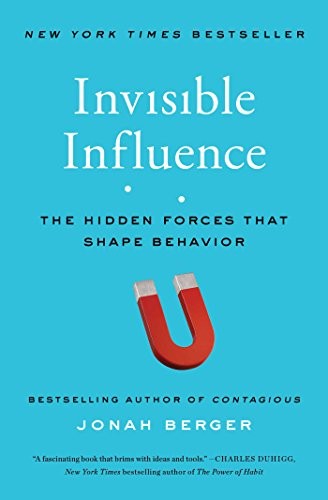 Invisible influenceJonah BergerIs Controversy Good For BusinessJonah BergerIs Little Data The Next Big DataJonah BergerMiley Cyrus’ Best Career Move. Ever.Jonah Berger
 The Catalyst How to Change Anyone's MindJonah BergerThe Tiny Adjustment That Could Change The Course Of Your Next InterviewJonah BergerViral 2.0Jonah BergerWant To Make Real Connections This Holiday Season Put Down The TechnologyJonah BergerWhy Clickbait FailsJonah BergerWhy The Word ‘Cool’ Has Stayed Hot For So LongJonah Berger