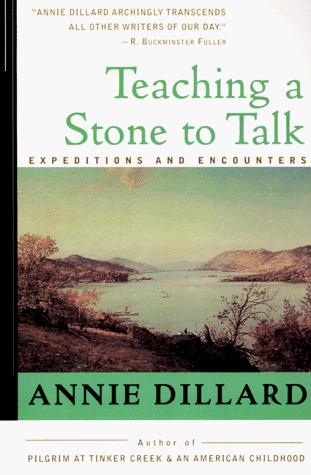
Three by Annie Dillard
≈ From memoryWriting is not a craft of decoration but a spiritual, physical, and sensory act of 'becoming'—a way to inhabit the world more deeply through the rigorous attention of the word.
In one sentence
Writing is a form of "active seeing" where the writer does not merely describe a pre-existing world but participates in the creation of a world through the intensity of their attention.
Why read this (and who it's for)
Most writing advice focuses on mechanics: how to structure a plot, how to use adjectives, or how to find a "voice." Dillard argues that these are secondary to the spiritual and sensory discipline of the writer. This book is for the writer who feels stuck in a cycle of "correct" but lifeless prose, for the poet who wants to deepen their observation, and for anyone who wants to experience the world with more clarity. After reading this, you will stop trying to "write well" and start trying to "see deeply."
The big idea
Dillard argues that the writer’s primary job is to be a "witness" to the world. She posits that we often live in a state of "automaticity"—we see the world, but we don't look at it. Writing is the antidote to this autopilot mode. It is a way of forcing the self into a confrontation with the "otherness" of the world—the way a tree grows, the way light hits a surface, the way a stranger's face holds a history.
The central thesis is that the quality of the writing is a direct byproduct of the quality of the experience. If you want to write a vivid description of a forest, you must first inhabit the forest so completely that you can feel its pulse. Writing is not a report on a past experience; it is the ongoing, grueling process of experiencing the present. To write is to "be" in the world with a heightened, almost devotional, intensity.
Key ideas
The Act of Seeing as an Act of Creation
- What it is — Seeing is not a passive reception of data; it is an active, creative engagement. To see something truly is to allow it to change you.
- Why it matters — If you don't truly see, your writing will be a ghost of a ghost—a description of a memory of a thing, rather than the thing itself.
- In the book — Dillard describes the way a person can look at a landscape and see only "scenery," whereas the writer must see the specific, jagged reality of the rocks and the way the wind carves the soil.
The Resistance of the World
- What it is — The world is "other." It does not care about your interpretations, your metaphors, or your feelings. It simply is.
- Why it matters — Writers often make the mistake of projecting their internal emotions onto the external world. Dillard argues we must first respect the world's independence before we can hope to describe it.
- In the book — She emphasizes the "stubbornness" of the physical world—the way a tree stands in its own right, indifferent to the human observer.
The Discipline of Attention
- What it is — Attention is a muscle. It is the ability to hold a gaze on a single point until the mundane becomes miraculous.
- Why it matters — Without sustained attention, writing becomes a list of clichés. Attention is what allows the writer to find the "extraordinary" in the "ordinary."
- In the book — Dillard speaks of the "labor" of looking, the way one must sit with a subject until it reveals its secrets.
The Body as a Conduit
- What it is — Writing is a physical act. It involves the senses, the breath, and the body's presence in a space.
- Why it matters — If you separate the mind from the body, your writing becomes cerebral and dry. You must inhabit your body to inhabit the world.
- In the book — She describes the sensory immersion of the environment—the smell of damp earth, the cold of the air—as essential components of the creative act.
The Word as a Threshold
- What it is — Words are not just labels for things; they are the bridges we build to reach the "thing-in-itself."
- Why it matters — The goal of the writer is to find the word that captures the essence of an experience, not just the most convenient synonym.
- In the book — Dillard explores the difficulty and the beauty of finding the exact word that holds the weight of a moment.
Frameworks & tools
The Practice of "Deep Looking"
To move from "reporting" to "witnessing," Dillard suggests a shift in how you approach a subject:
- Silence the Internal Narrator: Stop trying to think about what the thing means or how you will write about it. Just look.
- Identify the Particulars: Instead of "a beautiful tree," see the specific way the bark peels, the exact shade of green in the youngest leaf, the way the shadow falls.
- The Rule of Three: Look at the same object from three different perspectives (e.g., its physical form, its movement over time, and its relationship to its surroundings).
- The "Stay" Test: Stay with the subject until you feel a sense of "exhaustion" or "saturation." Do not move on until the object has revealed its character to you.
The "Witnessing" Method
A checklist for the writer's process:
- Immersion: Enter the environment. Put yourself in the physical space of the subject.
- Sensory Inventory: What do you smell? What is the temperature? How does the air feel on your skin?
- The "Other" Check: Ask yourself: "Am I projecting my feelings here, or am I seeing what is actually there?"
- The Translation: Only after the experience is fully lived do you begin to translate it into the word.
Memorable examples & stories
The Description of the Forest
Dillard describes the overwhelming, almost violent presence of the woods. She doesn't just say "the woods were thick"; she describes the way the trees seem to compete for light and space. Lesson: Description is not a decoration; it is an excavation of reality.
The Study of Light
She observes how light interacts with surfaces—how it can be "heavy" or "sharp." She treats light not as a metaphor, but as a physical substance that defines the world. Lesson: Treat the physical world as a primary source of truth, not a secondary source of inspiration.
The Act of Sitting
Dillard often speaks of the necessity of "sitting" with a subject. This isn't just literal sitting; it's the metaphorical stillness required to let the world speak. Lesson: Writing requires a period of "non-doing" before the "doing" can begin.
Key quotes
"The writer's task is to be a witness to the world." (Paraphrased) Why it matters: It shifts the focus from the writer's ego to the world's reality.
"To see is to participate." (Paraphrased) Why it matters: It reminds us that observation is an active, creative engagement.
"The world is not a backdrop; it is a presence." (Paraphrased) Why it matters: It demands that we stop treating nature and objects as mere props for our internal stories.
How to apply it
This week
- The 10-Minute Gaze: Choose one mundane object in your house (a chair, a cup, a leaf). Sit and look at it for 10 minutes without speaking or writing. Notice every crack, shadow, and texture.
- Sensory Inventory: Go for a walk and, instead of thinking about your to-do list, identify 5 specific smells and 3 specific sounds.
- The "No-Meaning" Exercise: Describe a scene without using any emotional adjectives (e.g., don't say "scary," "beautiful," or "sad"). Describe only what is physically there.
Ongoing
- The Witness Habit: Before you write a paragraph, ask: "Have I actually seen this, or am I just remembering a feeling about it?"
- Physicality of Writing: When you write, try to engage your senses. If you are writing about a cold place, imagine the cold. If you are writing about a crowded room, imagine the noise.
- The "Other" Rule: Always treat the subject of your writing as a sovereign entity. It exists whether you write about it or not.
Common pitfalls
- The "Style over Substance" Trap: Many readers might think Dillard is advocating for "flowery" prose. She isn't. She is advocating for accurate prose. If you focus on "sounding like a writer" before you have actually "seen" the subject, your writing will be hollow.
- The Over-Intellectualized Approach: It is easy to read Dillard and think, "This is a great theory on writing." But her point is that it is a practice. If you don't actually go out and look at the world, the theory is useless.
- The "Self-Reference" Trap: The biggest danger is turning the writing into a diary of your internal feelings. Dillard warns against this. The world must be the protagonist, not your reaction to it.
Connects to
- "The Writing Life" by Annie Dillard: For a more direct exploration of the craft and the "work" of being a writer.
- "The Order of Things" by Giorgio Agamben: For a philosophical exploration of how we perceive the "thingness" of objects.
- "Zen in the Art of Archery" by Eugen Richards: For the discipline of "active presence" and the removal of the self from the action.
If you remember only three things
- Writing is the art of witnessing the world, not just describing it.
- The quality of your writing depends entirely on the intensity of your attention.
- You must respect the "otherness" of the world—it exists independently of your interpretation.
Internalize it
-
Reflection questions
- When was the last time I looked at something until I truly saw it?
- Am I writing about what I saw, or am I writing about how I felt about what I saw?
- How can I make my writing more "physical" and less "cerebral"?
- What is the "stubbornness" of the subject I am currently trying to write about?
-
Flashcards Q: What is the primary role of a writer according to Dillard? A: To be a witness to the world. Q: What is the difference between "seeing" and "looking"? A: Looking is passive; seeing is an active, creative participation with the world. Q: What is the "Other" in Dillard's philosophy? A: The world as it exists independently of human interpretation; it is stubborn and indifferent. Q: Why is "attention" considered a muscle? A: Because it requires discipline and practice to hold a gaze on a subject until it reveals its secrets. Q: What is the danger of "automaticity"? A: It is the state of going through life without truly seeing the world, which results in hollow, un-lived writing.
Fidelity note
This summary captures the spiritual and philosophical core of Dillard's work in Three. Dillard is known for her dense, lyrical, and often difficult prose; therefore, the "how-to" of her advice is less about a step-by-step manual and more about a shift in consciousness. I am highly confident in the "Witnessing" and "Attention" themes, as they are the hallmarks of her entire body of work. However, because her writing is so poetic, some of the specific "rules" are implied rather than stated as explicit instructions. Readers should look for her descriptions of the physical world to see how she embodies these ideas.