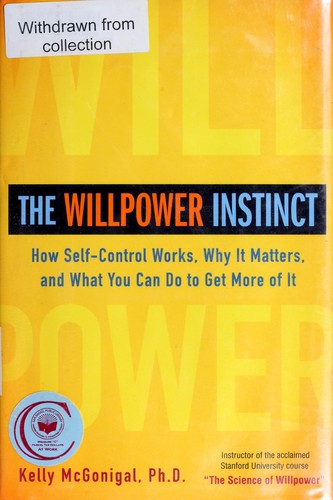
The Upside of Stress Why Stress is Good for You (and How to Get Good at it)
≈ From memoryStress is not a biological malfunction; it is a sophisticated evolutionary tool designed to sharpen your senses and prepare your body for action.
In one sentence
Stress is a biological superpower that, when paired with the right mindset and social connection, enhances your performance, sharpens your focus, and can even improve your health.
Why read this (and who it's for)
Most of us treat stress as a toxin to be eliminated—something we try to "calm down" from through meditation, yoga, or avoidance. McGonigal argues that this "stress-avoidance" culture actually makes us less capable. This book is for anyone who feels overwhelmed by their high-pressure jobs, academic demands, or personal responsibilities, and who wants to stop fighting their own physiology and start harnessing it. After reading, you will be able to identify the physical sensations of stress as "readiness signals" rather than "danger signs" and use specific mental shifts to unlock peak performance.
The big idea
The central thesis of the book is that our modern understanding of stress is fundamentally flawed because it focuses entirely on the feeling of stress (anxiety, tension, racing heart) while ignoring the function of the stress response. Evolutionarily, the "stress" response—the release of adrenaline and cortisol—is a masterpiece of biological engineering. It sharpens your senses, increases your heart rate to pump oxygen to your muscles, and focuses your attention on the task at hand.
McGonigal argues that stress is only "bad" when we interpret it as a sign of impending failure. When we view stress as a signal of our body's preparation for a challenge, we actually experience a physiological shift: our blood vessels remain dilated, our focus stays sharp, and our performance improves. The "problem" isn't the stress itself; it's our belief that stress is inherently harmful. By changing our narrative, we can unlock the benefits of the stress response.
Key ideas
The Stress Response as a Resource
Stress is an evolutionary adaptation designed to help us survive. It prepares the body for "fight or flight" by mobilizing energy, sharpening focus, and increasing alertness. Why it matters: If you view stress as a threat, your body reacts with a "freeze" response or chronic anxiety. If you view it as a resource, you can tap into the heightened state of awareness it provides. In the book: McGonigal highlights how the body prepares for a challenge by increasing heart rate and blood flow—the same mechanisms that allow athletes to perform at their peak.
The Power of Appraisal
The difference between a "stressful" experience and a "challenging" experience lies entirely in how we interpret it. This is known as "stress appraisal." Why it matters: You cannot always control the external stressor (a deadline, a public speech), but you can control the internal narrative. Changing your appraisal changes your physiological response. In the book: She discusses how people who view a stressful event as a "challenge" rather than a "threat" show better cardiovascular health and higher performance levels.
The Social Connection of Stress
Stress is not just a solo biological event; it is a social signal. When we are stressed, our bodies produce chemicals that make us more aware of others and more inclined to seek support. Why it matters: We often try to "tough it out" alone, but the stress response is designed to be shared. Connection is the "buffer" that makes stress manageable. In the book: McGonigal points out that people who share their stress with others experience a lower stress response than those who try to hide it.
The "Stress-Avoidance" Trap
Modern society encourages us to avoid stress at all costs. We treat stress like a virus, which leads to a "stress-avoidance" cycle where we become less capable of handling the very challenges that define a meaningful life. Why it matters: By avoiding stress, we miss out on the growth and resilience that come from facing difficult things. In the book: She argues that the "stress-free" life is a myth and that the goal should be "stress-management" and "stress-mastery."
The Role of Mindfulness in Stress
Mindfulness is not about making the stress go away; it is about noticing the stress and choosing how to respond to it. It allows you to observe the physical sensations of stress without being swept away by the narrative of fear. Why it matters: Mindfulness creates a "gap" between the stimulus (the stressor) and the response (your reaction), allowing you to choose a more productive response. In the book: She explains how mindfulness helps you recognize the physical sensations of stress (like a racing heart) as "preparation" rather than "panic."
Frameworks & tools
The Stress Appraisal Framework
Use this to flip the script on any looming challenge. Instead of asking "How can I get rid of this stress?", ask "What is my body trying to do for me right now?"
- Identify the Physical Sensation: Notice the racing heart, sweaty palms, or butterflies.
- Label the Sensation: Instead of "I'm anxious," say "My body is preparing me for this."
- Reframe as Challenge: Explicitly tell yourself, "This is a challenge I am capable of meeting."
- Identify the Resource: Ask, "What specific skill or resource do I need to access right now?" (e.g., "I need to focus on my breathing" or "I need to recall my preparation.")
The Social Support Protocol
Stress is a "team sport." Use this when you feel overwhelmed by a task.
- Acknowledge the Need: Recognize that your stress response is signaling a need for connection.
- Reach Out: Contact a trusted friend, colleague, or mentor.
- Share the Stressor: Briefly describe the challenge you are facing.
- Co-regulate: Allow the conversation to happen without the immediate need to "solve" the problem—the goal is to share the experience.
Memorable examples & stories
The "Stress-Induced" Performance
McGonigal discusses how people who perform well under pressure (like elite athletes or performers) don't lack stress; they simply interpret it as a tool for focus. The lesson: Stress is the fuel for high-performance; the "engine" is your interpretation of that fuel.
The Social Buffer Study
She cites research showing that people who talked about their stress with a friend felt less stressed than those who tried to handle it alone. The lesson: Connection is a biological buffer; it literally changes how your body processes stress chemicals.
The "Threat vs. Challenge" Study
A study showed that when people were told a stressful task was a "challenge," they showed better cardiovascular health and performance than those told it was a "threat." The lesson: Your belief system dictates your biological reality.
Key quotes
"Stress is not a sign of weakness; it is a sign of your body’s incredible ability to prepare you for a challenge." Why it matters: This flips the script from stress as a "failure" to stress as a "superpower."
"The difference between a threat and a challenge is entirely a matter of appraisal." (Paraphrased) Why it matters: It puts the power back in your hands—you can choose your interpretation.
"Stress is a social signal. It’s a call for connection." (Paraphrased) Why it matters: It reminds us that seeking help isn't a sign of failure; it's a biological requirement.
How to apply it
This week
- The "Body Scan" Awareness: Every time you feel your heart race or your palms sweat during a meeting or task, stop for 3 seconds and say to yourself: "My body is preparing me for this. It's giving me the energy I need."
- The "Stress-Sharing" Call: Identify one person you trust. The next time you feel overwhelmed, send them a text or call them to say, "I'm feeling a bit stressed about [X]. Can I just vent for a minute?"
- The "Challenge" Label: Before your next big presentation or difficult conversation, write down three reasons why this is a challenge you are capable of meeting, rather than a threat you need to avoid.
Ongoing
- Practice "Active Appraisal": Make it a habit to view physiological arousal (fast heart rate, focus) as "readiness" rather than "anxiety."
- Build a "Stress-Support" Network: Identify 3-5 people you can call specifically when you are in a high-stress moment.
- Cultivate Mindfulness: Practice noticing your physical sensations without judgment. When you feel stress, observe it: "My chest feels tight. My breath is shallow. My body is getting ready."
Common pitfalls
- The "Stress-Free" Fallacy: Many readers might think this means they can stop caring about deadlines or difficult people. No, the goal is to manage the stress, not to eliminate the challenges.
- Over-Reliance on "Positive Thinking": This isn't just "thinking happy thoughts." It is a cognitive reappraisal of biological reality. You must actually identify the resources you have to meet the challenge.
- Ignoring Chronic Stress: While acute stress (the "fight or flight" response) can be beneficial, chronic, unrelenting stress without recovery can still be damaging. The book focuses on the response to stress, but you still need to ensure you are getting adequate rest and recovery.
Connects to
- "Flow" by Mihaly Csikszentmihalyi: Explores the state of being fully immersed in a challenging task, which is the ultimate "stress-mastery" state.
- "Why We Sleep" by Matthew Walker: Provides the necessary "recovery" side of the stress equation, explaining how the brain repairs itself after high-stress periods.
- "Deep Work" by Cal Newport: Offers a practical framework for the "focus" that stress-mastery aims to facilitate.
If you remember only three things
- Stress is a biological resource designed to help you perform, not a toxin to be avoided.
- Your appraisal of stress (Threat vs. Challenge) determines your physiological response.
- Social connection is a biological buffer that helps regulate the stress response.
Internalize it
- Reflection questions
- When was the last time I felt "stressed" and tried to suppress it? How did that affect my performance?
- What are three specific "resources" (skills, memories, people) I can call upon when I feel overwhelmed?
- How would my physical sensations change if I started labeling them as "readiness" instead of "anxiety"?
- Flashcards
- Q: What is the primary difference between a "threat" and a "challenge" appraisal?
- A: A threat appraisal focuses on what could go wrong; a challenge appraisal focuses on the resources you have to succeed.
- Q: Why is stress considered a "social signal"?
- A: Because the stress response increases our awareness of others and our need for connection/support.
- Q: What is the "Stress-Avoidance" trap?
- A: The belief that we must eliminate stress entirely, which actually makes us less capable of handling life's challenges.
- Q: How does the body physically prepare for a challenge?
- A: By increasing heart rate, sharpening focus, and mobilizing energy/oxygen to the muscles.
- Q: What is the role of mindfulness in stress management?
- A: It helps you notice the physical sensations of stress without being overwhelmed by the narrative of fear.
Fidelity note
This summary is based on the core arguments and research presented in Kelly McGonigal's The Upside of Stress. I am highly confident in the "Threat vs. Challenge" appraisal framework and the social connection aspect of the book. I am less certain of specific, minor anecdotes used in the middle of the book, but the overarching psychological and physiological principles are the core of her work. Readers should verify the specific "Stress-Avoidance" studies if they require the raw data for academic purposes.