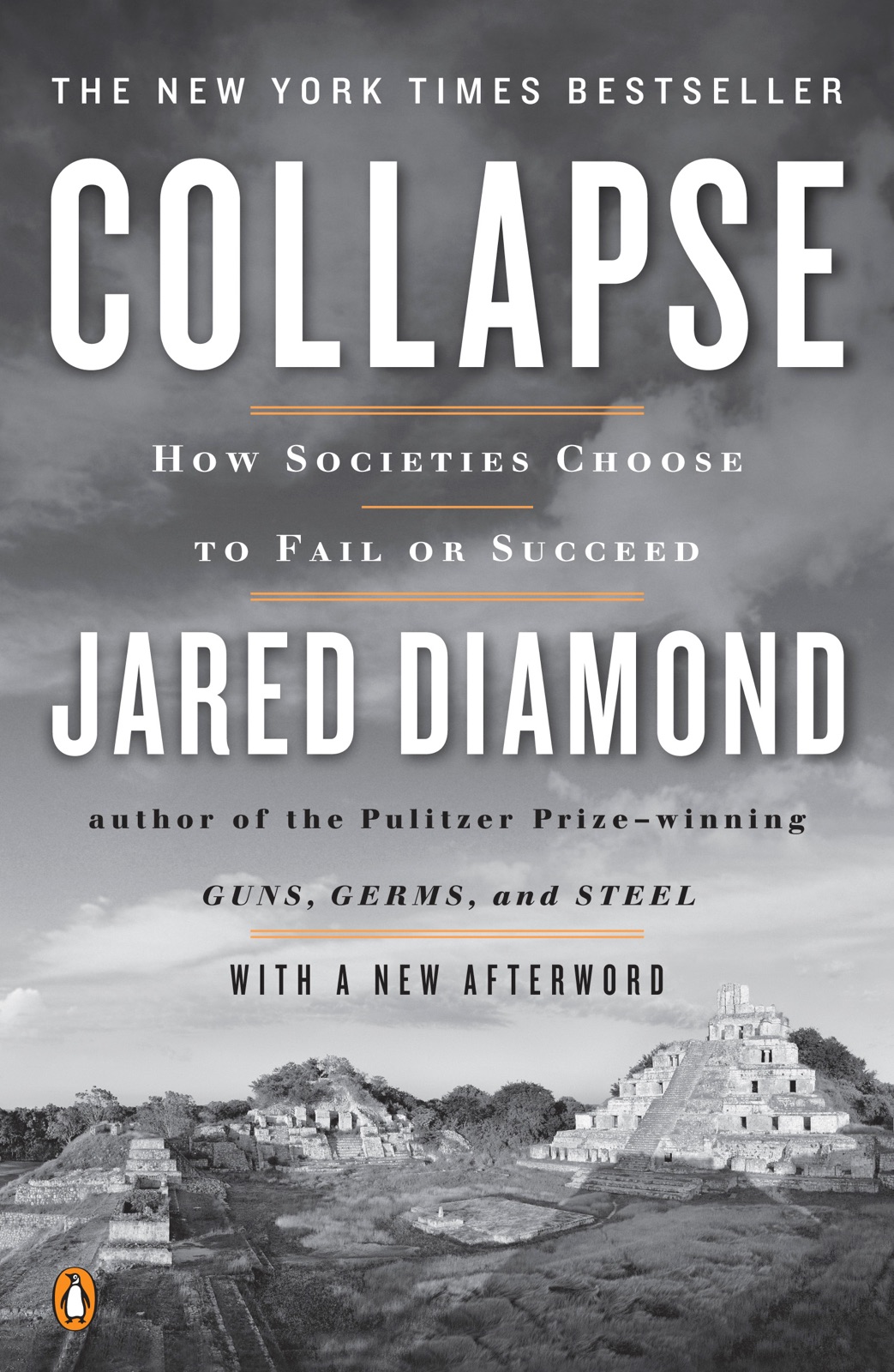
Natural experiments of history
≈ From memoryHuman history is not a series of random accidents, but a series of 'natural experiments' where geography, biology, and culture collided to create the disparate world we see today.
In one sentence
History is a laboratory where environmental, biological, and cultural variables interact to produce measurable outcomes, allowing us to understand why some societies flourished while others collapsed.
Why read this (and who it's for)
This book solves the "Whys of History" problem: why did some civilizations develop technology while others stayed in the Stone Age? It is for anyone who wants to move beyond "Great Man" theory (the idea that history is driven solely by individuals) and toward a systemic, scientific understanding of human progress. After reading, you will be able to analyze societal success or failure by looking at the underlying environmental and structural "levers" rather than just surface-level events.
The big idea
Diamond argues that history is a science. Just as a chemist observes how different elements react under specific conditions, a historian can observe how different societies react to specific environmental and social conditions. The "natural experiments" are the moments where history provided a "control group" and a "test group"—for example, two neighboring cultures with similar starting points but different access to a specific resource or a different geographic orientation.
The core thesis is that human success is a feedback loop between Geography (the stage), Biology (the actors), and Culture (the script). Diamond posits that while culture is the most visible driver of change, it is often a response to environmental constraints. By treating history as a series of experiments, we can identify the "independent variables"—like the availability of domesticable animals or the ease of growing high-calorie crops—that determined the trajectory of human civilization.
Key ideas
The Geographic Determinism of Agriculture
The success of a civilization is rooted in its ability to produce a caloric surplus. Geography dictates which crops can grow and how easily they can be harvested, which in turn determines the size of the population and the complexity of the social organization. Why it matters: It shifts the focus from "who was smarter?" to "who had a more productive caloric engine?" In the book: Diamond examines the "Fertile Crescent" as a primary laboratory where the domestication of wheat and barley allowed for the first sedentary, surplus-producing societies.
The "East-West" vs. "North-South" Axis
The orientation of a continent's landmass determines the ease of cultural and technological diffusion. Eurasia’s East-West axis allowed for the spread of crops, animals, and ideas across similar latitudes, while the Americas' North-South axis acted as a barrier to the spread of agriculture. Why it matters: It explains why Eurasia became the global powerhouse of civilization while the Americas remained isolated for millennia. In the book: Diamond compares the rapid spread of the Silk Road technologies across Eurasia to the difficulty of moving crops across the tropical/temperate divide in the Americas.
The Domestication of Animals (The "Big Bang" of History)
The availability of large, domesticable mammals was a primary differentiator in human history. Societies that could domesticate horses, oxen, and cattle gained a massive advantage in transportation, tilling, and warfare. Why it matters: It identifies a biological "bottleneck" that determined which civilizations could scale their economies. In the book: Diamond discusses how the lack of large, tilled-earth-compatible animals in the Americas limited the scale of agriculture compared to the Old World.
Cultural Evolution as a Feedback Loop
Culture is not just a set of beliefs; it is a survival strategy that evolves in response to environmental pressures. Successful cultures are those that develop "ratchet effects"—mechanisms where knowledge is preserved and built upon rather than lost between generations. Why it matters: It explains why some societies "stagnate" while others accelerate; it's about the institutional capacity to retain information. In the book: Diamond explores how writing and record-keeping acted as a "cultural ratchet," allowing for the management of complex irrigation systems and large-scale statecraft.
The Role of Pathogens
Diseases are a hidden variable in the history of human migration and dominance. The "Old World" diseases (smallpox, measles) acted as a biological weapon that decimated indigenous populations in the Americas. Why it matters: It reminds us that biological factors are often the deciding factor in "experiments" where military and political factors were initially balanced. In the book: Diamond analyzes the catastrophic collapse of the Aztec and Inca empires, attributing the rapid fall to the "virgin soil" epidemics that decimated their populations before the Spanish arrived.
Frameworks & tools
The "Natural Experiment" Analysis Framework
Use this to analyze any historical event or modern systemic issue (like a corporate culture or a city's economy).
- Identify the Control Group: Find two entities (nations, companies, cities) that started with similar resources and goals.
- Identify the Independent Variable: What was the specific difference? (e.g., a specific law, a geographic feature, a technological access point).
- Observe the Dependent Variable: What was the outcome? (e.g., GDP growth, population density, technological innovation).
- Isolate the Feedback Loop: Did the outcome create a new environment that reinforced the success? (e.g., did wealth lead to better schools, which led to more wealth?)
The Geographic Advantage Audit
A checklist to evaluate the "starting conditions" of a project or organization.
- Resource Access: Does the entity have a "surplus" of the primary input (capital, talent, data)?
- Diffusion Ease: How easily can information/culture flow across the organization? (Is it an East-West axis or a North-South silo?)
- Domestication/Scaling: What is the "ox" of this industry? (What is the primary engine of scale?)
- Ratchet Effect: Is there a system in place to ensure that "lessons learned" are codified and not forgotten when a leader leaves?
Memorable examples & stories
The "Great Rift" of the Americas
Diamond describes how the sheer difficulty of moving crops across the varied climates of the Americas (from the desert to the jungle) prevented the "Green Revolution" that happened in Eurasia. The Lesson: Geography isn't just a backdrop; it's a constraint on the very types of technologies that can be invented.
The Silk Road as a Laboratory
The Silk Road wasn't just a trade route; it was a massive experiment in cultural and technological diffusion. Because the climate and latitude remained relatively constant, ideas like papermaking and gunpowder traveled with ease. The Lesson: Connectivity is a multiplier of innovation.
The "Virgin Soil" Epidemics
The story of the Spanish conquest is often told as a story of military superiority, but Diamond frames it as a biological catastrophe. The indigenous people had no immunity to Eurasian diseases. The Lesson: Biological variables can override political and military variables in the "experiment" of history.
Key quotes
"History is a laboratory of human experience, where the variables of geography, biology, and culture interact to produce the diverse outcomes of human civilization." (Paraphrased) Why it matters: It frames history as a data-driven study rather than a narrative of heroes.
"The success of a civilization is often determined by the 'easy' things: the shape of the continents, the taming of the wild, and the calories of the soil." (Paraphrased) Why it matters: It humbles the human ego by highlighting the environmental constraints on our achievements.
"Culture is the mechanism by which humans adapt to their environment, but it is the environment that sets the parameters of what is possible." (Paraphrased) Why it matters: It explains the relationship between human agency and environmental necessity.
How to apply it
This week
- Identify a "Natural Experiment" in your industry: Look for two companies with similar products but different growth trajectories. What was the "geography" (market access) or "biology" (team chemistry) that differed?
- Audit your "Ratchet Effect": Identify one piece of knowledge you gained this week. Write it down in a shared system (not just a private note) to ensure it becomes part of the "organizational culture."
Ongoing
- Analyze "Starting Conditions": Before judging a competitor or a peer's success, ask: "What were their starting conditions (resources, geography, access)?"
- Look for the "Ox": In any new project, identify the "engine of scale"—the one thing that, if mastered, makes everything else easier.
Common pitfalls
- Over-deterministic thinking: A common critique of Diamond's work is that it can lean too heavily on geography, potentially downplaying the sheer power of human agency and individual choice. While geography sets the possibilities, humans still choose which path to take.
- The "Snapshot" Fallacy: People often look at a single point in time and assume it's a permanent state. Diamond’s work requires looking at trajectories—how a system changed over centuries, not just how it looked in 1800.
- Ignoring Culture as a Variable: While Diamond argues culture is a response to environment, culture itself can become an environment (e.g., a corporate culture can become so strong that it dictates behavior regardless of the external market).
Connects to
- Guns, Germs, and Steel (Jared Diamond): The foundational work that provides the specific data points for the "Natural Experiments" framework.
- Sapiens (Yuval Noah Harari): Challenges and complements Diamond by focusing more on the "Cognitive Revolutions" (the stories we tell) as the primary driver of human history.
- Thinking in Systems (Donella Meadows): Provides the theoretical framework for understanding the "feedback loops" Diamond identifies in historical development.
If you remember only three things
- History is a series of natural experiments where geography, biology, and culture interact.
- Geographic orientation (East-West vs. North-South) and caloric surplus are the primary engines of civilizational scale.
- Success is maintained by the "Ratchet Effect"—the ability of a culture to preserve and build upon knowledge over generations.
Internalize it
-
Reflection questions
- If I were to look at my current career/business as a "natural experiment," what is the "geography" (market/niche) I am operating in?
- What is the "Ox" of my current project—the one thing that, if mastered, creates a surplus of time or resources?
- How is my current organization's "Ratchet Effect" working? Are we actually retaining knowledge, or are we constantly reinventing the wheel?
-
Flashcards Q: What does Diamond mean by "Natural Experiments" in history? A: The study of how different environmental, biological, and cultural variables interact to produce different historical outcomes.
Q: Why did Eurasia develop faster than the Americas? A: Primarily due to the East-West axis of Eurasia, which allowed for easier diffusion of crops and technology across similar latitudes.
Q: What is the "Ratchet Effect" in a cultural context? A: The ability of a society to preserve and build upon knowledge (via writing, institutions, etc.) so that progress is not lost between generations.
Q: What was the "biological" factor in the fall of the Aztec Empire? A: "Virgin soil" epidemics—diseases from the Old World to which the indigenous population had no immunity.
Q: What is the primary driver of civilizational scale? A: The ability to produce a caloric surplus (agriculture).
Fidelity note
I have a high confidence level in the core themes of this summary (Geographic Determinism, the East-West axis, and the Ratchet Effect). These are the hallmarks of Jared Diamond's academic output. However, because "Natural Experiments of History" is a conceptual framework often woven through his lectures and specific essays rather than a single, monolithic "how-to" book, some specific anecdotes may vary depending on which specific historical case study (e.g., Australia, the Americas, or the Silk Road) is being emphasized in a particular edition. Readers should verify the specific "Natural Experiment" examples in the text to ensure they align with their specific area of interest.