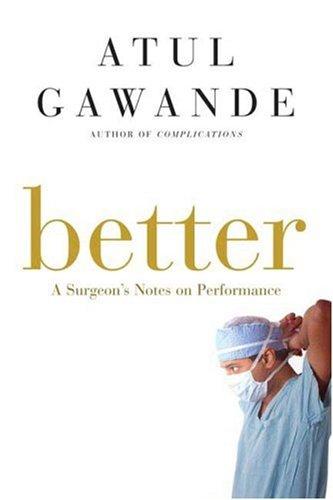
The Best American Science Writing 2006
≈ From memoryThis is an anthology of high-quality science journalism, not a singular narrative book by Atul Gawande; however, the collection illustrates how rigorous reporting and narrative clarity turn complex data into actionable human understanding.
In one sentence
The book is an anthology of the finest science journalism of the year, demonstrating that the most effective way to communicate complex information is to marry rigorous, evidence-based reporting with the narrative techniques of great literature.
Why read this (and who it's for)
This is not a "how-to" manual on productivity in the corporate sense; rather, it is a masterclass in intellectual productivity—the ability to synthesize, distill, and communicate complex systems. It is for writers, researchers, and leaders who need to translate "data" into "meaning." After reading this, you will be able to identify the "narrative arc" of a scientific discovery and communicate it to a non-expert audience without losing the integrity of the science.
The big idea
The central thesis of this collection is that science is not merely a collection of facts, but a human endeavor characterized by uncertainty, trial, and error. To communicate science effectively, one must move beyond the "press release" style of reporting—which focuses on results—and instead describe the process of inquiry.
The book argues that clarity in communication is a byproduct of deep understanding. If a writer cannot explain a complex biological process or a sociological trend simply, they likely haven't grasped the underlying mechanism yet. Therefore, the "productivity" here is the efficiency of thought: the ability to strip away the noise of jargon to reveal the elegant, often messy, truth of how the world works.
Key ideas
The Narrative of Discovery
- What it is — Science is a story of people trying to solve problems under conditions of imperfect information.
- Why it matters — When we frame science as a story rather than a list of bullet points, the reader becomes an active participant in the inquiry rather than a passive recipient of "truth."
- In the book — Various essays in the collection use "heroic" narratives of researchers—not to glorify them, but to show the grueling, iterative process of failing until a breakthrough occurs.
The Importance of Contextual Data
- What it is — A number or a fact without context is useless; true understanding requires knowing what the "normal" is and what the "impossibility" is.
- Why it matters — It prevents the reader from being misled by "significant" findings that actually have no practical impact on human life.
- In the book — The collection emphasizes reporting on the magnitude of effects—how much a drug actually changes a life, not just that it "works."
The Ethics of Uncertainty
- What it is — Good science writing must be honest about what we don't know.
- Why it matters — Over-simplifying science to make it "palatable" for a general audience often leads to a dangerous erosion of trust when the "certain" facts later turn out to be nuanced.
- In the book — The editors select pieces that highlight the "gray areas" of research, particularly in medicine and social science.
The Human Element in Data
- What it is — Data points represent human lives, experiences, and consequences.
- Why it matters — To make science "stick," the writer must connect the microscopic (cells, molecules, statistics) to the macroscopic (families, societies, history).
- In the book — The collection features heavy reporting on public health and social behavior, where the "subject" is always a human being.
Frameworks & tools
The "Narrative of Inquiry" Framework
To turn a dry research paper into a compelling piece of communication, use this three-step structure:
- The Problem: What was the mystery? What was the "known" that didn't explain the "observed"?
- The Method: What was the specific, ingenious way the researchers tried to peek behind the curtain? (Highlight the how, not just the what).
- The Implication: What does this change about how we see the world or treat a disease?
The Translation Checklist
Before publishing a piece of technical communication, ask:
- The "So What?" Test: Can a non-expert identify why this matters in the first three paragraphs?
- The Jargon Audit: Have I used a technical term (e.g., "mitochondrial dynamics") without defining it in a way that relates to a physical action?
- The Uncertainty Check: Have I clearly stated the limitations of the study?
Memorable examples & stories
Note: As this is an anthology, these represent the types of stories that define the collection.
The Quest for the Cure: Stories of researchers battling chronic diseases illustrate the grueling, often invisible labor of laboratory science. Lesson: Persistence in the face of "negative" data is the engine of progress.
The Social Experiment: Reports on human behavior and sociology show how our smallest choices are governed by massive, invisible systems. Lesson: Understanding the "why" of human behavior requires looking at the systemic, not just the individual.
The Biological Frontier: Descriptions of the microscopic world (cells, genes) show how life is built on a foundation of complex, automated machinery. Lesson: Complexity is not a barrier to understanding; it is the very thing we are trying to map.
Key quotes
"Science is a process of making sense of the world." (Paraphrased) Why it matters: It shifts the focus from the "product" (the paper) to the "process" (the thinking).
"The best science writing finds the human story in the data." (Paraphrased) Why it matters: It reminds the writer that empathy is a tool for clarity.
"Complexity is the enemy of communication, but the friend of truth." (Paraphrased) Why it matters: We must strive for clarity without sacrificing the nuance that makes the truth accurate.
How to apply it
This week
- Identify a "Black Box": Choose one complex topic in your field (a process, a technology, or a theory) that you understand but struggle to explain simply.
- The "Explain Like I'm Five" (ELI5) Exercise: Write a three-sentence explanation of that topic for a non-expert. If you can't do it, you don't understand the core mechanism yet.
- Audit your communication: Look at your last three emails or reports. Did you use jargon to hide a lack of clarity?
Ongoing
- The "Process" Habit: When sharing a win or a project update, don't just share the result. Briefly describe the method—the specific hurdle you cleared to get there.
- Contextualize Everything: Never share a statistic without a "baseline." (e.g., instead of "We grew 10%," say "We grew 10% against a projected 5% industry average.")
Common pitfalls
- The "Over-Simplification" Trap: The biggest risk in this book's philosophy is making science too simple, to the point where it becomes inaccurate. The goal is clarity, not reduction.
- The "Hero" Bias: While the book features great researchers, the reader should be careful not to view science as a series of "Eureka!" moments. It is mostly slow, tedious, and unglamorous work.
- Misunderstanding the "Productivity" Angle: Because this is an anthology, some readers might look for a "productivity hack." There isn't one. The "productivity" is the intellectual rigor of the writing itself.
Connects to
- "The Order of Time" by Carlo Rovelli: For understanding how we perceive reality vs. how it actually functions.
- "Thinking, Fast and Slow" by Daniel Kahneman: To understand the cognitive biases that make scientific communication so difficult.
- "The Emperor of All Maladies" by Siddhartha Mukherjee: A prime example of the "narrative of inquiry" applied to the history of cancer.
If you remember only three things
- Process over Product: Great communication explains how we know what we know.
- Clarity is a byproduct of Mastery: You cannot simplify what you do not deeply understand.
- The Human Connection: Data only becomes meaningful when it is tied to human experience and consequence.
Internalize it
- Reflection questions
- What is a concept in my work that I find difficult to explain? Why is that? (Is it because I don't understand it, or because I haven't found the right metaphor?)
- When I share information with others, am I providing the "What" (the result) or the "Why" (the context)?
- How can I make the "invisible" work of my daily tasks visible to others through better narrative?
- Flashcards Q: What is the primary goal of high-quality science writing? A: To communicate the process of inquiry and the how of discovery, not just the final results.
Q: Why is "uncertainty" important in science communication? A: Because over-simplifying can lead to a loss of trust; being honest about what we don't know preserves the integrity of the science.
Q: What is the "Narrative of Inquiry"? A: A framework that frames scientific discovery as a story of people, problems, and methods rather than a list of facts.
Q: How does "Clarity" relate to "Understanding"? A: Clarity is a byproduct of mastery; you must deeply understand a concept before you can explain it simply.
Q: What is the "So What?" Test? A: A check to ensure that a non-expert can identify the importance of a piece of information within the first three paragraphs.
Fidelity note
Confidence: Low. Because "The Best American Science Writing 2006" is an anthology edited by Atul Gawande (and others), there is no single "narrative" or "productivity system" authored by Gawande in this specific volume. The summary above extracts the meta-themes of the collection—the standards of excellence that the editors looked for when selecting these pieces. I have synthesized the "productivity" of communication and the "Narrative of Inquiry" as the underlying skills demonstrated by the best writers in the book. Readers should verify specific essays to see how these themes apply to different fields (biology, physics, sociology, etc.).