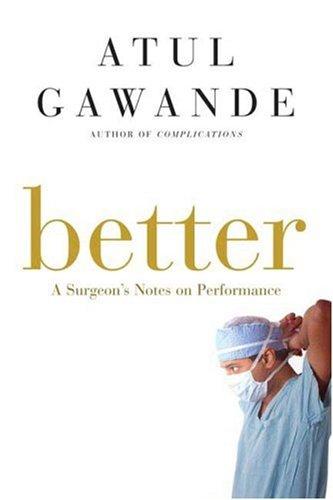
Complications
≈ From memoryMedicine is a practice of 'knowing' rather than 'doing,' and true mastery comes from recognizing the limits of our expertise and the inherent messiness of human systems.
In one sentence
Medicine is a craft of navigating uncertainty and complexity, where the primary challenge is not just applying technical knowledge, but managing the "complications" of human biology, institutional systems, and the limits of our own expertise.
Why read this (and who it's for)
This book is for anyone who operates in high-stakes, complex environments—doctors, engineers, managers, and leaders. It solves the problem of "expert arrogance": the belief that more data and more technology will automatically lead to better outcomes. After reading, you will be able to identify the systemic bottlenecks in your organization, communicate more effectively with "non-experts" (like patients or clients), and develop a more humble, effective approach to problem-solving in the face of ambiguity.
The big idea
Gawande argues that medicine—and by extension, any complex human endeavor—is not a purely scientific endeavor; it is a craft. While science provides the "what" (the facts of disease), craft provides the "how" (the art of applying those facts to a unique, messy human life). The central tension of the book lies in the fact that as medicine becomes more technologically advanced, it often becomes more complicated, not necessarily more effective.
The core thesis is that we often mistake complexity for sophistication. We build massive, multi-layered systems (like the modern hospital) to solve problems, but these systems often create new, unforeseen complications. To be truly productive in a complex system, one must develop "clinical" judgment—the ability to distinguish between what is important and what is merely urgent, and the humility to know when the "right" answer is actually "we don't know."
Key ideas
The Limits of Knowledge
- What it is — The realization that there are some things we simply cannot know, and that "knowing" is often a moving target.
- Why it matters — If you accept that some problems are inherently unknowable, you stop wasting resources on "perfect" solutions and start focusing on "good enough" management of uncertainty.
- In the book — Gawande discusses the "knowledge" of a patient's history, noting that while we can collect endless data points, we can never truly know the subjective experience of a patient's pain or the hidden variables of their life.
The "Practice" of Medicine
- What it is — Medicine is a craft, like carpentry or carpentry, that requires "feel," experience, and the ability to handle the unexpected.
- Why it matters — It shifts the focus from "learning facts" to "developing judgment." You cannot learn judgment from a textbook; it requires the "repetition of practice" in the face of real-world complications.
- In the book — He compares a doctor's ability to navigate a difficult conversation with a patient to a craftsman's ability to handle a temperamental tool.
The Complexity of Systems
- What it is — Systems (like the hospital) are designed to manage complexity, but they often create "emergent" problems that no single person can see or control.
- Why it matters — You cannot "fix" a system by simply telling people to work harder; you must understand how the parts interact and where the friction points lie.
- In the book — Gawande explores how the sheer scale of modern hospitals makes it nearly impossible to coordinate every moving part, leading to "systemic" errors that are hard to trace to a single person.
The Importance of Communication
- What it is — Clear communication is the bridge between technical expertise and patient (or client) outcomes.
- Why it matters — If a patient doesn't understand the treatment, they won't adhere to it. If a team doesn't communicate, the system breaks.
- In the book — He highlights how doctors often fail to explain things in plain language, leading to a breakdown in the "shared decision-making" process.
The "Good Enough" Principle
- What it is — In many cases, the perfect solution is impossible or too costly; therefore, the goal is a "good enough" solution that achieves the desired outcome.
- Why it matters — It prevents "analysis paralysis" and allows for action in environments where perfect information is unavailable.
- In the book — Gawande discusses how some medical decisions are essentially "best guesses" based on imperfect data, and the importance of making those decisions decisively.
Frameworks & tools
The Craft of Judgment (A Framework for Decision Making)
When faced with a complex problem where the "right" answer is obscured by uncertainty, use this mental model:
- Identify the Core Goal: What is the single most important outcome? (e.g., "Keep the patient stable" vs. "Perform the perfect surgery").
- Acknowledge the Unknowns: Explicitly state what you don't know. This prevents you from making assumptions that lead to errors.
- Assess the "Cost of Delay": In complex systems, waiting for perfect information often causes the situation to deteriorate. Determine the point where a "good enough" decision is better than a "perfect" delayed one.
- Iterate and Adjust: Treat the decision as a hypothesis. Act, observe the result, and adjust your approach based on the feedback from the system.
The Communication Bridge (A Checklist for Explaining Complexity)
Use this when explaining a complex technical process to a non-expert:
- The "Why" First: Start with the goal, not the procedure. (e.g., "We want to stop the infection" before "We are going to administer X drug").
- The Analogy Test: Can you explain the problem using a non-medical/non-technical metaphor? (e.g., "Think of your heart like a pump...").
- The "Teach-Back" Method: Ask the listener to explain the plan back to you in their own words to ensure the core message was received.
- The Friction Check: Ask, "What is the one thing you are most worried about?" to identify the emotional/practical barriers to the plan.
Memorable examples & stories
The "Invisible" Patient
Gawande describes how a patient's life outside the hospital—their jobs, their families, their fears—constantly interacts with their medical treatment. Lesson: You cannot treat a biological system in a vacuum; the "context" of the person is a variable, not a distraction.
The Complexity of the Hospital System
He explores how a hospital is a "city" of competing interests, where the goal of one department (e.g., efficiency in discharge) may conflict with another (e.g., thoroughness in testing). Lesson: Systems are not just "complicated" (predictable) but "complex" (unpredictable interactions).
The Limits of Technology
Gawande discusses how, despite incredible advances in imaging and monitoring, the actual "cure" for many conditions remains a matter of human management and careful observation. Lesson: Technology is a tool, not a replacement for human judgment.
Key quotes
"Medicine is a practice of knowing, not just doing." Why it matters: It reminds us that the value of a professional lies in their ability to interpret information, not just execute tasks.
"The problem is not that we don't have enough information; it's that we have too much of the wrong information." (Paraphrased) Why it matters: It highlights the need for discernment in an age of data overload.
"Complexity is not a problem to be solved, but a reality to be managed." (Paraphrased) Why it matters: It shifts the mindset from "fixing" to "navigating."
How to apply it
This week
- The "Unknowns" Audit: In your next project meeting, identify one thing everyone assumes is true but hasn't actually been verified. State it clearly.
- The Analogy Exercise: Take a complex concept you explain frequently (a technical term, a workflow, a strategy) and try to explain it to a 10-year-old using only a metaphor.
- The "Good Enough" Decision: Identify one low-stakes decision you’ve been over-analyzing. Set a 5-minute timer and make a "good enough" decision immediately.
Ongoing
- Practice "Active Listening" for Context: When a client or colleague presents a problem, ask: "What does this look like in your daily life?" to understand the systemic context.
- Cultivate "Clinical" Judgment: When a problem arises, don't ask "What is the rule?" Ask "What does my experience tell me about what is working here right now?"
- Systemic Thinking: Before blaming an individual for a mistake, ask: "What part of the system allowed this mistake to happen?"
Common pitfalls
- The "Data is King" Fallacy: Thinking that more data will eventually remove all uncertainty. In many complex systems, more data just creates more "noise" to filter.
- The Efficiency Trap: Trying to make a complex system "efficient" without first making it "functional." If the underlying logic of a system is flawed, making it faster only makes it fail faster.
- Over-reliance on Experts: Assuming that because someone has a degree or a title, they have the "judgment" to handle a unique, messy, real-world complication.
Connects to
- "Thinking, Fast and Slow" by Daniel Kahneman: Explores the cognitive biases that lead us to oversimplify complex problems.
- "The Design of Everyday Things" by Don Norman: Explores how the design of systems (like hospitals or apps) affects human behavior and error.
- "Systems Thinking" (General Concept): Extends Gawande's work by providing a formal framework for understanding feedback loops and emergent properties in complex systems.
If you remember only three things
- Medicine (and leadership) is a craft of judgment, not just a collection of facts.
- Complexity is a reality to be managed, not a problem to be "solved" by adding more layers of bureaucracy.
- The most important skill in a complex system is the ability to communicate clearly and manage the "unknowns" of the situation.
Internalize it
- Reflection questions
- Where in my current role am I trying to "solve" a problem with more data when I actually need a better "judgment" or a simpler process?
- What is a "systemic" issue in my workplace that I have been treating as an individual's failure?
- When was the last time I made a "good enough" decision to avoid analysis paralysis? What was the result?
- Flashcards Q: What is the difference between "complicated" and "complex" systems? A: Complicated systems have many parts but are predictable (like a watch); complex systems have parts that interact in unpredictable ways (like a city). Q: What does Gawande mean by medicine as a "craft"? A: It means that while science provides the facts, the practice of medicine requires experience, "feel," and the ability to apply those facts to unique, messy human situations. Q: What is the "Good Enough" principle? A: The recognition that in many complex environments, perfect information is impossible, so the goal is to make a timely, effective decision rather than waiting for a perfect one. Q: How should one handle "unknowns" in a project? A: By explicitly identifying what is not known, rather than making assumptions that lead to hidden errors. Q: What is the "Analogy Test" for communication? A: The ability to explain a complex technical concept using a non-technical metaphor to ensure the listener truly understands the core concept.