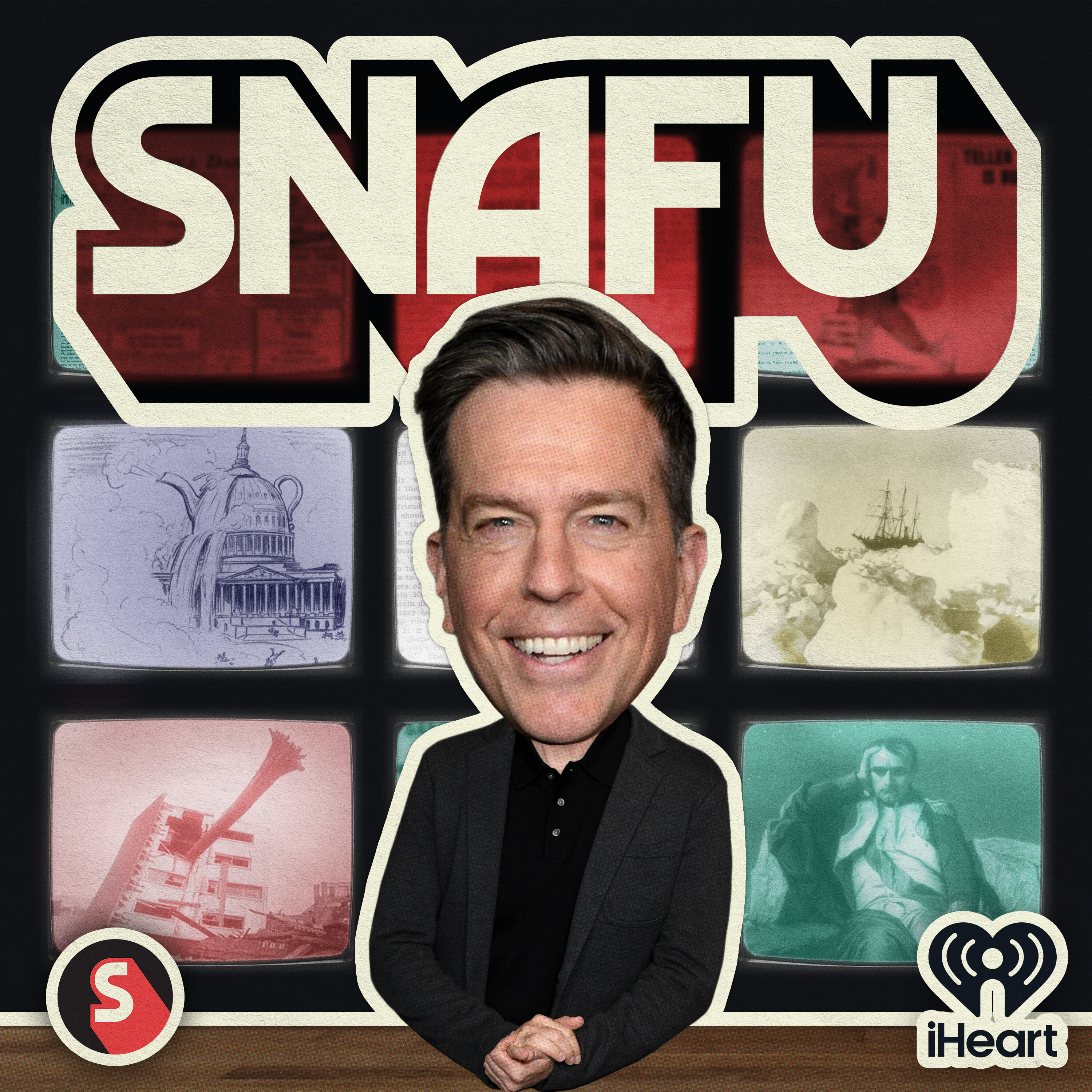
Ed Helms — Favorite Story Reveals & Twists
✓ Source-groundedA collection of historical 'screw-ups'—from aviation miracles and arctic survival to art heists and Masonic mysteries—that highlight the 'fog of war' and the extremes of human endurance.
In one sentence
The true history of human endeavor is often defined by "snafus"—the chaotic, desperate, and sometimes absurd moments where human beings are pushed to their absolute limits by unforeseen circumstances.
Why read this (and who it's for)
This summary is for the history buff, the storyteller, and the anyone who enjoys the "messy" side of human history. It strips away the sanitized versions of events to reveal the visceral reality of survival, the psychological toll of the "fog of war," and the sheer audacity of historical figures who survived the impossible. You will be able to identify the core themes of human resilience and the unpredictable nature of high-stakes environments.
The big idea
Ed Helms argues that history is rarely a clean line of progress; it is often a series of chaotic, high-stakes reactions to impossible situations. Whether it is a pilot flying a plane with zero power or a group of explorers stranded in the Antarctic, the "snafu" is the defining moment where systems fail and human instinct takes over.
The logic of these stories rests on the concept of the "fog of war"—the overwhelming, chaotic state where signals fail, adrenaline spikes, and groupthink can lead to tragic consequences. These stories serve as a testament to the "badass" nature of human survival and the sheer, sometimes terrifying, scale of historical accidents.
Key ideas
The Miracle of the Ram Air Turbine (RAT)
- What it is — A piece of emergency aviation technology where a small wind turbine deploys from the bottom of a jet to generate hydraulic and electrical power when all other systems fail.
- Why it matters — It represents the triumph of engineering over catastrophic failure, allowing pilots to maintain just enough control to perform the impossible.
- In the book — Ed describes the story of a pilot (Pichero) who used the RAT to fly a plane by hand with zero thrust, maintaining a precise speed of 140–200 knots to keep the turbine functioning while landing in the dark.
The Fog of War and Groupthink
- What it is — A psychological and physiological state where high-stress environments, lack of visibility, and overwhelming adrenaline cause individuals to lose their grip on clear decision-making.
- Why it matters — It explains why "friendly fire" and tragic mistakes occur: when the nervous system is over-active, people stop making good decisions and start reacting to the panic of those around them.
- In the book — Ed recounts the tragedy of the Canadian and American troops who, lost in the fog of a battlefield, opened fire on their own comrades because they were "too jacked up" to see clearly.
The "Crack" of the Mona Lisa
- What it is — The unique, microscopic fissures (craquelure) that form on an oil painting over centuries, acting as a unique "DNA signature."
- Why it matters — It illustrates how expertise allows for the detection of forgeries; a curator can recognize a copy because the specific pattern of cracking is virtually impossible to duplicate.
- In the book — The curator of the Louvre explains that while a copy can be made, matching the exact "fingerprint" of the cracks is impossible.
The Survival of the "Forlorn Hope"
- What it is — The desperate, high-stakes gamble of a small group attempting to find help while the rest of a group faces certain death.
- Why it matters — It highlights the extreme measures humans take when pushed to the brink of starvation and freezing temperatures.
- In the book — The story of the Donner Party and the "Forlorn Hope" group who set out on homemade snowshoes to find salvation, while those left behind faced the ultimate "snafu" of survival.
The Institutional Power of the Masons
- What it is — The immense, often secretive influence of the Freemasons in historical legal and social institutions.
- Why it matters — It shows how institutional discipline can be used to protect secrets, even when those secrets involve the disappearance of a person.
- In the book — The story of William Morgan, a Mason who disappeared in 1826, and the subsequent "closed" investigation where the Masons held the keys to the legal and social systems.
Frameworks & tools
The "Fog of War" Assessment
Use this to identify when a situation is becoming too chaotic for logical decision-making:
- Identify the Signal Failure: Is the information coming in contradictory or missing?
- Check the Nervous System: Are people reacting out of panic rather than plan?
- Pause for Mindfulness: Stop the group and force a "breathing" moment to reset the nervous system.
- Re-evaluate the Goal: Determine the immediate survival priority versus the long-term objective.
Memorable examples & stories
- The Landing at Kiska: Commandos were promised a flat beach but found a jagged mess of volcanic rock. They were forced to scramble over 16-foot boulders, highlighting how quickly "the brochure" of a plan can fail.
- The "Missing" Japanese Soldiers: 30,000 troops stormed an island only to find it was empty, the enemy having vanished weeks prior, leaving only graffiti mocking the leaders.
- The Rescue of the Endurance: After a year and a half of harrowing survival, Ernest Shackleton and his men survived the impossible, eventually rescuing every single crew member.
- The Disappearance of William Morgan: A man who vanished from a Masonic lodge, leading to a book that became a bestseller and fueled centuries of conspiracy.
Key quotes
- "The fog of war is incredibly real and present all the time." (Paraphrased)
- Why it matters: It reminds us that chaos is a constant variable in high-stakes environments.
- "The rest of the party gave them a name that sounds kind of like a badass heavy metal band, the Forlorn Hope." (Paraphrased)
- Why it matters: It captures the desperate, almost poetic naming of doomed situations.
- "The rest of the crew, the human crew, all survived." (Paraphrased)
- Why it matters: It highlights the sheer tenacity of human survival against impossible odds.
How to apply it
This week
- Identify your "Fog": Pinpoint one area in your life (work, personal, etc.) where you feel "over-active" or unable to see the next step clearly.
- The "Breathing" Rule: The next time a meeting or conversation turns into a "dumpster fire" of overlapping voices, literally stop and say, "Everyone breathe for a second."
Ongoing
- The "Rat" Mentality: When a system fails (a project, a tool, a plan), look for the "Ram Air Turbine" equivalent—the one core function you need to keep running to survive the crisis.
- Verify the "Brochure": Before starting a major project, identify the "jagged volcanic rock" (the potential points of failure) that the "official" plan might be hiding.
Common pitfalls
- Underestimating the "Fog": People often think they can "think" their way out of a high-adrenaline crisis. Ed emphasizes that the nervous system often overrides logic in these moments.
- Overestimating the "Plan": Many assume that because a plan was made (like the Kiska landing), it will hold. The "snafu" is that the environment often changes faster than the plan can adapt.
Connects to
- The Art of War (Sun Tzu): For the foundational understanding of the "Fog of War."
- Man's Search for Meaning (Viktor Frankl): For understanding the psychological endurance required to survive "insurvivable" situations.
If you remember only three things
- The "Fog of War" is a physical, physiological state where logic fails and reaction takes over.
- Success in impossible situations often depends on "Rat" systems—minimalist, essential functions that work when everything else breaks.
- History is a collection of "snafus" where human beings were pushed to the absolute edge of what is possible.
Internalize it
- Reflection questions
- When was the last time I felt "over-active" in a situation and made a poor decision because of it?
- If my current "plan" were to be completely wiped out by a "snafu," what is the one thing I would need to keep running to survive?
- How can I better recognize the "fog" before it leads to a "friendly fire" situation in my professional life?
- Flashcards
- Q: What is a Ram Air Turbine (RAT)?
- A: A small wind turbine that deploys in emergencies to generate hydraulic and electrical power when other systems fail.
- Q: What is the "Fog of War"?
- A: A state where high stress, lack of visibility, and adrenaline cause people to stop making good decisions and start reacting to panic.
- Q: What is "craquelure"?
- A: The tiny cracks and fissures in an oil painting that act as a unique "DNA signature."
- Q: What was the "Forlorn Hope"?
- A: A group of men who set out on homemade snowshoes to find help while the rest of the Donner Party were stranded.
- Q: Who was William Morgan?
- A: A man who disappeared from a Masonic lodge in 1826, sparking a massive scandal and a best-selling book.
Fidelity note
This summary is based strictly on the provided transcript of the "Favorite Story Reveals & Twists" episode of SNAFU with Ed Helms. I am confident in the descriptions of the historical events (the Donner Party, the RAT, the Masons) as they were presented by the host. The "Fog of War" and "Rat" concepts are the primary analytical frameworks used to synthesize the stories.