Steven Pressfield — How to Overcome Inner Resistance
✓ Source-groundedOvercoming creative resistance requires a professional shift in identity: moving from an amateur who reacts to feelings to a professional who treats the work as a disciplined, non-negotiable obligation.
In one sentence
To overcome the internal friction of creativity, you must stop acting like an amateur who waits for "inspiration" and start acting like a professional who treats the work as a non-negotiable, daily obligation.
Why read this (and who it's for)
This conversation is for anyone who feels paralyzed by procrastination, self-doubt, or the "blank page" syndrome. It solves the problem of emotional dependency in creative work—the habit of waiting until you "feel" like working. After reading this, you will be able to identify the specific "shadows" of your projects, recognize the difference between professional and amateur habits, and implement a rigorous, disciplined schedule to produce work regardless of your internal state.
The big idea
Steven Pressfield argues that the primary barrier to creative output is not a lack of talent, but a lack of professional identity. Most people approach their creative work as "amateurs"—they allow their feelings, moods, and the presence of distractions to dictate their productivity. A professional, by contrast, treats the work as a job. A professional shows up regardless of whether they are tired, uninspired, or facing adversity.
The core logic of Pressfield's philosophy is that Resistance is directly proportional to the importance of the work. If you feel a massive amount of internal friction, it is actually a positive diagnostic signal: it means the project you are avoiding is the one most vital to your "soul's evolution." Therefore, the work you should be doing is always the thing that is hardest to start.
Key ideas
The Professional vs. The Amateur
- What it is — An amateur reacts to feelings; a professional acts on discipline. An amateur waits to "feel" like working; a professional knows that "feeling" is irrelevant to the job.
- Why it matters — If you view yourself as an amateur, you give yourself permission to fold when things get hard. If you identify as a professional, you develop the "stubbornness" and "courage" required to stay in the room with your work.
- In the book — Pressfield notes that an amateur will "crap out" after a bad review, while a professional "plays hurt" and stays on the court, much like Kobe Bryant or Michael Jordan.
The Shadow of the Tree
- What it is — Resistance is the "shadow" cast by the "tree" of your dream. The larger the dream, the bigger the shadow.
- Why it matters — It reframes fear as a compass. Instead of being discouraged by how hard a project feels, you should realize that the intensity of the resistance confirms the importance of the project.
- In the book — Pressfield uses the analogy of a tree in a sunny meadow: as soon as the tree appears, the shadow appears. The shadow is the resistance you feel, and it is directly proportionate to the size of the tree.
The "Soul's Evolution" Principle
- What it is — The more important a project is to your personal and spiritual growth, the stronger the resistance will be.
- Why it matters — It helps you prioritize your to-do list. If you have three projects and are terrified of one, that is the one you must do because it is the one that will move the needle on your personal evolution.
- In the book — Pressfield argues that the "hardest" project is the one that "punches you in the face" the most because it is the one that matters most to your soul.
The Physical Rehearsal
- What it is — Using physical exertion as a "rehearsal" for mental discipline.
- Why it matters — By doing something difficult (like a 4:45 AM workout) before you sit down to write, you "grease the ways." You prove to yourself that you can do something hard, making the subsequent mental work feel less daunting.
- In the book — Pressfield describes his 4:45 AM gym routine as a way to face the resistance of the day. Once he finishes the workout, "nothing I'm going to do for the rest of the day is going to be as hard as what I already did."
The "Two-Part" Professional (The CEO Model)
- What it is — Viewing yourself as a corporation rather than just an individual.
- Why it matters — It removes personal judgment from the work. If you are the "CEO" of your creative corporation, you can separate your personal insecurities from the professional requirements of the business.
- In the book — Pressfield suggests thinking of yourself as a "two-part thing": the CEO of the corporation and the person who does the work. This allows you to "pimp the hell" out of your ideas without the fear of personal failure.
Frameworks & tools
The Professional Identity Shift
To stop being an amateur, you must flip a switch in your mind.
- Identify the "Amateur" Habit: Recognize when you are saying, "I don't feel like doing this today."
- Invoke the Professional: When that thought arises, immediately call up a professional archetype (e.g., "I am going to attack this as if I were Kobe Bryant").
- Ignore the Feeling: Do not wait for the feeling of motivation to arrive. Act as if the feeling is irrelevant to the task.
The "Professional" Work Routine
Pressfield suggests a highly regimented, high-intensity structure for creative output:
- The Ritual: Start at the same time every day.
- The Bout: Work in intense, focused blocks (e.g., 1-2 hours).
- The "Sharp Knife" Principle: As you become more skilled, your work bouts should become shorter and more intense.
- The "Rack" Method: Once a session is done, "rack it" and don't look at it. Do not think about it for the rest of the day.
- The Buffer: Use mundane tasks (like laundry) as a break between intense work bouts.
Memorable examples & stories
The "Pulling the Pin" Story
Pressfield shares a story about a friend in the fruit-picking world who would "pull the pin" (quit) when things got hard. Pressfield realized he had "pulled the pin" on his own marriage and projects before. Lesson: Recognize the "pulling the pin" impulse as a defense mechanism against the difficulty of finishing.
The Professionalism of the Military
Pressfield reflects on his time as a Marine, noting that the virtues of the military—stubbornness, patience, and the willingness to embrace adversity—are the exact same virtues required to survive the "War of Art." Lesson: You don't need a new set of skills; you need to call upon the "warrior" virtues you already possess.
The "CEO" of the Corporation
Pressfield explains how he overcame shyness in pitching ideas by imagining himself as the CEO of a corporation rather than just an individual writer. Lesson: Creating a professional "persona" can provide a shield against personal insecurity.
Key quotes
"The more important to your soul's growth, the stronger the resistance will be." Why it matters: It turns fear into a roadmap for your most important work.
"An amateur worries about how they feel... A professional doesn't care how they feel, they do it." Why it matters: It highlights the necessity of decoupling emotion from action.
"The bigger the tree, the bigger the shadow." Why it matters: It validates the intensity of your creative blocks as a sign of greatness.
"I'd rather die; I will die before I'll give up on this project." Why it matters: It captures the "stubbornness" required to finish what you start.
How to apply it
This week
- The "Shadow" Audit: List three projects you are currently avoiding. Identify which one causes the most "Resistance." That is your priority for this week.
- The Physical Rehearsal: Before your next writing/creative session, do 10 minutes of something physically uncomfortable (push-ups, a cold shower, a brisk run). Use it to "grease the ways" for the mental work.
- The CEO Shift: For one day, act as if you are a "professional" hired to do a job. When you sit down to work, do not allow yourself to check the news, social media, or "feel" your way into the work.
Ongoing
- The 1-Hour Bout: Commit to a focused, 60-minute work session at the same time every day.
- The "Rack" Rule: Once you finish a session, stop thinking about the work. Do not "noodle" over it.
- The "Professional" Identity: Whenever you feel the urge to procrastinate, say out loud: "A professional doesn't care how they feel. They do the work."
Common pitfalls
- Waiting for "The Muse": Pressfield argues that while a "higher plane" might provide the ideas, your job as a professional is to be ready to "take that voltage" and produce it in material form. You cannot wait for the muse to do the work for you.
- The "Nirvana" Trap: Do not look for "nirvana" or a magical feeling of ease. Pressfield warns that the path of the artist is a "f*** of a lot of hard work" that may never be rewarded with fame or money.
- The "Amateur" Trap of Perfectionism: Don't let the fear of being "imperfect" stop you from starting. The professional "plays hurt" and gets the work out.
Connects to
- The War of Art (Steven Pressfield): The foundational text for these concepts.
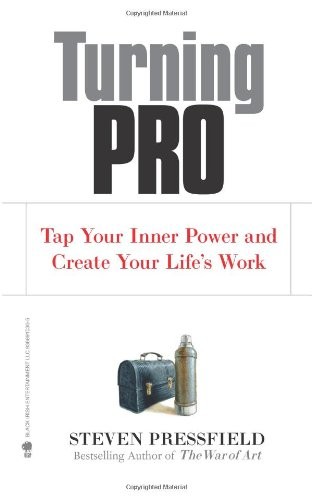
- Turning Pro (Steven Pressfield): Focuses specifically on the shift from amateur to professional habits.
- Flow State (Mihaly Csikszentmihalyi): While Pressfield focuses on discipline, Flow is the "state" that often occurs when the professional successfully manages the "War of Art."
If you remember only three things
- Resistance = Importance: The harder it is to start, the more it matters to your soul.
- Professional vs. Amateur: Professionals do the work regardless of how they feel; amateurs wait for inspiration.
- The Physical Rehearsal: Use physical discomfort to build the mental stamina required for creative work.
Internalize it
- Reflection questions
- Which of my current projects is producing the "biggest shadow" (the most resistance)?
- Am I currently acting as an amateur by waiting for a "feeling" before I start my work?
- How can I "grease the ways" for my next session using a physical rehearsal?
- Flashcards Q: What does the "Shadow of the Tree" analogy mean? A: The "tree" is your dream/project, and the "shadow" is the resistance you feel. The bigger the tree, the bigger the shadow. Q: What is the primary difference between an amateur and a professional? A: An amateur reacts to feelings and waits for inspiration; a professional acts on discipline and does the work regardless of how they feel. Q: Why does Pressfield suggest doing something physically difficult before working? A: It serves as a "rehearsal" for facing resistance, making the mental work feel less daunting because you've already faced a harder physical challenge. Q: What is the "CEO" model of professional identity? A: Viewing yourself as a corporation/CEO allows you to separate personal insecurities from the professional requirements of the work. Q: How should you handle a project once a work bout is finished? A: "Rack it"—hang it up and do not think about it for the rest of the day.
Fidelity note
This summary is based strictly on the provided transcript of the Huberman Lab interview with Steven Pressfield. I am highly confident in the "Professional vs. Amateur" distinction and the "Shadow" analogy as these are central to his arguments. The "CEO" model and "Physical Rehearsal" are specific applications he provides to bridge the gap between his philosophy and daily practice. The summary does not include any information regarding his specific books other than what was mentioned in the transcript.