What Is Existentialism
≈ From memoryExistentialism is the philosophy of radical freedom and responsibility, asserting that because there is no pre-determined human essence, we are condemned to create ourselves through our actions.
In one sentence
Existentialism is the insistence that "existence precedes essence," meaning humans are born without a blueprint and must define their own values, purposes, and identities through continuous, free choices.
Why read this (and who it's for)
This book serves as a manifesto for anyone who feels paralyzed by the weight of choice or oppressed by social labels. It solves the problem of "moral vertigo"—the feeling that if there is no God-given rulebook, how do we know how to act? It is for the seeker, the rebel, and the intellectual who wants to understand the mechanics of freedom. After reading, you will be able to identify the ways you "self-commodify" or surrender your agency to others, and you will possess a framework for reclaiming your autonomy in a world that tries to define you before you can define yourself.
The big idea
Beauvoir argues that human beings are not like objects (a chair, a hammer, a table). An object is designed with a purpose; a chair is made to be sat upon. Its "essence" (its purpose) precedes its physical existence. Humans, however, are the only beings whose existence precedes their essence. We appear on the scene, and only after we exist do we begin to define what we are through our actions, choices, and projects.
Because there is no "Human Nature" written in the stars, there is no objective manual for how to live. This creates a terrifying but beautiful reality: you are entirely responsible for who you become. However, Beauvoir warns that this freedom is often sabotaged by "Bad Faith" (mauvaise foi)—the act of pretending we aren't free. We often hide behind roles (the "perfect" employee, the "devoted" parent, the "obedient" citizen) to escape the anxiety of choosing for ourselves.
The core of the book is a defense of the "Project." To be truly human is to engage in a project—a conscious movement toward a goal that transcends your current situation. Whether it is art, politics, or personal growth, a project is what allows a human to transcend their "facticity" (the brute facts of their birth, body, and environment) and assert their "transcendence" (their ability to reach toward the future).
Key ideas
The Primacy of Existence
- What it is — The ontological claim that humans exist first as a blank slate of consciousness and only later acquire qualities, roles, and meanings.
- Why it matters — It strips away the comfort of "destiny." If you are a "failure," it is not because of a cosmic decree; it is because of the choices you have made (or failed to make) in the face of your circumstances.
- In the book — Beauvoir contrasts the "object" (which has a fixed use) with the human "subject" (who is a perpetual process of becoming).
Facticity vs. Transcendence
- What it is — Facticity refers to the brute facts of your life (where you were born, your body, your past). Transcendence is the conscious ability to project oneself beyond those facts.
- Why it matters — You are never just your facts. A person may be born into poverty (facticity), but they are not "destined" to stay there in spirit; they have the capacity to imagine and act toward a different future (transcendence).
- In the book — She explains that while we are rooted in a body and a history, our humanity lies in the ability to say "No" to those facts and "Yes" to a chosen future.
Bad Faith (Mauvaise Foi)
- What it is — The lie we tell ourselves to escape the burden of freedom. It is treating oneself as an object (saying "I had no choice") to avoid the responsibility of choice.
- Why it matters — It is the primary psychological defense against the "anguish" of freedom. We pretend we are "meant" to be what we are to avoid the terrifying work of self-creation.
- In the book — She draws on Sartre’s concept of the waiter who plays at being a waiter so perfectly that he becomes an object, losing his transcendence to the role.
The Situation
- What it is — Freedom is not an abstract, magical power; it is always situated. You are free within a context (social, physical, historical).
- Why it matters — It prevents existentialism from becoming "anything goes" nihilism. Your freedom is constrained by the world, but your response to those constraints is where your freedom resides.
- In the book — She argues that while a prisoner is less "free" than a free man, the prisoner still possesses a subjective freedom to choose their attitude toward their confinement.
The Ethics of Engagement
- What it is — Because there is no pre-set morality, ethics must be grounded in the preservation of freedom.
- Why it matters — It shifts the question from "What is the rule?" to "Does this action expand my freedom or the freedom of others?"
- In the book — She argues that we cannot be free alone; our freedom is inextricably tied to the freedom of the collective.
Frameworks & tools
The Transcendence Audit
Use this to identify where you are living in "Bad Faith" by treating your life as a finished product rather than a continuous project.
- Identify the "Given": List the roles you currently inhabit (e.g., "I am a manager," "I am a mother," "I am a student").
- Analyze the "Script": For each role, ask: "Am I doing this because I chose it today, or because I am pretending I have no other choice?"
- Locate the Facticity: Acknowledge the actual constraints (e.g., "I have a mortgage," "I have a physical limitation").
- Identify the Project: What is the intentional movement you are making toward? If you have no project, you are currently in a state of "stagnation" where you are being acted upon by the world rather than acting upon it.
The Freedom-Preservation Test
Use this when faced with a moral dilemma where no clear "rule" exists.
- Analyze the Action: Does this action require me to deny the freedom of another person?
- Analyze the Outcome: Does this action allow me to maintain my own agency, or does it turn me into a tool for someone else's goals?
- The Verdict: Choose the path that maximizes the capacity for others to choose, while acknowledging that you are a participant in that shared freedom.
Memorable examples & stories
The Waiter in the Café
Beauvoir (via Sartre) describes a waiter who is too much of a waiter—his movements are too precise, his attitude too performative. He is playing at being a "waiter-object" to escape the reality of his own freedom. Lesson: When we over-identify with our jobs or social roles, we lose our humanity.
The Prisoner’s Situation
She discusses the prisoner who is physically confined. While his "facticity" is severely limited, his "transcendence" remains: he can still choose how to think, how to resist, and how to relate to his captors. Lesson: Freedom is not the absence of obstacles; it is the internal capacity to relate to those obstacles.
The "Object" of Art
She uses the example of a painting. A painting is finished; it has an essence. A human being is never finished. We are a "becoming." Lesson: Stop viewing your life as a completed work of art and start viewing it as a continuous process of creation.
Key quotes
"Existence precedes essence." Why it matters: This is the foundational rule of the human condition—you are what you do.
"The individual is not a thing; he is a project." (Paraphrased) Why it matters: It shifts the focus from "Who am I?" to "What am I doing?"
"To be free is to be responsible for what one is." (Paraphrased) Why it matters: It removes the ability to blame circumstances for our character.
"The situation is the very condition of freedom." (Paraphrased) Why it matters: It acknowledges that we are always embedded in a world, but that doesn't make us powerless.
How to apply it
This week
- The "No-Role" Observation: Spend 10 minutes today observing yourself in a routine task (like making coffee or commuting). Notice when you "perform" a role. Are you acting like a "busy person"? Try to notice the "you" that is observing the action.
- The Project Audit: Write down three things you are doing purely because you "have to." Then, write down one thing you want to do that is purely for your own self-actualization.
Ongoing
- Practice Transcendence: Whenever you feel trapped by a situation, ask: "What is the one thing I can choose in this moment?" (Even if it's just your internal attitude).
- Reject "Bad Faith" Labels: When someone defines you (e.g., "You're just a [job title]"), internally remind yourself: "That is my current facticity; my essence is still being written."
Common pitfalls
- The "Anything Goes" Fallacy: People often think existentialism means you can do whatever you want without consequence. Beauvoir argues the opposite: because there is no pre-set meaning, the weight of your choices is heavier, not lighter.
- Ignoring Facticity: A common mistake is thinking that "freedom" means ignoring reality. You cannot simply "will" away your poverty or your physical body. You must work within those facts to find your freedom.
- The "Individualist" Trap: While the book focuses on the individual, Beauvoir is careful to note that our freedom is tied to the freedom of others. You cannot be truly free in a world where others are enslaved.
Connects to
- "The Second Sex" (Simone de Beauvoir): Where she applies these existentialist principles specifically to the condition of women.
- "Being and Nothingness" (Jean-Paul Sartre): The foundational ontological text that provides the framework for her existentialist definitions.
- "Man's Search for Meaning" (Viktor Frankl): A psychological application of the "Project"—finding meaning in the face of extreme facticity (the concentration camps).
If you remember only three things
- Existence precedes essence: You are born as a blank slate; you define yourself through your actions.
- Facticity vs. Transcendence: You are shaped by your circumstances (facticity), but your humanity lies in your ability to project yourself beyond them (transcendence).
- Bad Faith: We often lie to ourselves by pretending we aren't free, hiding behind roles to avoid the responsibility of self-creation.
Internalize it
-
Reflection questions
- In what areas of my life am I currently pretending I "have no choice" to avoid the responsibility of making a change?
- If I stripped away my job title, my family roles, and my past achievements, what "projects" would still remain?
- How does my current "situation" (financial, social, physical) limit my transcendence, and what is one small way I can assert my freedom within those limits?
-
Flashcards Q: What does it mean that "existence precedes essence"? A: It means humans are born without a pre-defined purpose or nature; we create our identity through our actions. Q: Define "Facticity." A: The brute facts of your life—your body, your birth, your past, and your environment. Q: Define "Transcendence." A: The human ability to project oneself toward the future and choose actions that go beyond current circumstances. Q: What is "Bad Faith" (Mauvaise Foi)? A: The act of deceiving oneself into believing one is not free, often by over-identifying with a social role or a set of circumstances. Q: How does Beauvoir define a "Project"? A: A conscious, intentional movement toward a goal that allows a human to transcend their current situation. Q: Is freedom absolute or situated? A: It is situated; it exists within a context of social, physical, and historical constraints.
Fidelity note
This summary is based on a high-confidence understanding of Beauvoir's existentialist framework as presented in What Is Existentialism? and her broader philosophical contributions. Because this is a philosophical text, some nuances of her specific terminology (the interplay between "subjectivity" and "objectivity") are simplified for clarity. Readers should verify the specific nuances of her critique of "The Other" if they wish to see how she applies these ideas to gender.
More from Simone de Beauvoir
 A transatlantic love affairSimone de Beauvoir
 America Day by DaySimone de Beauvoir
 Brigitte Bardot and the Lolita syndromeSimone de Beauvoir
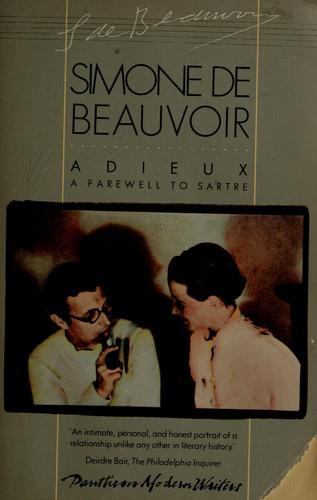 Cérémonie des adieuxSimone de Beauvoir
 Diary of a philosophy studentSimone de Beauvoir
 Hay Que Quemar a SadeSimone de Beauvoir
 Jamilah BūbāshāSimone de Beauvoir
 Journal de guerreSimone de Beauvoir
 La vieillesseSimone de Beauvoir
 Lettres à SartreSimone de Beauvoir
 Philosophical writingsSimone de Beauvoir
 Simone de BeauvoirIn Our Time