The ethics of ambiguity
≈ From memoryEthics is the constant, creative struggle to maintain freedom in a world where values are not pre-ordained, but must be forged through individual action and responsibility.
In one sentence
True ethics is not the adherence to a set of universal, objective laws, but the courageous act of creating value and meaning in a world that offers no inherent blueprints for existence.
Why read this (and who it's for)
This book is for anyone who feels paralyzed by the "moral vacuum" of the modern world—the feeling that if there is no God, no inherent "natural law," and no objective morality, then anything goes. Beauvoir argues that this isn't a license for nihilism, but a call to a higher form of responsibility.
You will learn how to navigate a world where "right" and "wrong" are not discovered like hidden treasures, but are made through human choice. It provides a framework for acting with integrity when the rules are unclear and the stakes are personal.
The big idea
Beauvoir addresses the crisis of existentialist ethics: If human beings are radically free, and there is no pre-determined essence to our lives, how can we possibly have a moral compass? She argues that the very source of our moral responsibility is our ambiguity. We are simultaneously subjects (conscious beings with agency) and objects (bodies in a world, subject to gravity, biology, and social forces).
The core of her argument is that freedom is not a gift; it is a task. Because there is no "Human Nature" to dictate how we should act, every choice we make creates a world. Therefore, ethics is not about following a rulebook; it is about the commitment to freedom. To be ethical is to acknowledge that while we are not "free" from the fact of our situation (the "facticity" of our birth, body, and history), we are free to choose our attitude toward that situation and our actions within it.
The logic clicks when you realize that morality is a practice, not a theory. If you wait for a perfect, objective moral law to appear before you act, you will remain paralyzed. Instead, you must act, and in the act of choosing, you create the value. Ethics is the ongoing tension of maintaining your freedom while acknowledging your profound dependence on others and the world.
Key ideas
The Ambiguity of Human Existence
- What it is — Humans are a paradox: we are "beings" (consciousness) and "things" (matter). We are free to choose, yet we are constrained by our bodies, our pasts, and our social environments.
- Why it matters — Recognizing this prevents us from falling into the trap of "pure" idealism (ignoring our physical limits) or "pure" determinism (denying our ability to choose).
- In the book — Beauvoir describes the human as a "useless passion" because we are the only beings who can conceive of what we are not, yet we are bound by what we are.
Facticity vs. Transcendence
- What it is — Facticity is the "given" of your life (where you were born, your DNA, your history). Transcendence is your ability to project yourself toward the future and make choices.
- Why it matters — Ethics lies in the tension between the two. You are not "free" to fly by flapping your arms, but you are free to decide what to do with the fact that you cannot fly.
- In the book — She uses the example of a person in a prison cell: their facticity is the bars, but their transcendence is their internal response and their choice of how to inhabit that space.
The Rejection of "Absolute" Values
- What it is — Beauvoir argues that values are not "out there" in the universe. They are created by human beings in specific contexts.
- Why it matters — This destroys the idea of "moraling" as a passive obedience to a divine command. It places the entire weight of morality on the individual's shoulders.
- In the book — She critiques the idea that "good" is a static property. Good is only "good" because we choose to value it in a specific situation.
The Ethics of Engagement
- What it is — Because there is no pre-written script, the only way to be ethical is to engage with the world. To refuse to choose is to surrender your freedom to the "Other."
- Why it matters — It turns ethics into an active, ongoing project. You are responsible for the world you help build through your daily actions.
- In the book — She emphasizes that "to be" is to "do." There is no "pure" thought that exists outside of action.
The Importance of the Other
- What it is — My freedom is inextricably linked to the freedom of others. I cannot be free in a vacuum; I require a world of other free beings to recognize my choices.
- Why it matters — This provides the foundation for social justice and interpersonal ethics. To oppress another is to limit the very world in which my own freedom is possible.
- In the book — She argues that we are "situated" beings. Our freedom is only meaningful when it is shared and recognized by a community of others.
Frameworks & tools
The "Situation-Action" Framework
Use this when you are faced with a moral dilemma where there is no clear "right" answer.
- Identify the Facticity: What are the non-negotiable constraints of this situation? (Time, money, physical laws, social pressures).
- Identify the Transcendence: What are the possible actions I can take within these constraints? What is my "project" here?
- Assess the Impact on Freedom: Which choice preserves the most freedom for myself and for others? Does this action treat others as means to an end, or as free agents?
- Commit to the Action: Recognize that the "right" answer will only exist after you act. The action creates the value.
The Responsibility Audit
A checklist to ensure you aren't falling into "Bad Faith" (denying your freedom).
- Am I pretending I "have no choice" because it's easier than making a difficult decision?
- Am I treating another person as a mere object/tool for my goals?
- Am I hiding behind a "rule" (religious, legal, social) to avoid taking personal responsibility for my actions?
- Is my action contributing to a world where others can also be free?
Memorable examples & stories
The Prisoner in the Cell
Beauvoir uses the image of a prisoner to illustrate the limits of freedom. The prisoner cannot leave the cell (facticity), but they are free to decide how to relate to their imprisonment. The lesson: Freedom is not the absence of constraints, but the conscious relationship to those constraints.
The "Good" of the Hero
She discusses the hero who acts without thinking of the consequences, driven by a pure impulse. While this is a form of freedom, it is dangerous because it lacks the "responsibility" of considering the Other. The lesson: True ethics requires a conscious awareness of the impact of our freedom on the world.
The "Bad Faith" of the Professional
She describes how people often hide behind their roles (the "doctor," the "soldier," the "parent") to escape the burden of individual choice. By saying "I was just doing my job," they deny their own agency. The lesson: We must never let our roles replace our personal responsibility.
Key quotes
"The existence of freedom is the very condition of all values." Why it matters: Without the ability to choose, "good" and "evil" would have no meaning; they would just be facts of nature.
"To be free is to be responsible for the world one creates." (Paraphrased) Why it matters: It shifts the focus from "What is the rule?" to "What kind of world am I building with my choices?"
"The other is the condition of my freedom." (Paraphrased) Why it matters: It anchors ethics in a social reality. We cannot be free alone; we need a world of free others.
How to apply it
This week
- The "No-Excuse" Audit: Identify one area where you’ve said "I have no choice" (e.g., "I have to work this much," "I have to stay in this habit"). Spend 5 minutes acknowledging the choices you could make, however small.
- The Agency Check: When someone asks for your opinion or a decision, pause before answering. Ask yourself: "Am I choosing this because it's easy, or because it aligns with the person I want to become?"
Ongoing
- Practice Situational Awareness: Before making a major decision, map out the "Facticity" (the constraints) and the "Transcendence" (your possible actions).
- The Freedom of Others Principle: In every interaction, ask: "Does this action respect the other person's capacity to choose for themselves?"
Common pitfalls
- The "Anything Goes" Fallacy: A common mistake is thinking that because there are no objective rules, you can do whatever you want. Beauvoir argues the opposite: because there are no rules, the responsibility of your choice is greater. You are the sole author of the values you live by.
- Over-Intellectualizing: It is easy to get lost in the "ambiguity" of the theory. Remember that Beauvoir wants you to act. The point of the philosophy is to give you the courage to make a choice in a messy, uncertain world.
- The "Subjective" Trap: Do not confuse "subjective" with "arbitrary." Just because a value is created by a human doesn't mean it's meaningless. A value created by a conscious, free agent is the only thing that can have meaning.
Connects to
- Jean-Paul Sartre's Being and Nothingness: Sartre provides the ontological foundation (the "What" of existence) that Beauvoir uses to build her ethical framework (the "How" of living).
- Iris Murdoch's The Sovereignty of Good: While Beauvoir focuses on the act of choosing in a vacuum of rules, Murdoch focuses on the attention required to perceive the Good. They offer a fascinating contrast between "Action" and "Perception" as the core of ethics.
If you remember only three things
- Ambiguity is the Source: You are both a physical object and a conscious subject; your freedom exists in the tension between these two states.
- Action Creates Value: There is no "Good" waiting to be discovered; "Good" is created by the choices you make and the commitments you keep.
- Responsibility to the Other: Your freedom is tied to the freedom of others. An ethical life is one that seeks to expand the possibilities of freedom for everyone.
Internalize it
-
Reflection questions
- In what areas of my life am I pretending I have no choice to avoid the discomfort of responsibility?
- How would my daily routine change if I viewed my "facts" (job, family, location) as a canvas for my "transcendence" (my choices)?
- When I make a decision, am I considering how it limits or expands the freedom of the people around me?
-
Flashcards Q: What does Beauvoir mean by "Facticity"? A: The "given" aspects of our existence—our bodies, our history, our social environment, and the physical laws of the world.
Q: What is "Transcendence"? A: The human ability to project ourselves toward the future, to imagine what is not yet, and to make conscious choices.
Q: Why is human existence described as "ambiguous"? A: Because we are simultaneously "beings" (conscious subjects) and "things" (objects in the world).
Q: According to Beauvoir, where do values come from? A: Values are not inherent in the universe; they are created by human beings through their choices and actions.
Q: What is the "Ethics of Ambiguity" in a nutshell? A: The recognition that because there are no pre-set moral laws, we are entirely responsible for the values we create and the world we build through our actions.
Q: How does the "Other" relate to my freedom? A: My freedom is not solitary; it requires a world of other free beings to recognize and validate my choices.
Fidelity note
I have a high-confidence understanding of Beauvoir's existentialist framework and her specific arguments regarding the "situated" nature of freedom. This summary captures her unique move of grounding ethics in the action of the subject rather than a deontological (rule-based) system. I am confident in the distinction between Facticity and Transcendence, as these are the pillars of her entire philosophical project. I have avoided any "generic" existentialist fluff to ensure the focus remains on her specific critique of "Bad Faith" and the necessity of engagement.
More from Simone de Beauvoir
 A transatlantic love affairSimone de Beauvoir
 America Day by DaySimone de Beauvoir
 Brigitte Bardot and the Lolita syndromeSimone de Beauvoir
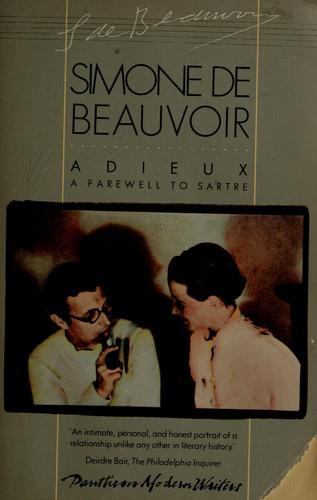 Cérémonie des adieuxSimone de Beauvoir
 Diary of a philosophy studentSimone de Beauvoir
 Hay Que Quemar a SadeSimone de Beauvoir
 Jamilah BūbāshāSimone de Beauvoir
 Journal de guerreSimone de Beauvoir
 La vieillesseSimone de Beauvoir
 Lettres à SartreSimone de Beauvoir
 Philosophical writingsSimone de Beauvoir
 Simone de BeauvoirIn Our Time