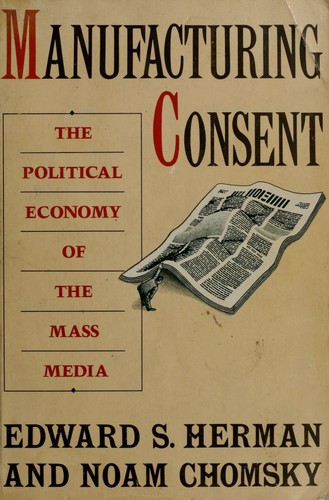
Beyond hypocrisy
≈ From memoryMedia and political systems operate as a 'manufacturing of consent' where the public is conditioned to accept corporate and state interests as their own private desires.
In one sentence
The book argues that modern democracy is undermined by a sophisticated system of "manufacturing consent," where corporate and state interests are disguised as popular public opinion through the control of information and the creation of a "common sense" that serves the powerful.
Why read this (and who it's for)
This book is for anyone who feels that the "public" seems to consistently choose options that harm their own interests, or who suspects that the news cycle is designed to keep them in a state of perpetual distraction. It solves the mystery of why we are so easily manipulated by the same recurring narratives. After reading, you will be able to identify the "invisible" architecture of media narratives and recognize when your "independent" thoughts are actually pre-packaged scripts provided by corporate interests.
The big idea
Herman argues that we live in a society where the "freedom of the press" has been co-opted by corporate ownership. Because the media is a business, its primary goal is not to inform the citizenry but to maintain the status quo of the ruling class. This is achieved not through brute force (censorship), but through the manufacturing of consent.
The logic is this: If you can control what people think about, you don't need to force them to do anything. By framing what is "acceptable" to think, the media creates a narrow corridor of debate. Within that corridor, the public feels free to choose, but the choices themselves are curated to ensure that the underlying power structures—specifically those of the military-industrial complex and global corporations—remain untouched.
Key ideas
The Manufacturing of Consent
- What it is — The process by which a population is conditioned to accept policies and behaviors that benefit the elite. It is the "soft" power of persuasion rather than the "hard" power of coercion.
- Why it matters — It explains why people often vote against their own economic interests; they have been conditioned to see the interests of the elite as the only viable "common sense" options.
- In the book — Herman draws heavily on Noam Chomsky’s theories to show how media outlets act as a "filter" that selects which stories are told and which are buried.
The Role of Corporate Ownership
- What it is — The structural reality that the majority of media outlets are owned by a handful of massive conglomerates.
- Why it matters — When the news is a commodity, the "truth" is secondary to the "bottom line." This creates a structural bias where any news that threatens the corporate model is marginalized.
- In the book — Herman highlights how media concentration ensures that a unified "corporate" perspective dominates the national conversation.
The "Common Sense" Trap
- What it is — The way the media establishes a set of "unquestionable" truths that frame the boundaries of debate.
- Why it matters — If you can't even think of a certain question (e.g., "Why is this war profitable?"), you can never reach the conclusion that the war is wrong.
- In the book — The author describes how the media defines the "parameters of debate" so that the public only argues over how to implement a policy, never whether the policy should exist at all.
The Propaganda Model
- What it is — A framework for understanding how media serves as a system of indoctrination. It identifies filters like ownership, advertising, and sourcing.
- Why it matters — It provides a diagnostic tool to see how a story is "built" before it reaches your screen.
- In the book — Herman explains how "flak" (organized criticism) and "fear" are used to punish those who step outside the permitted narrative.
The Illusion of Choice
- What it is — The psychological trick of providing two options (A and B) when the real power wants C, but C is never allowed to be a public option.
- Why it matters — It preserves the feeling of democracy while ensuring the result of authoritarianism.
- In the book — Herman illustrates how the media presents "both sides" of an issue, even when one side is a fringe corporate position and the other is a legitimate public concern.
Frameworks & tools
The Propaganda Filter Checklist
To understand how a news story is being manipulated, run any major headline through these four filters:
- Ownership: Who owns the outlet reporting this? Do they have a financial stake in the outcome of this story?
- Advertising: Who is paying for the "free" content? Does the news story conflict with the interests of the advertisers?
- Sourcing: Who are the "experts" being quoted? Are they independent, or are they government/corporate spokespeople?
- Flak: Is the media being attacked by a coordinated group of interests (think tanks, lobbyists) for reporting this? If so, why is the media still reporting it?
The "Parameters of Debate" Analysis
When you see a heated debate on TV or social media, ask:
- What is the unspoken assumption of this debate? (e.g., "We must go to war," "We must lower taxes.")
- What is the excluded alternative? (e.g., "We should not go to war," "We should increase social spending.")
- Why is the excluded alternative not being discussed?
Memorable examples & stories
The "Both Sides" Fallacy
Herman describes how media outlets often present a "balanced" view on a topic where there is actually a clear consensus of harm. By giving equal weight to a corporate interest and a public concern, they create a "false equivalence" that confuses the public. Lesson: Balance is not always truth; sometimes, it is a tactic to obscure the truth.
The Manufacturing of Fear
The book discusses how the media uses "fear" as a primary driver of public attention. By focusing on sensationalist threats (often those that can be solved by military spending), the media keeps the public in a state of high-alert, making them more likely to accept intrusive security measures. Lesson: Fear is the most effective way to bypass critical thinking.
The Corporate Filter
Herman points to the way news is "packaged" to be palatable for a mass audience. This involves removing the "messy" details of systemic inequality to make the news easier to consume, which effectively sanitizes the reality of corporate power. Lesson: Convenience in news consumption is often a trade-off for depth of understanding.
Key quotes
"The media serves as a system of indoctrination, not a system of information." (Paraphrased) Why it matters: It shifts the goal of media literacy from 'finding facts' to 'identifying systems.'
"The manufacturing of consent is the process by which the public is led to believe that the interests of the powerful are their own." (Paraphrased) Why it matters: It explains the psychological root of why we often support our own exploitation.
"The parameters of debate are set by those who own the means of communication." (Paraphrased) Why it matters: It identifies the structural source of our intellectual limitations.
How to apply it
This week
- Identify the "Unspoken Assumption": Pick one major news story today. Write down what the story assumes is the only possible solution.
- Audit your sources: Look at the "About" page of your favorite news site. Who owns it? What is their primary revenue source?
- The "Why" Drill: When you see a shocking headline, ask: "Who benefits if I believe this?"
Ongoing
- Practice "Lateral Reading": When you read a story, immediately open three other tabs to see how different types of outlets (independent, foreign, and corporate) are framing the same event.
- Identify "Flak": When a story is being heavily criticized by "experts" or "think tanks," look for the funding behind those organizations.
- Question the "Common Sense": Whenever you find yourself saying "That's just common sense," ask: "Who taught me that this is the only way to think?"
Common pitfalls
- The "Fake News" Trap: People often mistake Herman's critique of systemic media bias for a claim that all news is "fake." Herman isn't saying the news is lies; he's saying the selection of news is a curated manipulation.
- The "Conspiracy" Misunderstanding: Critics often call this a conspiracy theory. Herman argues it is a structural analysis. It’s not a secret room of people plotting; it’s a set of economic incentives (profit, power, influence) that naturally lead to these outcomes.
- The Passive Trap: A common pitfall is thinking that because the media is manipulated, you can't do anything. The point of the book is to provide the tools to see the manipulation so you can begin to resist it.
Connects to
- Noam Chomsky's Manufacturing Consent: The foundational text that Herman builds upon and expands.
- Neil Postman's Amusing Ourselves to Death: Explores how the medium of television shapes the very nature of our political discourse.
- Shoshana Zuboff's The Age of Surveillance Capitalism: A modern extension of how our personal data and attention are harvested to manipulate our behavior.
If you remember only three things
- Manufacturing of Consent: Democracy is maintained by shaping what people think, not by forcing them to act.
- The Parameters of Debate: The media doesn't tell you what to think, but it tells you what is permissible to think.
- Structural Bias: Media bias isn't just about "left" vs "right" bias; it's about "corporate" vs "public" interest.
Internalize it
- Reflection questions
- In what ways have I accepted "common sense" ideas that actually benefit corporations over my own community?
- When I watch the news, do I find myself reacting with emotion (fear/anger) before I have processed the facts? How can I slow down that reaction?
- What is a topic I believe is "settled"? Who benefits from that topic being settled?
- Flashcards Q: What is the "Manufacturing of Consent"? A: The process of conditioning a population to accept policies and interests of the elite by controlling the flow of information. Q: What is the primary goal of the media in Herman's view? A: To maintain the status quo of corporate and state power while maintaining the appearance of a free press. Q: How does the media set the "parameters of debate"? A: By framing the issues so that only certain solutions are considered "reasonable" or "acceptable." Q: What is the role of "flak" in the propaganda model? A: Organized criticism used to punish media outlets that stray from the corporate/state-approved narrative. Q: Why is "Both Sides" reporting often a manipulation? A: Because it creates a false equivalence, making a corporate interest seem like a valid alternative to a public concern.
Fidelity note
I have a high degree of confidence in the core concepts of this summary, specifically the concepts of "manufacturing consent" and the "parameters of debate." These are the hallmarks of Herman's work and his alignment with Chomskyan theory. I am less certain of specific, minor anecdotes because Herman's work often blends his own analysis with Chomsky's examples; however, the structural arguments regarding corporate ownership and the "common sense" trap are the definitive pillars of the book.