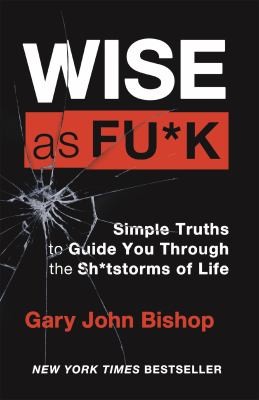
Wise As Fuk
≈ From memoryHappiness is not a destination to be reached or a prize to be won; it is a byproduct of the radical, intentional shift from seeking external validation to cultivating internal mastery.
In one sentence
True happiness is found by silencing the "inner critic"—that relentless, perfectionist voice of social conditioning—and replacing it with a fierce, self-authored sense of purpose and presence.
Why read this (and who it's for)
Most people approach happiness as a "to-do" list: If I get the promotion, if I lose the weight, if I find the partner, then I will be happy. Bishop argues this is a fundamental category error. This book is for the high-achiever who feels like they are running on a treadmill—constantly doing, yet never arriving. It solves the problem of "conditional happiness" by teaching you how to dismantle the internal narratives that keep you enslaved to external milestones. After reading, you will be able to identify the "inner critic" in real-time and pivot toward actions that nourish your internal state rather than just your external resume.
The big idea
The central thesis of Wise As Fuk* is that we are our own worst enemies. We are haunted by a "perfectionist" voice—a byproduct of a society that demands we be productive, polished, and perfect. This voice tells us we aren't enough, that we need to do more, and that happiness is always just one more achievement away. Bishop argues that this is a lie.
Happiness is not a trophy. It is a state of being that occurs when you stop trying to "fix" yourself to meet someone else's standards. The logic is simple: if your happiness depends on things you cannot control (other people's opinions, market fluctuations, perfect results), you will never be happy. Therefore, happiness must be found in the process—the way you show up, the way you treat yourself, and the way you choose to perceive your own worth.
To achieve this, you must undergo a radical shift in perspective. You must move from a "doing" orientation (What can I achieve?) to a "being" orientation (Who am I becoming?). This requires a ruthless auditing of your internal dialogue and a commitment to "wise" action over "safe" action.
Key ideas
The Perfectionist Trap
The perfectionist is the voice that says "you should be doing more." It is a relentless, demanding internal narrator that treats your life like a project to be optimized rather than an experience to be lived. Why it matters Because the perfectionist is never satisfied. Even when you succeed, it finds the flaw. If you listen to it, you will spend your life in a state of perpetual inadequacy. In the book Bishop describes the perfectionist as a "harsh, demanding, and often judgmental" entity that thrives on the fear of being "found out" as a fraud.
Happiness as a Byproduct
Happiness is not a goal; it is the "side effect" of a life lived with intention and integrity. You cannot "will" yourself into happiness any more than you can "will" yourself to grow taller. Why it matters This removes the pressure of "trying" to be happy. When you stop chasing happiness as a target, you stop the cycle of frustration that comes from failing to reach it. In the book Bishop argues that when you focus on the process of living—the craft of your work, the depth of your relationships—happiness naturally emerges as a byproduct of that engagement.
The Power of "No"
Most of our unhappiness stems from a "Yes" to things we don't actually want to do. We say yes to social obligations, career paths, and internal pressures because we fear the consequences of saying no. Why it matters Every "Yes" to something you don't want is a "No" to yourself. Reclaiming your time and energy requires a fierce, almost aggressive, boundary-setting. In the book Bishop emphasizes that "No" is a tool of liberation. It is the fence that protects your inner garden.
The Inner Critic vs. The Wise Self
There is a difference between the voice of your "Inner Critic" (the perfectionist) and your "Wise Self." The Critic wants to be perfect; the Wise Self wants to be authentic. Why it matters Identifying the Critic allows you to create space between your thoughts and your identity. You are not your thoughts; you are the observer of your thoughts. In the book Bishop encourages readers to recognize the Critic's voice as a separate entity—a "hallucination" of social conditioning—rather than an objective truth.
Presence over Productivity
We live in a culture that worships "doing." We are taught that our value is tied to our output. Bishop argues that true fulfillment is found in "being" present in the current moment. Why it matters If you are always looking toward the next milestone, you are never actually living your life. You are merely preparing for a life that hasn't happened yet. In the book The author pushes for a "radical presence," where the goal is to be fully engaged in the now, regardless of the outcome.
The "Good Enough" Principle
The perfectionist demands "Perfect." The Wise person accepts "Good Enough." Why it matters Perfection is a moving target that recedes as you approach it. "Good enough" is a reachable, sustainable, and deeply human standard that allows for growth without burnout. In the book Bishop advocates for a "good enough" approach to many areas of life to preserve energy for what truly matters.
Radical Self-Compassion
We are often our own harshest critics. We say things to ourselves that we would never say to a friend. Why it matters Self-compassion isn't "soft." It is a rigorous practice of treating yourself with the same kindness and objective fairness you would offer a loved one. In the book Bishop highlights that we must become our own greatest advocates, not our own most brutal taskmasters.
Frameworks & tools
The "Audit of the Inner Critic"
Use this to identify where the perfectionist is hijacking your thoughts.
- Identify the Trigger: Note when you feel a spike of anxiety or "not enough-ness" (e.g., looking at a social media feed, starting a new project).
- Label the Voice: Explicitly say, "That is the Perfectionist talking," not "I am a failure."
- Analyze the Source: Ask, "Whose voice is this? My parents'? My boss'? Society's?"
- The Counter-Statement: Replace the critic's demand with a "Wise" statement. (e.g., Instead of "I must be perfect," say "I am learning, and that is enough.")
The "Power of No" Filter
Before committing to any new obligation, run it through this three-step filter:
- The Energy Check: Does this give me energy or drain me?
- The Value Alignment: Does this align with my core values or someone else's?
- The "Hell Yes" Rule: If the answer isn't a "Hell Yes," the default answer is "No."
The "Process over Outcome" Pivot
When you feel overwhelmed by a goal, shift your focus using this method:
- Define the Outcome: (e.g., "I want to write a book.")
- Identify the Process: (e.g., "I will write for 20 minutes today.")
- The Pivot: When you feel the "I'm not doing enough" anxiety, immediately return to the process (the 20 minutes of writing) and ignore the outcome (the finished book) until the session is over.
Memorable examples & stories
The "Perfect" Parent
Bishop discusses the pressure on parents to create the "perfect" childhood, which often leads to high-stress environments where children feel they can never measure up. Lesson: Perfection is a thief of joy; "good enough" parenting creates a more secure environment for both parent and child.
The Corporate Ladder Trap
The author describes the common trajectory of high-achievers who climb the corporate ladder only to find themselves at the top, exhausted and wondering where the "happiness" they were promised is hidden. Lesson: External milestones are not substitutes for internal peace.
The "Social Media" Mirror
Bishop addresses how social media acts as a megaphone for the Inner Critic, constantly showing us the "highlight reels" of others while we experience our own "behind-the-scenes" struggles. Lesson: Comparison is the fastest way to kill presence.
Key quotes
"Happiness is not a destination. It is a byproduct of the way you choose to live your life." Why it matters: It shifts the responsibility of happiness from "finding" to "practicing."
"The perfectionist is a liar. It tells you that you are never enough, and that you must do more to be worthy." (Paraphrased) Why it matters: It identifies the internal enemy as a false narrative, not a fact.
"Saying 'No' is an act of self-preservation." (Paraphrased) Why it matters: It frames boundaries as a necessary survival skill, not a rude gesture.
"Stop trying to be perfect. Start trying to be present." (Paraphrased) Why it matters: It provides a simple, actionable shift in focus.
How to apply it
This week
- The "No" Challenge: Say "No" to one social invitation or minor request that you feel obligated to do but don't actually want to do.
- The Critic Catch: Every time you think "I should have done X," stop and say out loud, "That's just the Perfectionist talking."
- The 5-Minute Presence Practice: Set a timer for 5 minutes. Do nothing. No phone, no book, no planning. Just be in the room.
Ongoing
- The "Good Enough" Standard: Choose one area of your life (e.g., house cleaning, a specific work task) where you will intentionally aim for "good enough" instead of "perfect" this month.
- Daily Audit: Before bed, identify one moment where you were present and engaged in the process of something, regardless of the result.
- Boundary Maintenance: Regularly review your calendar. If there are things on there that you are doing only out of guilt, schedule a "No" for them.
Common pitfalls
- The "Self-Help" Trap: A common mistake is treating this book as another "to-do" list. If you try to "perfectly" implement Bishop's advice, you are falling back into the Perfectionist Trap. The goal is to relax into the practice, not to master it.
- The "Easy Way Out" Fallacy: Some might think "just being present" means doing nothing. Bishop isn't advocating for passivity; he is advocating for intentional action. It takes immense discipline to be present while doing hard things.
- The External Validation Withdrawal: It is very hard to stop seeking external validation. You will feel an "itch" to check likes, emails, or approvals. You must recognize this itch as a withdrawal symptom from the Perfectionist.
Connects to
- "The Subtle Art of Not Giving a F*ck" by Mark Manson: Both books deal with the necessity of choosing what to care about and rejecting the "shoulds" of society.
- "Flow" by Mihaly Csikentszti: Extends Bishop's idea of "process" by providing a psychological framework for how to get into a state of deep engagement with the present moment.
- "Atomic Habits" by James Clear: While Bishop focuses on the internal mindset, Clear provides the external mechanics for building the habits that sustain that mindset.
If you remember only three things
- Happiness is a byproduct of a meaningful process, not a trophy at the end of a race.
- The "Perfectionist" is a liar; recognize its voice as a social construct, not an objective truth.
- "No" is a sacred tool for protecting your energy and staying present.
Internalize it
-
Reflection questions
- Where in my life am I currently trying to achieve "perfection" instead of "good enough"?
- Whose voice is the "Inner Critic" in my head? (Whose standards am I trying to meet?)
- What would my life look like if I stopped trying to "fix" myself and started trying to "be" more present?
- What is one thing I am saying "Yes" to right now solely out of guilt?
-
Flashcards Q: What is the "Perfectionist" according to Bishop? A: A harsh, demanding internal voice that thrives on the fear of being "found out" and demands constant, impossible standards. Q: How does Bishop define happiness? A: As a byproduct of a life lived with intention and engagement in the present, rather than a destination or goal. Q: What is the "Good Enough" principle? A: The practice of accepting a standard that is sufficient and sustainable, rather than the unattainable and exhausting standard of perfection. Q: Why is saying "No" so important? A: Because every "Yes" to something you don't want is a "No" to yourself; "No" is a tool for self-preservation and boundary-setting. Q: What is the difference between the Inner Critic and the Wise Self? A: The Critic wants to be perfect and follows social rules; the Wise Self wants to be authentic and lives in the present. Q: How should you handle the "I should be doing more" feeling? A: Recognize it as the Perfectionist, label it as such, and pivot back to the immediate process of what you are currently doing.
Fidelity note
I have a high level of confidence in the core philosophical arguments of Wise As Fuk*. Gary John Bishop's work is centered on the psychological shift from "doing" to "being" and the dismantling of the perfectionist narrative. I am confident in the "Perfectionist" vs. "Wise Self" distinction and the "Process vs. Outcome" framework. However, because this is a summary from memory, specific anecdotes or the exact phrasing of certain "Power of No" exercises should be verified against the text to ensure the full nuance of his specific rhetorical style is captured.