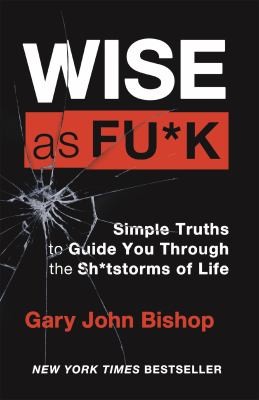
Stop Doing That Sht
≈ From memoryHappiness is not a destination to be reached by changing your circumstances; it is a byproduct of changing your internal narrative and the way you relate to your own thoughts.
In one sentence
You are not your thoughts; you are the observer of your thoughts, and true freedom comes from realizing that you can choose which thoughts to believe and which actions to take.
Why read this (and who it's for)
Most people approach happiness as a problem of external circumstances: "If I had more money, a better job, or a thinner body, I would be happy." Bishop argues this is a fundamental category error. This book is for the chronic overthinker, the perfectionist, and the person who feels "stuck" in a loop of self-criticism. After reading this, you will be able to identify the "inner critic" as a separate entity from your true self and develop a toolkit to stop the self-sabotaging mental loops that keep you miserable.
The big idea
The central thesis of Stop Doing That Sht* is that our suffering is largely self-inflicted through a process of "mental labeling" and "narrative construction." We take a neutral event, layer it with a story (usually a negative one), and then react to that story as if it were an objective reality. This creates a feedback loop where our emotions reinforce our beliefs, and our beliefs dictate our behaviors.
Bishop argues that we are not "broken" people who need to be fixed; we are people who have developed habitual ways of thinking that are no longer serving us. To find happiness, you must stop trying to "fix" your life and start dismantling the internal architecture of your self-judgment. You must move from being a victim of your internal monologue to being the conscious architect of your internal environment.
Key ideas
The Narrative Fallacy
What it is — We are storytelling animals who constantly interpret our experiences into a cohesive narrative. While useful for making sense of the world, this often leads us to create "scripts" for our lives that are rooted in past failures or imagined futures. Why it matters — If you believe the story that "I am a failure," your brain will actively seek out evidence to support that claim while ignoring evidence to the contrary. In the book — Bishop explains how we take a single data point (like a rejected application) and turn it into a global identity ( "I am unworthy"), which then dictates how we behave in the next opportunity.
The Observer Effect
What it is — The realization that there is a "you" that hears your thoughts. You are not the voice in your head; you are the consciousness that perceives the voice. Why it matters — When you realize you are the observer, you create a "gap" between the thought and the reaction. In that gap lies your freedom to choose a different response. In the book — He emphasizes that just because you think a thought doesn't mean it's true. You can observe a thought like a cloud passing in the sky without having to "own" it.
The Trap of "Should"
What it is — We often torture ourselves with a list of "shoulds": I should be further along, I should be thinner, I should be more social. These are often externalized pressures masquerading as internal desires. Why it matters — "Should" creates a constant state of friction between who you are and who you think you ought to be. It fuels the inner critic and creates a perpetual sense of inadequacy. In the book — Bishop highlights how we use "should" to shame ourselves into action, but shame is a terrible fuel; it eventually burns out the very motivation it seeks to create.
Cognitive Friction
What it is — The mental energy wasted on internal conflict, such as trying to force yourself to do something you don't want to do or criticizing yourself for not doing it. Why it matters — This friction drains your battery. When you spend all your energy fighting yourself, you have no energy left to actually engage with the world or pursue your goals. In the book — He describes this as a "mental tug-of-war" where you are both sides of the rope, and the only way to win is to drop the rope.
The Power of Choice
What it is — The fundamental truth that while you cannot control every external event, you have absolute agency over how you interpret those events and how you respond to them. Why it matters — This shifts the locus of control from the outside world to your internal response. It is the ultimate source of empowerment. In the book — Bishop argues that we often give away our power by believing that our feelings are "facts." They are not; they are reactions to interpretations.
Frameworks & tools
The Observer Framework
Use this when you feel overwhelmed by a negative emotion or a self-critical thought.
- Identify the Thought: Label the thought clearly (e.g., "I am thinking that I'm going to fail").
- Create Distance: Remind yourself: "I am the one noticing this thought."
- Observe without Judgment: Watch the thought like a stranger. Do not try to argue with it or "fix" it. Just notice it.
- Choose the Response: Ask yourself, "Given this thought, what is the most helpful action I can take right now?"
The "Drop the Rope" Technique
Use this when you find yourself in a cycle of self-criticism or "shoulding."
- Recognize the Conflict: Notice when you are trying to force a behavior through shame or self-punishment.
- Identify the "Should": What is the rule you are trying to enforce on yourself?
- Release the Pressure: Explicitly tell yourself, "I am dropping the rope." Stop trying to force the change for a moment.
- Focus on Action: Instead of focusing on the feeling of being "not enough," ask: "What is one tiny, manageable action I can take right now?"
Memorable examples & stories
The "Failure" Narrative
Bishop describes a person who fails at a task and immediately labels themselves as a "failure." The lesson is that the event (the failure) is a data point, not a definition of identity.
The Inner Critic as a Character
The author frames the inner critic as a separate entity—a "bully" or a "harsh coach." By externalizing this voice, you can begin to treat it with less authority. The lesson is that you don't have to obey every voice in your head.
The "Should" Trap
He illustrates how we create a "perfect" version of ourselves that doesn't exist, and then we suffer because we can't live up to that impossible standard. The lesson is that perfection is a barrier to progress.
Key quotes
"You are not your thoughts. You are the observer of your thoughts." Why it matters: This is the foundational shift required to stop the cycle of self-judgment.
"The problem is not the thought itself; it's the story you tell yourself about the thought." (Paraphrased) Why it matters: It highlights that our suffering comes from our interpretation, not the raw data of our experience.
"Stop trying to be 'better.' Start being more aware of what you are doing right now." (Paraphrased) Why it matters: It moves the focus from a distant, idealized goal to the immediate, actionable present.
How to apply it
This week
- The Thought Labeling Experiment: Every time you have a self-critical thought (e.g., "I'm so stupid for forgetting that"), immediately rephrase it as "I am having the thought that I am stupid." Do this at least 10 times a day.
- The "Should" Audit: Write down three things you feel you "should" be doing. For each, ask: "Who told me I should do this? Is this actually my value, or someone else's expectation?"
- The 5-Minute Awareness Break: Set a timer for 5 minutes. Sit quietly and simply observe what thoughts come up. Do not try to change them; just watch them like clouds.
Ongoing
- Practice the Observer Role: Whenever you feel a strong emotion (anger, anxiety, guilt), pause and ask: "What story am I telling myself about this situation?"
- Drop the Rope: When you feel yourself spiraling into "I should be doing X," stop. Take a breath. Drop the internal pressure. Then, ask yourself what the smallest possible step forward is.
- Value-Based Action: Instead of focusing on "fixing" your personality, focus on acting in alignment with your values. If you value "kindness," ask: "How can I be kind in this moment?" rather than "How can I be a kinder person?"
Common pitfalls
- The "Self-Help" Trap: A common mistake is trying to use this book as another "to-do" list. If you try to "perfectly" practice these techniques, you are just creating a new "should" and a new inner critic. The goal is awareness, not perfection.
- Over-Intellectualizing: It is easy to understand the concept of the Observer Effect while still reacting emotionally to your thoughts. You must practice the "muscle" of observation daily to make it stick.
- Expecting Instant Results: The internal narrative is built over years; it won't vanish in a week of reading. Consistency in noticing your thoughts is the only way to rewire the brain's habitual paths.
Connects to
- "The Untethered Soul" by Michael Singer: Extends the idea of the "observer" and how to transcend the ego's constant chatter.
- "Mindfulness Anxiety Relief" by Jonica Davis: Provides more structured mindfulness techniques to achieve the "observer" state Bishop describes.
- Cognitive Behavioral Therapy (CBT): The underlying psychological framework for identifying and challenging distorted thought patterns.
If you remember only three things
- You are the observer of your thoughts, not the thoughts themselves.
- Your suffering comes from the stories you tell yourself about your experiences, not the experiences themselves.
- Stop trying to "fix" yourself through shame; instead, practice awareness and take small, value-aligned actions.
Internalize it
-
Reflection questions
- What is the most frequent "story" my inner critic tells me about my abilities?
- If I stopped believing the "shoulds" I've placed on myself, what would I actually want to do today?
- Can I identify a moment today where I reacted to a thought rather than to reality?
- How would my day change if I viewed my thoughts as "mental weather" rather than "moral facts"?
-
Flashcards Q: What is the "Observer" in Bishop's framework? A: The awareness that perceives your thoughts; the realization that you are not the voice in your head. Q: Why is the "Should" trap so damaging? A: Because it creates a constant state of friction between your current reality and an impossible, idealized standard. Q: What is the difference between a thought and a fact? A: A thought is a mental interpretation; a fact is a piece of data. We suffer when we treat interpretations as facts. Q: What does it mean to "Drop the Rope"? A: To stop the internal tug-of-war of trying to force yourself to change through shame or self-criticism. Q: How does the "Narrative Fallacy" affect our behavior? A: It creates a script (e.g., "I am a failure") that causes us to seek out confirming evidence and ignore contradictory data. Q: What is the primary goal of the book? A: To move from being a victim of your internal narrative to being a conscious observer and actor in your own life.
Fidelity note
I have a high level of confidence in the core philosophical pillars of this summary (the Observer, the Narrative, and the "Should" traps). Bishop’s work is heavily rooted in mindfulness and cognitive behavioral principles. However, because this is a summary of a self-help/philosophy book, some of the specific "flavor" of his anecdotes may be generalized in this summary to ensure the core concepts are internalized. Readers should verify specific personal stories if they are looking for his exact anecdotal style.