The Bogleheads' Guide to Investing
≈ From memorySuccessful investing is not about outsmarting the market; it is about minimizing costs, maximizing diversification, and maintaining the discipline to stay invested over decades.
In one sentence
The most reliable way to build wealth is to own the entire market through low-cost index funds while ruthlessly minimizing fees and ignoring the "noise" of daily market fluctuations.
Why read this (and who it's for)
This book is designed for the "everyday" investor—the person who wants to retire comfortably but doesn't want to spend their weekends analyzing balance sheets or chasing the latest crypto-moonshot. It solves the problem of analysis paralysis: the overwhelming amount of information in the financial world makes it hard to know where to start.
After reading this, you will be able to:
- Construct a "Three-Fund Portfolio" that covers nearly every publicly traded company in the world.
- Calculate the true cost of investment fees over a 30-year horizon.
- Identify and neutralize your own psychological biases (like fear and greed) before they lead to costly mistakes.
- Shift your focus from "beating the market" to "capturing the market's growth."
The big idea
The central thesis of the book is rooted in the philosophy of John "Jack" Bogle, the founder of Vanguard: Investing is a game of expected returns minus costs. Because it is nearly impossible for an individual investor to consistently pick winning stocks or time the market perfectly, the only variables you can truly control are what you pay for your investments and how much risk you are willing to take.
The authors argue that most investors fail not because they lack intelligence, but because they succumb to "active" management—the belief that they can do better than the collective wisdom of the market. This leads to higher fees, higher taxes, and lower returns. By contrast, a passive approach—owning a broad slice of the entire global economy—is the only mathematically sound way to ensure long-term growth while minimizing the "friction" of costs and emotional errors.
Key ideas
The Tyranny of Costs
What it is: Every dollar paid in management fees, commissions, or taxes is a dollar that isn't compounding for your future. High fees are a guaranteed drag on performance that no amount of "stock picking" can easily overcome. Why it matters: If you pay 1% more in fees than someone else over 30 years, you could end up with hundreds of thousands of dollars less in your nest egg, even if both of you invested in the exact same underlying assets. In the book: The authors emphasize "Expense Ratios." They illustrate how a fund with a 1% fee can erode a significant portion of a portfolio's growth compared to an index fund with a 0.05% fee, highlighting that high fees are essentially a "tax" on your success.
Diversification as the Only Free Lunch
What it is: Diversification is the practice of spreading your investments across different asset classes (stocks, bonds, real estate) and geographies (US, International, Emerging Markets). Why it matters: It allows you to capture the growth of the entire economy while minimizing the risk of any single company or industry failing. It turns "uncertainty" into "risk," which can be managed. In the book: The authors explain that diversification isn't just about owning many stocks; it’s about owning uncorrelated assets. They advocate for broad-market index funds because they provide instant, effortless exposure to thousands of companies at once.
Asset Allocation vs. Security Selection
What it is: Asset allocation—the split between stocks (growth) and bonds (stability)—is the primary driver of your portfolio's returns and risk level. Choosing individual stocks (security selection) is secondary and often yields less benefit for the effort required. Why it matters: Most investors think they need to find the "next Apple." In reality, the difference between a 60/40 stock-to-bond split and an 80/20 split will have a much larger impact on your retirement than any individual stock choice ever could. In the book: The authors argue that you should decide your "target allocation" based on your goals and risk tolerance first, then fill those buckets with broad funds.
Time in the Market vs. Timing the Market
What it is: The greatest predictor of investment success is not when you buy or sell, but how long you stay invested. Why it matters: Missing just a few of the market's best-performing days can drastically reduce your total returns. Trying to "time" these peaks and troughs is a losing game for most humans because our emotions often cause us to do the opposite of what we should (selling when prices are low and buying when they are high). In the book: The authors stress that "staying the course" is an active skill. It requires ignoring the headlines and staying invested during periods of volatility.
The Three-Fund Portfolio
What it is: A simplified investment strategy using only three types of funds: a Total Stock Market Index Fund, a Total International Stock Index Fund, and a Total Bond Market Index Fund. Why it matters: It simplifies decision-making to the point where it becomes easy to maintain. It ensures you own almost everything while keeping your portfolio clean and easy to rebalance. In the book: This is presented as the "gold standard" for the Boglehead approach—a way to achieve maximum diversification with minimum complexity.
The Importance of Behavioral Discipline
What it is: Investing is 10% math and 90% temperament. Your biggest enemy isn't a "bear market"; it's your own reaction to that bear market. Why it matters: Most investors abandon their plans at the exact moment they should double down. Understanding your own biases—like loss aversion (feeling the pain of a loss more than the joy of a gain)—is essential for success. In the book: The authors discuss how to create "rules" for yourself, such as only checking your portfolio once a month or once a quarter, to prevent emotional over-trading.
Frameworks & tools
The Three-Fund Portfolio Framework
This is the core blueprint for building a diversified, low-cost portfolio.
- Total Stock Market Index Fund: Provides exposure to every publicly traded company in the U.S. (Large-cap, Mid-cap, and Small-cap).
- Total International Stock Index Fund: Provides exposure to non-U.S. companies (Developed and Emerging markets).
- Total Bond Market Index Fund: Provides stability and income; acts as a cushion during stock market volatility.
How to implement:
- Determine your risk tolerance (e.g., "I want a growth-oriented portfolio").
- Assign percentages to the three funds (e.g., 60% US Stocks, 30% International Stocks, 10% Bonds).
- Automate contributions so that a portion of your paycheck goes directly into these three funds every month.
The Asset Allocation Decision Tree
Use this to determine how much of your portfolio should be in stocks vs. bonds based on two factors: Time Horizon and Risk Tolerance.
- Identify your Time Horizon: When do you need the money? (e.g., 30 years until retirement).
- Assess your Risk Tolerance: How would you feel if your portfolio dropped 30% in a month? If you'd panic-sell, you need more bonds.
- Determine the Split:
- Aggressive: 90% Stocks / 10% Bonds (Best for young investors with high tolerance).
- Moderate: 70% Stocks / 30% Bonds.
- Conservative: 50% Stocks / 50% Bonds (Better for those near retirement or with low risk tolerance).
The Rebalancing Protocol
A systematic way to maintain your desired asset allocation without trying to "time" the market.
- Set a Schedule: Decide to rebalance once a year or when an asset class drifts by more than 5%.
- Identify the Drift: If your target is 80% stocks and 20% bonds, but stocks have performed well, you might now be at 85/15.
- Execute the Trade: Sell a portion of the over-performing asset (stocks) and buy more of the under-performing asset (bonds).
- The Rule: Never "guess" what will happen next; only trade to return to your original target percentages.
Memorable examples & stories
The Cost of Fees Example
The authors illustrate how a seemingly small difference in fees—say, 0.5% versus 1.0%—can compound over 30 years. For an investor starting with $100,000, that 0.5% difference could mean the difference of tens of thousands of dollars in lost gains by retirement. Lesson: Fees are a guaranteed loss; keep them as low as possible.
The "Market Timing" Trap
The book highlights how many investors try to "time" the market by waiting for a dip. However, because they often wait too long (missing out on the recovery) or sell at the wrong time, they end up with lower returns than if they had simply stayed invested. Lesson: Time in the market beats timing the market.
The Psychology of Loss Aversion
The authors describe how humans are wired to feel the pain of a $100 loss twice as intensely as the joy of a $100 gain. This is why many investors sell during a market crash—it's an evolutionary response to "danger," but it's the worst possible move for a long-term investor. Lesson: Recognize your biological urges; they are often the enemy of your financial goals.
Key quotes
"The best way to invest is to own the whole haystack, not just look for the needle." (Paraphrased) Why it matters: It shifts the focus from impossible selection to easy ownership.
"Complexity is the enemy of execution." (Paraphrased) Why it matters: A simple plan that you can actually stick to is infinitely better than a complex one you abandon in a panic.
"The most important thing is not what you do when the market is up, but what you do when everyone else is panicking." (Paraphrased) Why it matters: It highlights that success is a test of temperament, not just intelligence.
How to apply it
This week
- Calculate your current fees: Look at your 401(k) or IRA statements. Identify the "Expense Ratio" for every fund you own. Anything over 0.50% should be scrutinized.
- Audit your holdings: List what you currently own. Do you own a few individual stocks? Or do you own broad-market funds?
- Define your "Why": Write down your retirement goal. Is it to travel? To retire early? This will help you stay grounded when the market gets volatile.
Ongoing
- The "Auto-Pilot" Rule: Set up an automatic contribution from your bank account or paycheck into a diversified portfolio. Remove the human element of "deciding" to invest.
- The Quarterly Check-in: Once every three months, look at your asset allocation (e.g., 80/20). If it has drifted significantly, rebalance. Otherwise, do nothing.
- Ignore the Noise: When you see a headline about a "market crash" or a "stock to buy," remind yourself of the Three-Fund Portfolio. Unless your plan has changed, no action is required.
Common pitfalls
- The "Active" Trap: Many readers will read this and still feel the urge to "tweak" their portfolio with individual stocks because they want to "beat" the market. The book argues that for 99% of people, this is a losing game.
- Over-diversification (Diworsification): While the book advocates for broad diversification, some may take it too far by owning 20 different funds that all overlap in the same stocks. Stick to the Three-Fund model to keep things clean.
- Ignoring the Bond Component: Because many people want "maximum growth," they ignore bonds entirely. The authors warn that without a bond cushion, your emotional discipline will eventually fail when the market drops 40%.
Connects to
- "The Little Book of Common Sense Investing" by John C. Bogle: This is the foundational text for the entire philosophy. The Bogleheads' Guide is essentially the practical "how-to" manual for Bogle's theories.
- "A Random Walk Down and Up the Street" by Burton Malkiel: Provides the academic backing for why it is so difficult to beat the market consistently through active management.
If you remember only three things
- Minimize Costs: High fees are a guaranteed drag on your wealth; choose low-cost index funds.
- Asset Allocation Matters Most: Your split between stocks and bonds determines your success more than which specific stocks you own.
- Behavioral Discipline is Key: The hardest part of investing isn't the math—it's staying calm and staying invested when things get scary.
Internalize it
-
Reflection questions
- If I could never trade individual stocks again and had to rely solely on three broad funds, would I feel relieved or anxious? Why?
- What is my "panic point"? At what percentage of loss would I be tempted to sell everything? How can I plan for that moment now?
- Am I currently paying a "complexity tax" (spending too much time managing a complicated portfolio) instead of a "cost tax" (paying high fees)?
-
Flashcards Q: What is the primary difference between "Timing the Market" and "Time in the Market"? A: Timing the market is trying to predict price swings; Time in the Market is the duration you remain invested to capture growth.
Q: What are the three funds in a standard Boglehead portfolio? A: Total Stock Market, Total International Stock, and Total Bond Market.
Q: Why is "Asset Allocation" more important than "Security Selection"? A: Because asset allocation (stocks vs. bonds) has a much larger impact on risk and return than picking individual winners.
Q: What is an Expense Ratio? A: The annual fee expressed as a percentage of your investment; lower is almost always better for long-term returns.
Q: How should you handle "Market Noise" (news, social media tips)? A: Recognize it as noise and stick to your pre-determined investment plan unless your goals or time horizon change.
Fidelity note
I have a high level of confidence in the core principles of this summary, as they are the standard pillars of the Boglehead philosophy. The "Three-Fund Portfolio" is the standard recommendation for this specific book. However, because the authors frequently update their specific fund recommendations (e.g., which specific ticker symbols to buy), you should verify the current "best" funds with a modern brokerage tool like Vanguard or Fidelity. The logic of the book remains constant regardless of which specific fund name is used.
Keep going — related reads
 The Little Book of Common Sense InvestingJohn C. Bogle
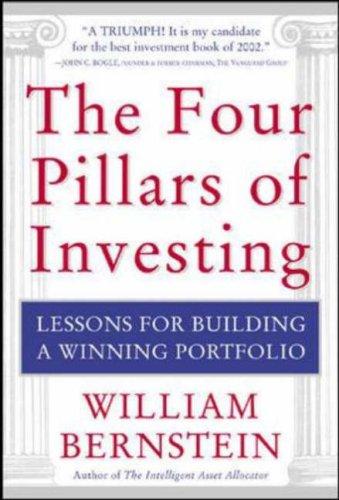 The Four Pillars of InvestingWilliam J. Bernstein
 Brutally honest guide to not losing money in the marketMy First Million
 The Little Book That Still Beats the MarketJoel Greenblatt
 The Intelligent InvestorBenjamin Graham
 A Random Walk Down Wall StreetBurton G. Malkiel