Being Me, Loving You
≈ From memoryTrue connection is only possible when we stop trying to manipulate others' behavior and instead focus on expressing our own needs and hearing the needs of others.
In one sentence
Human conflict arises not from personality clashes, but from unmet needs and the "tragic" habit of using manipulative tactics to get those needs met.
Why read this (and who it's for)
This book is for anyone who feels exhausted by repetitive, circular arguments with partners, children, or coworkers. It solves the problem of "reactive" communication—where we respond to what people do rather than what they need. After reading, you will be able to identify the underlying needs behind any accusation and communicate your own feelings without triggering defensiveness in others.
The big idea
Rosenberg argues that our primary human problem is a lack of "emotional literacy." We have been conditioned to believe that the way to get what we want is to influence, coerce, punish, or manipulate the people around us. While these tactics might work in the short term (getting a child to stop crying or a boss to give a raise), they fail to address the underlying needs, leading to a cycle of resentment and "tragic" expressions of feelings.
The core logic is this: Every behavior is an attempt to meet a need. When we see someone acting out—shouting, withdrawing, or being sarcastic—we should see it as a "tragic" expression of a desperate need. The goal of Nonviolent Communication (NVC) is to shift from judgment (labeling people as "mean" or "lazy") to observation (identifying the needs and feelings involved). By identifying our own needs and the needs of others, we create a space for "connection" rather than "control."
Key ideas
The Four Components of Nonviolent Communication
What it is — NVC is built on four pillars: Observations (not evaluations), Feelings (not interpretations), Needs (the universal human requirements), and Requests (clear, actionable asks). Why it matters — Most of our communication is "evaluation" disguised as "observation." When we say "You're always late," we are judging. When we say "You arrived 20 minutes after our agreed time," we are observing. Only the latter allows for a productive conversation. In the book — Rosenberg illustrates how "You're being selfish" is an evaluation, whereas "I feel lonely when you spend the evening alone" is an expression of a feeling and a need.
The Tragedy of Manipulative Communication
What it is — Manipulation is any attempt to influence another person's feelings or behavior for our own ends without expressing our own needs. This includes coercion, threats,ingratiation, and guilt-tripping. Why it matters — Manipulation is a "tragic" expression because it doesn't actually meet the needs of the other person; it only serves our immediate goal. It creates a "win-lose" dynamic that erodes intimacy. In the book — Rosenberg describes how "guilt-tripping" (e.g., "If you loved me, you'd do this") is a way to get a need met without actually stating what that need is.
Needs vs. Strategies
What it is — A "Need" is a universal human requirement (like safety, belonging, or autonomy). A "Strategy" is the specific action we take to meet that need. Why it matters — We often argue about strategies (e.g., "You should do the dishes this way") instead of needs (e.g., "I need to feel supported"). When we identify the need, we open the door to a thousand different strategies. In the book — Rosenberg explains that "I need you to do the dishes" is a strategy, not a need. The need is "order" or "contribution."
The Difference Between Feelings and Thoughts
What it is — Feelings are internal physical sensations (heavy, tight, light, energized). Thoughts are interpretations of the world (I'm being ignored, they are being mean). Why it matters — When we say "I feel ignored," we are actually reporting a thought about what someone else is doing. When we say "I feel lonely," we are expressing a feeling. Only the latter allows for genuine connection. In the book — Rosenberg emphasizes that "I feel like you're attacking me" is a thought, not a feeling. A feeling would be "I feel hurt" or "I feel scared."
Empathic Listening
What it is — Empathic listening is the act of listening to the needs and feelings of the other person without trying to fix them, judge them, or offer advice. Why it matters — Most people listen to respond or to fix. Empathic listening creates a "holding space" where the other person feels truly heard, which is often the very thing they need to calm their nervous system. In the book — Rosenberg describes this as "hearing the needs behind the words." It involves identifying the "tragic" expression of a need in the other person's words.
Frameworks & tools
The NVC Four-Step Expression
Use this whenever you feel the urge to complain, criticize, or react to someone's behavior.
- Observation: Describe the specific behavior without any adjectives or "you always/never" statements.
- Instead of: "You're so messy."
- Say: "I see that the dishes have been in the sink for three days."
- Feeling: State how you feel in that moment. Avoid "I feel like..." or "I feel that..."
- Instead of: "I feel like you don't care."
- Say: "I feel frustrated and overwhelmed."
- Need: Identify the universal human need behind your feeling.
- Example: "...because I need order and predictability in our shared space."
- Request: Ask for a specific, positive action. Avoid "Don't" or "Stop."
- Instead of: "Stop being lazy."
- Say: "Would you be willing to put the dishes in the dishwasher before 8:00 PM tonight?"
The Empathy Loop (For Listening)
When someone is expressing anger or frustration, use this to de-escalate.
- Listen for the "Tragic" Expression: When they say something hurtful, ask yourself: "What need is being met by this expression?"
- Identify the Feeling: What is the emotion they are experiencing? (Sadness, fear, anger, exhaustion?)
- Identify the Need: What universal human need is behind that feeling? (Respect, safety, connection?)
- Reflect Back: State what you heard without judging.
- Example: "It sounds like you're feeling really frustrated because you need more support with the kids right now. Is that right?"
Memorable examples & stories
The "Mean" Child
Rosenberg describes a child who is throwing a tantrum. Instead of seeing a "bad" child, the parent learns to see a child whose need for autonomy or expression is not being met. Lesson: Behavior is a form of communication; the "problem" is the unmet need, not the child's character.
The "Lazy" Spouse
A common scenario where one partner accuses the other of not helping enough. Rosenberg breaks this down: The accuser needs contribution and partnership. The accused feels criticized and inadequate. By identifying these, they can stop the "blame game" and talk about how to actually share the load. Lesson: Criticism is a "tragic" expression of a need for help.
The "Aggressive" Coworker
A story of a colleague who snaps at a teammate. Instead of reacting defensively, the listener identifies that the coworker might be feeling overwhelmed and needs clarity or prioritization. Lesson: Empathy is a tool for self-regulation; when you see someone's need, it's harder to stay angry at them.
Key quotes
"All human beings are expressing and listening to needs." (Paraphrased) Why it matters: This is the foundational shift from seeing people as "good/bad" to seeing them as "needy."
"When we express our needs clearly, we are less likely to be misunderstood." (Paraphrased) Why it matters: Clarity is the antidote to the "mind-reading" that causes so much domestic friction.
"Empathy is the ability to hear the needs behind the words." (Paraphrased) Why it matters: It shifts the goal of communication from 'winning' to 'understanding.'
How to apply it
This week
- The "No-Judgment" Observation: For one day, whenever you feel annoyed by someone, stop yourself from saying "You're being [adjective]." Instead, say to yourself, "I see [specific action]."
- The Feeling Audit: When you feel a "ping" of irritation, stop and name the feeling. Is it anger? Fear? Disappointment? Frustration? Identify the feeling word, not the thought ("I feel like you're ignoring me").
- The Need Identification: When you are upset, ask yourself: "What is the need I'm trying to meet right now?" (Is it respect? Safety? Connection? Ease?)
Ongoing
- The "Request" Rule: Never give a command or a "don't." Always ask for a specific, doable action. Instead of "Clean this up," try "Would you be willing to clear the table?"
- The Empathy Pause: Before reacting to a criticism, pause and ask: "What is this person's need that is being expressed through this angry words?"
Common pitfalls
- The "Soft" Trap: People often think NVC means being a "doormat." It is not. It is about being clear about your needs. You can be firm and say "No" while still being non-violent.
- The "Analysis" Trap: Don't get so caught up in the "technique" of identifying needs that you forget to actually connect with the person. The goal is connection, not a perfect linguistic formula.
- The "I Feel" Fallacy: Many people still say "I feel like you're being mean." This is still a thought. You must strip away the "that" or "like" to get to the actual feeling (e.g., "I feel hurt").
Connects to
- "Nonviolent Communication" by Marshall Rosenberg: The foundational textbook that provides the deep theory and more exhaustive exercises for this specific methodology.
- "Emotional Intelligence" by Daniel Goleman: Provides the broader psychological framework of self-awareness and social skills that NVC puts into practice.
- "Active Listening" (Carl Rogers): The precursor to empathic listening, focusing on the "unconditional positive regard" that allows NVC to function.
If you remember only three things
- Every behavior is an attempt to meet a need.
- Stop judging (evaluating) and start observing.
- Express your feelings and needs clearly, and listen for the needs of others.
Internalize it
-
Reflection questions
- When was the last time I accused someone of being "lazy" or "selfish"? What was the actual need I was trying to express in that moment?
- How would my conversation with my partner/boss change if I stopped using "You" statements (You did this, You made me feel...) and started using "I" statements (I feel... because I need...)?
- Can I identify three "needs" I have that are currently being ignored? (e.g., I need rest, I need creative expression, I need appreciation).
-
Flashcards Q: What is the difference between an observation and an evaluation? A: An observation is a factual description of behavior (e.g., "The dishes are in the sink"). An evaluation is a judgment or label (e.g., "You are messy").
Q: What are the four components of NVC? A: Observation, Feeling, Need, and Request.
Q: Why is "I feel like you're ignoring me" considered a thought rather than a feeling? A: Because it contains an interpretation of someone else's behavior. A feeling would be "I feel lonely" or "I feel hurt."
Q: What is a "tragic" expression? A: A behavior that tries to meet a need through manipulation, coercion, or punishment rather than clear communication.
Q: What is the difference between a Need and a Strategy? A: A Need is a universal human requirement (e.g., "I need respect"). A Strategy is a specific action to meet that need (e.g., "I need you to say thank you").
Q: How do you turn a criticism into a request? A: Identify the feeling and the need behind the criticism, then ask for a specific, positive action (e.g., "Would you be willing to...").
Fidelity note
This summary is based on the core principles of Marshall Rosenberg's Nonviolent Communication (NVC) as presented in Being Me, Loving You. I am highly confident in the four-step model (Observation, Feeling, Need, Request) and the distinction between Needs and Strategies. The specific "tragic" terminology is a hallmark of Rosenberg's work. Readers should verify the specific "Feelings vs. Thoughts" list in the book, as Rosenberg provides a very specific taxonomy of feelings to help readers avoid "pseudo-feelings" (interpretations of others' behavior).
More from Marshall B. Rosenberg
 Nonviolent CommunicationMarshall B. Rosenberg
 Practical SpiritualityMarshall B. Rosenberg
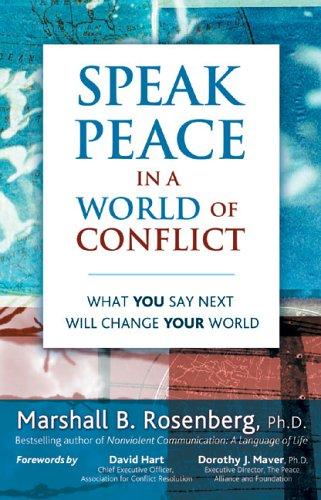 Speak Peace in a World of ConflictMarshall B. Rosenberg
 Speaking PeaceMarshall B. Rosenberg
 Teaching Children CompassionatelyMarshall B. Rosenberg
 The Surprising Purpose of Anger Beyond Anger ManagementMarshall B. Rosenberg
 We Can Work It OutMarshall B. Rosenberg