That's not what I meant!
≈ From memoryCommunication is not just about the words we say, but about the invisible social rules and 'cultural' codes we use to navigate relationships, manage identity, and establish status.
In one sentence
Communication is a complex system of social rules where the "content" of a message is often secondary to the "relational" purpose of the interaction.
Why read this (and who it's for)
Most people believe that if they just "say the right thing," they will be understood. Tannen argues that this is a fallacy: we often fail to communicate because we are playing by different rulebooks. This book is for anyone who feels frustrated by "misunderstandings" in their personal life, workplace, or across different cultures. After reading, you will stop viewing communication as a simple transfer of data and start seeing it as a dance of social positioning.
The big idea
The central thesis of That's not what I meant! is that communication is a social tool used to build and maintain relationships, not just to exchange information. Tannen argues that we use language to perform "social work": we use it to establish who we are, who the other person is, and what our relationship to each other is.
Because communication is so deeply rooted in our upbringing and cultural background, we often operate on "invisible" rules. When two people with different backgrounds (or even different personalities) interact, they may be using the same words but applying different rules. For example, one person might see a joke as a way to build rapport, while the other sees it as a violation of professional boundaries. The "misunderstanding" isn't a failure of vocabulary; it's a clash of underlying social scripts.
To master communication, you must stop looking at what was said and start looking at why it was said. Why did they choose that specific moment to bring this up? What status were they trying to claim? What "rule" were they trying to uphold? By identifying these hidden layers, you can navigate complex social environments with much higher precision.
Key ideas
The Difference Between Content and Relation
- What it is — Every interaction has a "content" level (the literal information) and a "relational" level (the social purpose).
- Why it matters — If you only listen to the content, you miss the point of the interaction. If a spouse asks, "Is that shirt clean?" they aren't asking for a laundry report; they are expressing a relational concern or a request for cooperation.
- In the book — Tannen explains how people often get angry when they "misinterpret" a request as a criticism, when the speaker was actually trying to establish a shared reality or a routine.
Communication as a Tool for Identity
- What it is — We use language to "construct" ourselves and others. We use words to signal who we are (e.g., "I'm a person who values punctuality").
- Why it matters — Understanding this helps you see why people get so defensive. They aren't just defending an idea; they are defending their identity as a "competent" or "kind" person.
- In the book — Tannen discusses how we use "self-presentation" to manage how others perceive us, often prioritizing the impression of competence over the actual demonstration of it.
The Role of "Rules" in Conversation
- What it is — Conversation is governed by unwritten rules (turn-taking, topic management, etc.) that we learn from our families and cultures.
- Why it matters — When someone "breaks" a rule, it feels like a personal affront. Recognizing that these are just learned rules helps you stay calm when someone behaves unexpectedly.
- In the book — Tannen highlights how different families have different "rules" for interrupting or for how much information is shared about private lives.
Cultural Context and Communication Styles
- What it is — Culture dictates the "rules of engagement" for communication, including how we handle conflict, hierarchy, and indirectness.
- Why it matters — This explains why "direct" communication can feel like an attack to some, while "indirect" communication can feel like manipulation to others.
- In the book — Tannen explores how different cultures (and even sub-cultures) vary in their use of "high-context" (implied) vs. "low-context" (explicit) communication.
The Importance of Context
- What it is — The meaning of a word or gesture is entirely dependent on the physical, social, and temporal context in which it occurs.
- Why it matters — You cannot judge a message in a vacuum. To understand a "misunderstanding," you must look at the environment: Who was there? What was the history of the relationship? , In the book — Tannen argues that "the same words can mean different things in different contexts," and we often fail because we assume our context is universal.
Frameworks & tools
The Relational Analysis Framework
When a communication breakdown occurs, stop trying to "fix" the words. Instead, analyze the interaction using these three lenses:
- The Content: What was the literal information being shared? (e.g., "The door is open.")
- The Relation: What was the social goal? (e.g., "I'm annoyed that you left it open," or "I'm trying to show you where the door is.")
- The Identity: What was the speaker trying to say about themselves? (e.g., "I am a person who values a tidy house.")
The "Rule-Breaking" Diagnostic
Use this when someone reacts with unexpected anger or confusion to a simple statement:
- Identify the Rule: What rule did the listener think was being followed? (e.g., "We are just making small talk.")
- Identify the Violation: What did the speaker do that broke that rule? (e.g., "They brought up a deeply personal/heavy topic.")
- The Gap: The "misunderstanding" is the space between the rule the listener expected and the rule the speaker was actually following.
Memorable examples & stories
The "Laundry" Example
A spouse asks, "Is that shirt clean?" and the other responds with a defensive "Why are you judging me?" The first spouse isn't judging; they are trying to coordinate a household task. The second spouse hears a critique of their character. Lesson: We often hear "criticism" where there is only "coordination."
The "Expert" Identity
A person might over-explain a simple concept not because they want to teach, but because they want to be perceived as an authority. *Lesson: Communication is often about status and identity rather than the transfer of knowledge.
Cultural Directness
Tannen discusses how some cultures view "getting to the point" as efficient and honest, while others view it as rude and lacking in "relational" warmth. Lesson: "Politeness" is a cultural variable, not a universal constant.
Key quotes
"Communication is not just about the words we say, but about the social rules we use to navigate our relationships." (Paraphrased) Why it matters: It shifts the focus from vocabulary to social strategy.
"We use language to construct our identities and to define the identities of others." (Paraphrased) Why it matters: It explains why people get so protective of their "image" during conversations.
"Misunderstandings often occur because we are playing by different sets of rules." (Paraphrased) Why it matters: It removes the blame from the individual and places it on the conflicting "rulebooks."
How to apply it
This week
- The "Relation" Check: The next time someone says something that irritates you, stop. Ask yourself: "What was the relational goal of this message? What were they trying to achieve other than just giving me this information?"
- Identify your "Rules": Think of a recurring argument with a friend or colleague. Write down the "rule" you think they are breaking (e.g., "They shouldn't be so blunt"). Then, write down what rule you think they are trying to follow (e.g., "They are trying to be efficient").
Ongoing
- Contextual Awareness: Before responding to a heated email or text, pause and consider the "context" of the relationship. Is this person trying to be helpful, assertive, or protective?
- Identity Awareness: When you speak, ask yourself: "What identity am I trying to project right now? Am I trying to seem smart? Kind? Competent?"
Common pitfalls
- The "Mind Reading" Trap: Tannen does not suggest you can perfectly read minds. She suggests you can better understand the rules people are following. You still won't always know exactly what someone is thinking, but you will understand the type of social work they are trying to do.
- Over-Analyzing: Don't let this make you so analytical that you stop being spontaneous. The goal is to understand the "why" so you can communicate more effectively, not to become a laboratory scientist of every interaction.
- The "Perfect Communication" Myth: There is no such thing as perfect communication. There will always be some level of "noise" or misunderstanding. The goal is to reduce the friction of those misunderstandings.
Connects to
- "Crucial Conversations" (Grenny et al.): While Tannen focuses on the rules of communication, Crucial Conversations focuses on the skills for high-stakes dialogue.
- "How to Win Friends and Influence People" (Carnegie): Carnegie provides the "how-to" for social success; Tannen provides the "why" behind the social mechanics.
If you remember only three things
- Communication is a tool for relationship management, not just information exchange.
- We all have different "rulebooks" for conversation based on our upbringing and culture.
- To solve a misunderstanding, stop looking at the words and start looking at the social rules being violated.
Internalize it
-
Reflection questions
- When I get angry during a conversation, is it because of the content of what they said, or because I feel they violated a social rule?
- How does my family's "rule" for communication (e.g., "don't talk about feelings") affect how I interact with coworkers?
- In what ways do I use communication to "perform" a certain identity (e.g., the "busy" worker, the "chill" friend)?
-
Flashcards Q: What is the difference between "content" and "relation" in communication? A: Content is the literal information; Relation is the social purpose or goal of the interaction.
Q: Why do we often experience "misunderstandings" even when we use the same words? A: Because we are often operating under different, invisible "rules" of communication.
Q: How does Tannen define the purpose of communication? A: As a tool for "social work"—constructing identities, managing relationships, and establishing status.
Q: What is the "Rule-Breaking" Diagnostic? A: A way to analyze conflict by identifying the rule the listener expected, the rule the speaker actually followed, and the gap between them.
Q: Why is context so important in Tannen's theory? A: Because the meaning of any communication act is entirely dependent on the social, physical, and historical environment in which it occurs.
Fidelity note
I have a high level of confidence in the core concepts of this summary, specifically the distinction between content/relation and the idea of communication as "social work." Tannen's work is a staple in sociolinguistics. However, because this is a summary of a 1990 text, some of the specific cultural examples she uses may be dated. Readers should verify specific cultural comparisons (e.g., specific country-to-country comparisons) against the original text to ensure they are current.
More from Deborah Tannen
 Conversational styleDeborah Tannen
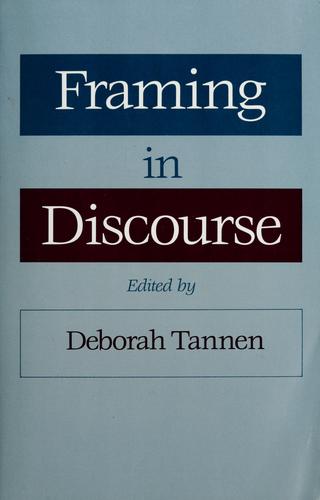 Framing in discourseDeborah Tannen
 Gender and conversational interactionDeborah Tannen
 Gender and discourseDeborah Tannen
 I Only Say This Because I Love YouDeborah Tannen
 Perspectives on silenceDeborah Tannen
 Talking from 9 to 5Deborah Tannen
 Talking voicesDeborah Tannen
 The argument cultureDeborah Tannen
 The Handbook of Discourse AnalysisDeborah Tannen
 You Just Don't UnderstandDeborah Tannen
 You were always mom's favoriteDeborah Tannen