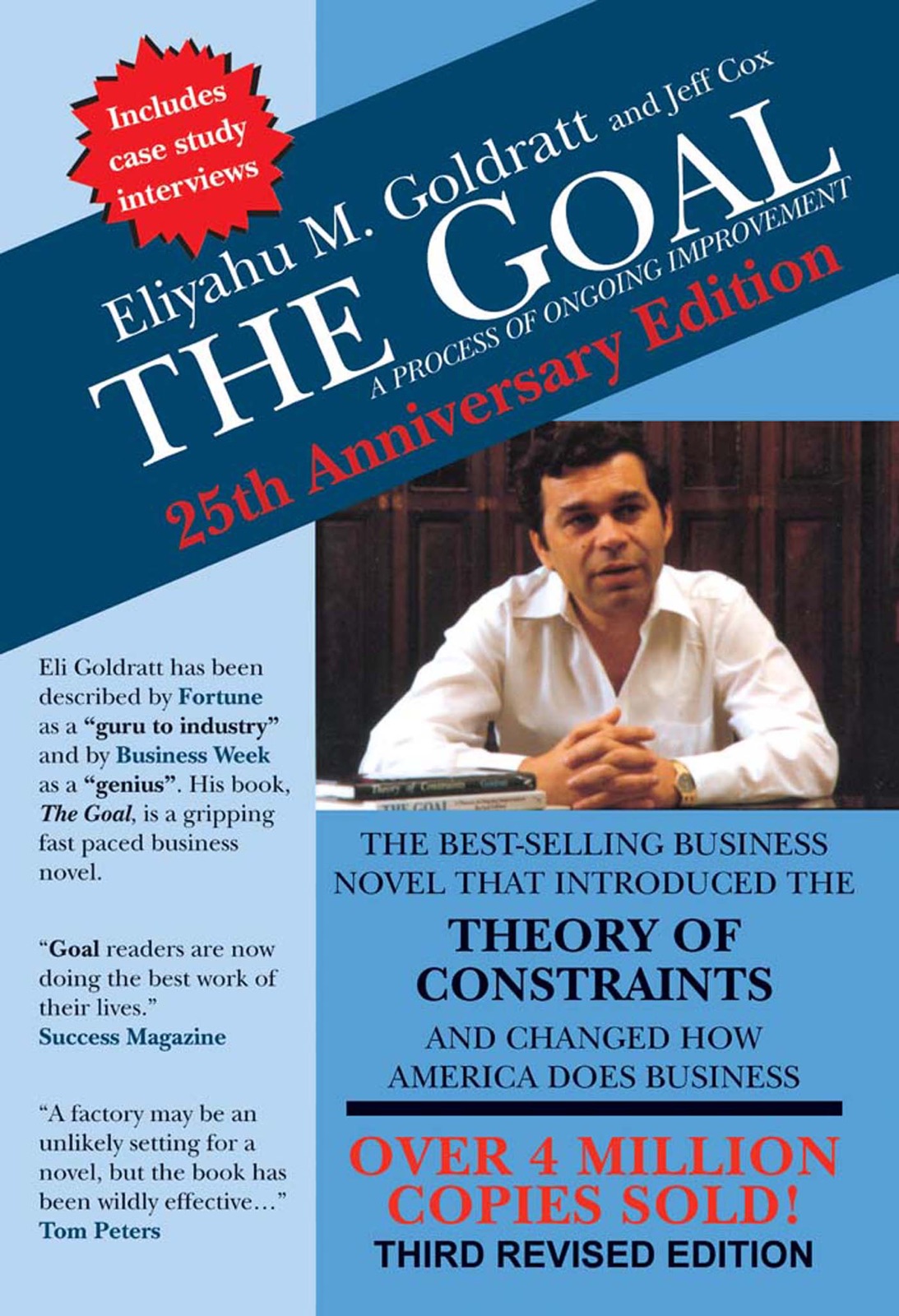
Theory of Constraints
≈ From memoryA system is only as strong as its weakest link; therefore, to increase total output, you must identify and manage the specific bottleneck that limits the entire flow.
In one sentence
The throughput of any complex system is determined solely by its constraints (bottlenecks), and any effort spent improving non-constraints is a waste of time and resources.
Why read this (and who it's for)
Most managers are taught to optimize every part of a process individually—increasing the speed of every machine, hiring more people for every department, and pushing for 100% utilization everywhere. Goldratt argues this is fundamentally flawed because it creates "hidden" waste.
This book is for Operations Managers, CEOs, and Project Leads who feel like they are working harder but seeing less output. After reading this, you will stop trying to "fix" everything and start identifying the one specific "choke point" that is actually holding back your revenue, and you will learn how to manage the flow of work around that point.
The big_idea
The central thesis of the Theory of Constraints (TOC) is that a system is not a collection of independent parts; it is a cohesive whole. In any manufacturing or service process, there is always one specific constraint (a machine, a person, a policy, or a market demand) that limits the system's total output. If you improve anything other than that constraint, the system's total output remains unchanged.
Goldratt uses the analogy of a chain: the strength of the chain is determined by its weakest link. If you strengthen a link that is already strong, the chain is not any stronger. To make the chain stronger, you must find the weakest link and reinforce it. In a business, this means identifying the "bottleneck" where work piles up.
The logic follows that "Local Optimization" is the enemy of "Global Throughput." If you make a machine run faster than the bottleneck can handle, you aren't increasing production; you are simply creating a pile of unfinished work (Work-in-Process, or WIP) that consumes space and capital without generating revenue. To succeed, you must manage the flow of the entire system, not the efficiency of individual components.
Key ideas
The Constraint (The Bottleneck)
- What it is — The specific resource or step in a process that limits the system's capacity. It is the "narrow" part of the pipe.
- Why it matters — If you don't know where your constraint is, you will waste resources optimizing parts of the system that don't actually contribute to the final output.
- In the book — Goldratt illustrates this with a factory where a machine is slower than the rest of the line. If you make the other machines run faster, the parts just pile up in front of the slow machine, creating a mess without increasing the number of finished goods.
Throughput vs. Inventory vs. Operating Expense
- What it is — Goldratt defines three metrics: Throughput (the rate at which the system generates money through sales), Inventory (all the money tied up in things waiting to be sold), and Operating Expense (all the money spent turning inventory into throughput).
- Why it matters — Traditional accounting often focuses on "efficiency" (lowering operating expenses). Goldratt argues that lowering expenses is useless if it decreases throughput or increases inventory. You must maximize Throughput while minimizing Inventory and Operating Expense.
- In the book — He argues that "efficiency" is often a trap. For example, keeping a machine running 100% of the time might seem efficient, but if that machine isn't the bottleneck, you are wasting electricity and labor to produce parts that will just sit in a warehouse.
Work-in-Process (WIP) as a Liability
- What it is — WIP is the "stuff" currently being worked on but not yet finished. Goldratt views WIP as a waste of money and a source of chaos.
- Why it matters — High WIP hides problems. When you have a mountain of unfinished work, it is impossible to see where the flow is actually breaking down. It also ties up cash and occupies physical space.
- In the book — He compares a factory with high WIP to a crowded highway. When there are too many cars on the road, everyone slows down, and the "flow" of traffic grinds to a halt.
The Goal of a System
- What it is — The only goal of a manufacturing or service business is to make money. Everything else (efficiency, employee happiness, machine utilization) is a means to that end.
- Why it matters — Most managers get distracted by "sub-goals" (like keeping everyone busy). If a sub-goal doesn't directly increase profit, it is a distraction.
- In the book — Goldratt challenges the reader to ask: "Does this action help us make more money?" If the answer is no, it is a waste of time, even if it looks like "productive" work.
The Five Focusing Steps
- What it is — A systematic methodology for identifying and managing constraints: 1. Identify, 2. Exploit, 3. Subordinate, 4. Elevate, 5. Repeat.
- Why it matters — It provides a roadmap for continuous improvement. It prevents you from making "permanent" changes to things that are only temporary constraints.
- In the book — This is the core operational framework of the book, moving from identifying a bottleneck to fundamentally changing the system's capacity.
Frameworks & tools
The Five Focusing Steps
Use this 5-step process to systematically improve any process (manufacturing, software development, project management, etc.).
- Identify: Find the bottleneck. Where is the work piling up? Where is the longest queue? Where is the "waiting" happening?
- Exploit: Ensure the bottleneck is never idle. Don't let the bottleneck "waste" time. (e.g., Don't let a bottleneck machine sit idle during a lunch break; ensure it only works on high-priority, "perfect" parts).
- Subordinate: Align everything else to the bottleneck. Do not let non-bottlenecks produce more than the bottleneck can handle. This means intentionally slowing down some parts of the process to ensure the bottleneck is never overwhelmed.
- Elevate: If the bottleneck still exists after steps 2 and 3, invest in more capacity (buy a new machine, hire a new person, add a new shift).
- Repeat: Once the constraint is broken, a new one will appear. Go back to Step 1.
The Throughput Equation
When evaluating any business decision, use this mental filter:
- Throughput: How much money is coming in from sales?
- Inventory: How much money is tied up in "unfinished" work/goods?
- Operating Expense: How much money is spent to turn Inventory into Throughput?
- Rule: Only make decisions that increase Throughput while minimizing Inventory and Operating Expense.
Memorable examples & stories
The Factory Floor (The "Aha!" Moment)
Goldratt describes a factory where a machine is the bottleneck. The manager tries to make the other machines run faster to "increase production." Instead, the parts just pile up in front of the slow machine. Lesson: Speeding up a non-bottleneck does not increase output; it only increases inventory.
The Highway Analogy
Goldratt compares a production line to a highway. When a highway is over-congested with cars (WIP), the flow of traffic slows down for everyone. Lesson: Too much work-in-process creates "friction" and slows down the entire system.
The "Lunch Break" Rule
Goldratt points out that if a machine is the bottleneck, it should never stop. Even during lunch breaks, the machine should be running (with a human operator taking a break elsewhere). Lesson: Exploiting the constraint means ensuring 100% "up-time" for the bottleneck.
Key quotes
- "An hour lost at working on a bottleneck is an hour lost for the entire system." (Paraphrased)
- Why it matters: It forces you to prioritize the bottleneck over any other task.
- "The goal of a system is to make money." (Paraphrased)
- Why it matters: It strips away the "vanity metrics" of management like 100% employee utilization.
- "Any investment in a non-constraint is a waste of resources." (Paraphrased)
- Why it matters: It provides the permission to stop "busy work" that doesn't move the needle.
How to apply it
This week
- Identify the "Pile": Walk through your office, warehouse, or digital workflow. Where is the work currently "piling up"? That is your bottleneck.
- Audit the Bottleneck: Look at the bottleneck and ask: "Is this resource being used to its full potential?" (e.g., Is the person/machine waiting for information? Is it being distracted by non-essential tasks?)
- Stop the "Over-production": Identify one area where you are producing more than the next step can handle. Stop that activity immediately to reduce WIP.
Ongoing
- The "Lunch Break" Rule: Ensure your bottleneck resource is never idle. If it's a person, ensure they are never waiting for a "clear" signal or a piece of data.
- WIP Limits: Set a hard cap on how many projects/tasks can be "In Progress" at once. Only allow new work to start when a current piece of work is finished.
- Throughput Focus: In every weekly meeting, ask: "Does this action increase our Throughput (sales/output) or just decrease our Operating Expense?"
Common pitfalls
- The "Efficiency" Trap: Many managers think "efficiency" means keeping everyone busy 100% of the time. In TOC, if a non-bottleneck is 100% busy, it might actually be hurting the system by creating a massive pile of WIP that the bottleneck can't handle.
- The "Temporary" Constraint: People often fail to realize that constraints change. A machine might be the bottleneck today, but a lack of raw materials might be the bottleneck tomorrow. You must constantly re-evaluate.
- The "Human" Factor: It can be psychologically difficult to tell people to "slow down" or "do less" to optimize the system. Managers must be brave enough to prioritize flow over "busy-ness."
Connects to
- The Lean Methodology (Toyota Production System): While Lean focuses on eliminating waste (Muda), TOC focuses on managing constraints. They are highly complementary; TOC tells you where to apply Lean principles.
- Theory of Queuing: This provides the mathematical foundation for why lines form and why "waiting" is the primary waste in any system.
If you remember only three things
- The system is only as fast as its slowest part.
- Focus on Throughput, not just "efficiency."
- Reduce Work-in-Process (WIP) to see the truth of your system's flow.
Internalize it
- Reflection questions
- Where is the "pile" in my current project? What is the specific bottleneck?
- Am I currently over-producing work that my team/system cannot handle?
- If I stopped doing one "busy" task today, would it actually improve the flow of the rest of the work?
- Flashcards
- Q: What is the primary goal of any business system?
- A: To make money.
- Q: What are the three metrics of TOC?
- A: Throughput, Inventory, and Operating Expense.
- Q: What is the difference between "Efficiency" and "Throughput"?
- A: Efficiency is often local (keeping a machine busy); Throughput is global (the rate at which the system generates money).
- Q: What is the "Subordinate" step in the 5 Focusing Steps?
- A: Aligning all non-bottlenecks to the pace of the bottleneck (don't let them produce more than the bottleneck can handle).
- Q: Why is high Work-in-Process (WIP) bad?
- A: It hides problems, ties up cash, and creates "friction" that slows down the entire system.
Fidelity note
This summary is grounded in the core principles of Goldratt's The Goal (the novelization) and Theory of Constraints. I am highly confident in the 5 Focusing Steps and the definitions of Throughput/Inventory/Operating Expense. The "Highway" and "Factory" analogies are the primary pedagogical tools used by Goldratt to explain these concepts. Readers should verify the specific "Five Focusing Steps" as they are the standard operational framework of the theory.