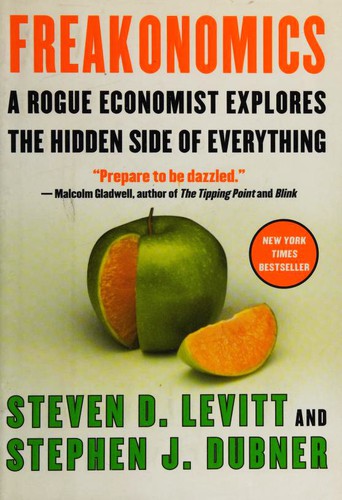
Think Like a Freak
≈ From memoryTo understand why people do what they do, you must stop looking at the 'rational' reasons they give and start looking at the incentives, biases, and hidden motivations that actually drive their behavior.
In one sentence
Human behavior is rarely driven by the noble, logical reasons people provide for their actions; instead, it is driven by hidden incentives, social pressures, and psychological quirks that we often ignore.
Why read this (and who it's for)
This book solves the "Why did they do that?" problem. Most people try to understand behavior by asking, "What was their logic?" Levitt argues that this is a flawed approach because humans are not perfectly rational actors.
This book is for:
- Decision-makers and leaders who want to understand why employees or customers behave in counter-intuitive ways.
- Marketers and entrepreneurs who want to design systems that actually influence human choice.
- Anyone interested in social science who wants to see the world through a "freakish" lens—looking for the hidden levers of human behavior.
After reading, you will be able to identify the "hidden" incentives in any system (a workplace, a household, a city) and predict behaviors that others would find surprising.
The big idea
The central thesis of Think Like a Freak is that we are terrible at predicting human behavior because we look for the wrong reasons. We assume people act out of a sense of duty, morality, or logic. Levitt argues that if you want to understand why someone did something, you must look for the incentives—the rewards and punishments—that were actually at play in that specific moment.
To "think like a freak" means to ignore the "common sense" explanations and instead look for the "weird" incentives. For example, if a person stays in a bad relationship, the "common sense" reason is that they love their partner. The "freak" reason might be that the social cost of a breakup is higher than the cost of staying. By identifying these hidden incentives, you can predict behavior with much higher accuracy and design better systems to achieve your goals.
Key ideas
The Incentive Principle
What it is — People respond to incentives, not to "good" intentions or abstract goals. If you want to change behavior, you must change the rewards and costs associated with that behavior. Why it matters — If you try to change behavior by appealing to someone's "better self" without changing the underlying incentives, you will almost always fail. In the book — Levitt discusses how "moral" appeals to reduce smoking often fail unless they are paired with economic incentives (like taxes or subsidies) because the immediate reward of the nicotine outweighs the abstract future cost of cancer.
The Power of Social Proof
What it is — Humans are social animals who look to others to determine what is acceptable behavior. We often do things not because we want to, but because we want to be seen as "normal." Why it matters — You can influence behavior by changing what the "norm" looks like. If you make a behavior look common, people will do it. In the book — Levitt highlights how "social norms" can be engineered. For example, if a building manager tells residents that "90% of neighbors recycle," people are more likely to recycle than if they are simply told "recycling is good."
The "Reason" Fallacy
What it is — The reasons people give for their actions are often "post-hoc" justifications. They aren't the cause of the action; they are the story they tell themselves to feel better about the action. Why it matters — If you believe the reasons people give, you will be blindsided when they act on their true incentives. In the book — Levitt explains that when people are asked why they did something, they often invent a narrative that aligns with their values, even if the actual driver was a hidden, selfish, or impulsive incentive.
The Importance of Friction
What it is — Behavior is often a function of how easy or hard it is to do something. If you want to stop a behavior, make it harder; if you want to encourage one, make it easier. Why it matters — Most people think they lack willpower, but often they just lack a "path of least resistance." In the book — Levitt discusses how "defaults" work. For example, people are much more likely to save for retirement if they are automatically enrolled in a plan (the default) than if they have to opt-in manually.
The Role of Identity
What it is — People act in ways that protect their self-image and their membership in a group. Why it matters — To change behavior, you sometimes have to change how a behavior is framed relative to a person's identity. In the book — Levitt explores how people will endure significant discomfort to maintain a certain identity, such as a "loyal" employee or a "dedicated" parent, even when the behavior no longer serves a practical purpose.
Frameworks & tools
The Incentive Audit
Use this to diagnose why a behavior (or lack thereof) is happening in any system.
- Identify the Target Behavior: What is the specific action you want to see (or stop)?
- Map the Current Incentives: What are the immediate rewards for doing it? What are the immediate costs? (Ignore the "shoulds" and "oughts").
- Identify the Friction: How many steps does it take to perform the behavior? Is there a "default" setting?
- Analyze the Social Pressure: What would happen if the person did the behavior (or didn't) in front of their peers?
- Redesign the Environment: Change the rewards, reduce the friction, or alter the social norm to align with the desired outcome.
The "Freak" Perspective Shift
When faced with a puzzling human behavior, run this mental checklist:
- The "Common Sense" Explanation: What is the "moral" or "logical" reason they gave? (Write this down).
- The "Freak" Explanation: What is the hidden incentive? What would they gain if they did this? What would they lose? Compare the two. The Freak explanation is usually the one that actually predicts the future.
Memorable examples & stories
The "Good" Employee Who Doesn't Work
Levitt discusses how some employees appear to be "lazy" but are actually responding to a system where they are rewarded for "looking busy" rather than for actual output. Lesson: If you reward the appearance of work, you will get the appearance of work.
The Neighborhood Recycling Norm
The study where people were told "most neighbors recycle" vs. "recycling is good." Lesson: Social norms are a more powerful motivator than moral pleas.
The Default Effect in Savings
How changing the "opt-out" to "opt-in" for 401(k) plans drastically changed participation rates. Lesson: Humans are inherently lazy; design for the path of least resistance.
Key quotes
"People do not do what they say they will do; they do what they are incentivized to do." (Paraphrased) Why it matters: This is the foundational rule of the book. It demands a shift from trusting words to analyzing systems.
"The reason people do things is rarely the reason they give for doing them." (Paraphrased) Why it matters: This warns us against taking human explanations at face value.
"To change behavior, you must change the environment, not just the person." (Paraphrased) Why it matters: It shifts the focus from "willpower" to "architecture."
How to apply it
This week
- The Friction Audit: Identify one thing you want to do more of (e.g., exercising) and one thing you want to do less of (e.g., scrolling social media). Identify the "friction" for each. Make the bad habit harder (put the phone in another room) and the good habit easier (lay out your gym clothes).
- The Incentive Audit: Observe a recurring problem at work or home. Instead of asking "Why are they being difficult?", ask "What incentive is this behavior currently satisfying?"
Ongoing
- Design for Defaults: Whenever you start a new habit, make it the "default." If you want to eat healthier, put the fruit bowl in the center of the table.
- The "Freak" Filter: Before making a judgment on someone's behavior, pause and ask: "What is the hidden incentive here?"
Common pitfalls
- Over-Engineering: A common mistake is trying to change everything at once. Start by identifying the single most powerful incentive.
- Ignoring Human Agency: While incentives are powerful, humans still have goals. The goal is to align the incentives with the right goals, not to manipulate people into doing things they hate for no reason.
- The "Nudge" Trap: Don't confuse "nudging" with "manipulation." Use these tools to help people achieve their own goals (like health or wealth) more easily, rather than just for profit.
Connects to
- Predictably Irrational by Dan Ariely (Explores the specific cognitive biases that make us "irrational").
- Nudge by Richard Thaler and Cass Sunstein (The foundational text on choice architecture).
- Thinking, Fast and Slow by Daniel Kahneman (The psychological foundation of why our brains take shortcuts).
If you remember only three things
- People act on incentives, not on "good" reasons.
- Social norms and defaults are more powerful than moral arguments.
- To change behavior, change the environment/incentives, not the person's willpower.
Internalize it
-
Reflection questions
- What is a behavior I've been frustrated by in someone else? What is the hidden incentive that makes that behavior "logical" for them?
- In my own life, what is one "good" habit I've failed to start? How can I make it the path of least resistance?
- Where am I currently giving myself a "bad" incentive (e.g., rewarding myself with junk food for finishing a hard task)?
-
Flashcards Q: What is the "Freak" way to look at human behavior? A: Look for the hidden incentives and social pressures rather than the "logical" reasons people give.
Q: Why do "defaults" work so well in behavioral economics? A: Because humans tend to take the path of least resistance; if a behavior is the default, people are less likely to expend the effort to change it.
Q: What is the difference between a "moral" plea and a "social" norm? A: A moral plea asks people to do something because it is "right"; a social norm tells people to do something because "everyone else is doing it."
Q: How does the "Reason Fallacy" affect our understanding of others? A: It means we often believe the stories people tell themselves to justify their actions, rather than seeing the actual incentives driving those actions.
Q: What is the primary tool for changing a behavior? A: Changing the incentives (rewards and costs) and the friction of the environment.