Feeling Good The New Mood Therapy
≈ From memoryYour emotions are not caused by external events, but by the internal interpretations of those events; by identifying and correcting distorted thinking patterns, you can fundamentally rewire your emotional response to life.
In one sentence
Depression and anxiety are maintained by "automatic" cognitive distortions—systematic errors in thinking that we mistake for facts—and they can be dismantled by identifying, challenging, and replacing these thoughts with objective reality.
Why read this (and who it's for)
Most people believe their feelings are a direct reaction to what happens to them: “I feel sad because my boss yelled at me.” David Burns argues that this is a fundamental misunderstanding of human psychology. The actual sequence is: Event $\rightarrow$ Thought $\rightarrow$ Feeling.
This book is for anyone who feels "stuck" in a loop of negative self-talk, chronic anxiety, or low self-esteem. It is for the person who knows their problems are rooted in their own head but doesn't know how to "think" their way out of them. After reading this, you will possess a systematic toolkit to catch your thoughts in the act, dismantle their logical fallacies, and replace them with evidence-based beliefs that foster resilience and calm.
The big idea
The core thesis of Feeling Good is the Cognitive Model. Burns argues that our "mood" is not an independent entity; it is a byproduct of our internal monologue. When you experience a negative emotion (like anxiety or despair), it is because you have subconsciously evaluated a situation and reached a conclusion about yourself, your future, or others.
The problem is that when we are depressed or anxious, our "internal judge" becomes biased. We begin to use Cognitive Distortions—mental shortcuts that are logically flawed but emotionally convincing. For example, if you fail at one task, your brain might jump to the conclusion: "I am a total failure" (Overgeneralization). Because you believe this thought is a fact, you feel depressed. The depression then reinforces the belief, creating a self-sustaining feedback loop of misery.
To break this cycle, Burns argues you must stop trying to "force" yourself to feel better. Instead, you must treat your thoughts as hypotheses, not facts. By systematically identifying the specific errors in your logic (the distortions), you can strip away the emotional power of those thoughts and replace them with a more accurate, balanced view of reality.
Key ideas
The Cognitive Model
What it is — The theory that our feelings are determined by our interpretations of events rather than the events themselves. It posits that between a stimulus (the event) and your response (the feeling), there is a "thought" that acts as the mediator. Why it matters — If you believe your feelings are caused by external events, you are a victim of your circumstances. If you realize they are caused by your interpretations, you regain agency. You can change your feelings by changing your thoughts. In the book — Burns illustrates this by showing how two people can experience the same event (e.g., a friend not returning a phone call) and feel completely different: one feels rejected (thinking "They hate me"), while the other feels indifferent (thinking "They must be busy").
Automatic Thoughts
What it is — The rapid, reflexive, and often unconscious evaluations we make about ourselves and others. These are the "inner critics" that pop into our heads instantly in response to any situation. Why it matters — We tend to believe these thoughts because they happen so quickly. However, they are rarely accurate; they are usually biased by our past experiences and current moods. Identifying them is the first step toward emotional freedom. In the book — Burns describes how a person might see a coworker succeed and immediately think, "I'll never be that good." This thought isn't a fact; it's an automatic reaction to a perceived threat to one's ego.
Cognitive Distortions
What it is — A set of systematic errors in thinking (such as "All-or-Nothing" thinking, "Mental Filtering," or "Catastrophizing") that maintain negative moods. These are like "mental glitches" where the brain takes a shortcut to a negative conclusion. Why it matters — By labeling these distortions as they occur, you create "cognitive distance." Instead of saying "I'm a loser," you say, "I am having the All-or-Nothing thought that I am a loser." This prevents the thought from overwhelming your identity. In the book — Burns lists and explains dozens of distortions, such as Emotional Reasoning (feeling something is true because you feel it: "I feel anxious, so there must be a danger") and Should Statements ("I should be able to do this effortlessly").
Behavioral Activation
What it is — The principle that action often precedes motivation. When you are depressed, waiting for "the feeling of wanting to do something" before acting is a losing strategy because the depression has hijacked your motivation centers. Why it matters — It breaks the cycle of inertia. By scheduling activities that provide a sense of mastery or pleasure, you force your brain to experience positive feedback, which eventually improves your mood. In the book — Burns emphasizes that for many people with depression, "doing" is the medicine. You don't wait to feel like going for a walk; you go for the walk to eventually feel better.
Core Beliefs (The Self-Schema)
What it is — The deep-seated, underlying "rules" we have about ourselves, others, and the world (e.g., "I am unlovable," "People are untrustworthy"). These are the roots from which automatic thoughts grow. Why it matters — While automatic thoughts provide immediate relief by addressing current feelings, changing core beliefs provides long-term healing. If you don't address the root belief, the same distortions will keep reappearing in different contexts. In the book — Burns explains that a person with the core belief "I am incompetent" will interpret a minor mistake as "proof" of their incompetence, while someone with the belief "I am capable" will see it as a learning opportunity.
Frameworks & tools
The Three-Column Technique
This is the foundational exercise for identifying and challenging automatic thoughts. Use this whenever you feel a sudden dip in mood or a spike in anxiety.
- Column 1 (Automatic Thought): Write down exactly what went through your mind the moment you felt bad. (e.g., "I'm going to get fired because I made that mistake.")
- Column 2 (Cognitive Distortion): Identify which of the distortions from the book is present in that thought. (e.g., Fortune Telling, Catastrophizing.)
- Column 3 (Rational Response): Write a balanced, evidence-based rebuttal to the thought. This must be a realistic alternative, not just "positive thinking." (e.g., "I made a mistake, but my boss has praised me before. One mistake does not equal termination. I will do my best to fix it.")
The Double Standard Technique
Use this when you are being overly self-critical or experiencing "Labeling" distortions.
- Identify the Criticism: Note the harsh thing you are saying to yourself (e.g., "I'm so stupid for forgetting that appointment.")
- The Comparison: Imagine a dear friend came to you with the exact same problem and said those exact words about themselves.
- The Response: Write down what you would say to that friend. (e.g., "It's okay, everyone forgets things sometimes. You've been really busy lately.")
- The Application: Read that response back to yourself and acknowledge why it is a more accurate and kinder way to view the situation.
Behavioral Experiments
Use this when you are paralyzed by "What If" thoughts or social anxiety.
- Identify the Prediction: State the negative thought as a testable hypothesis (e.g., "If I speak up in the meeting, everyone will laugh at me and think I'm incompetent.")
- The Experiment: Design a small, safe way to test this. (e.g., Ask one question during the next team meeting.)
- The Data Collection: Observe what actually happens. Did people laugh? Did they ignore you? Did they answer your question?
- The Conclusion: Compare the actual result with your prediction. Use the data to update your belief system.
Memorable examples & stories
The "Fortune Teller" Error
Burns describes a person who is constantly worried about their future, predicting only negative outcomes (e.g., "I know I'm going to fail this exam"). He explains that because the future hasn't happened yet, there is no evidence for this "prediction." It is a mental trap where we treat an imagined catastrophe as a certainty. The Lesson: Anxiety thrives on treating "possibilities" as "probabilities."
The Friend Test (Double Standard)
Burns highlights how we are often much harsher judges of ourselves than of others. We might call a friend "lazy" for missing a workout, but call ourselves "depressed" or "worthless" for the same behavior. The Lesson: Your internal critic is using a standard of judgment that you would never apply to anyone else; use that inconsistency as proof that your self-criticism is distorted.
The Depressive Spiral
Burns illustrates how depression functions as a feedback loop: A negative thought leads to a negative feeling, which leads to a withdrawal from activity (avoidance), which leads to more negative thoughts and feelings. The Lesson: To break the spiral, you must intervene at any point—usually by forcing an action (Behavioral Activation) or challenging a thought.
Key quotes
"Our feelings are not caused by events; they are caused by our interpretations of those events." Why it matters: This is the fundamental shift from being a victim of your environment to being the architect of your internal experience.
"The most important thing you can do is to identify the automatic thoughts that are causing your distress." (Paraphrased) Why it matters: Awareness is the prerequisite for change. You cannot fix what you cannot see.
"Depression is a way of seeing the world, not a way of being in the world." (Paraphrased) Why it matters: It frames depression as a cognitive filter—a set of glasses you are wearing—rather than an inherent flaw in your character.
How to apply it
This week
- Start a Thought Diary: Every time you feel a sudden shift in mood (irritation, sadness, anxiety), stop and write down: What was I just thinking? Do not analyze yet; just capture the raw data of your automatic thoughts.
- Identify Three Distortions: Choose three distortions from the book's list (e.g., Catastrophizing, All-or-Nothing Thinking, Mind Reading) and try to "catch" yourself using them in daily conversation or internal monologue.
- One Act of Behavioral Activation: Identify one activity you have been avoiding because you "don't feel like it" (a walk, a phone call, a chore). Schedule it for tomorrow and do it regardless of your mood.
Ongoing
- The Three-Column Technique: Practice this daily for any recurring negative thought patterns until the rational response becomes your default reaction.
- Evidence Checking: Whenever you think "I'm a failure" or "They hate me," ask yourself: "What is the objective evidence for this? What is the evidence against it?"
- Interrupting the Spiral: When you feel yourself withdrawing from life (socially or physically), immediately engage in a small, manageable task to break the cycle of inertia.
Common pitfalls
- The "Thinking" Trap: A common mistake is trying to think your way out of a feeling without actually identifying the specific distorted thought. You cannot just say "I should be positive." You must identify the specific lie your brain is telling you (e.g., "I'm going to fail") and dismantle it with logic.
- Ignoring Biology: While CBT is incredibly effective, Burns acknowledges that severe clinical depression can sometimes involve biological factors. If you find yourself unable to even begin the exercises because of a total lack of energy or focus, professional medical intervention may be necessary as a baseline.
- The "Positive Thinking" Fallacy: Many people mistake this book for "positive thinking." It is not. It is accurate thinking. Sometimes the reality is difficult; the goal is to see that reality clearly without the distorted "filters" of depression and anxiety.
Connects to
- The Happiness Trap (Joseph Ledger): Extends these ideas into Acceptance and Commitment Therapy (ACT), focusing on how to accept feelings rather than just trying to "fix" thoughts.
- Flow (Mihaly Csikszentmihagi): Complements the Behavioral Activation section by providing a framework for what types of activities are most effective at generating engagement and mastery.
- Minder (Daniel Kahneman): Provides the cognitive science behind why our brains are prone to these "heuristics" or mental shortcuts that lead to distortions.
If you remember only three things
- Your feelings are caused by your thoughts, not by external events.
- Identify and label your "Automatic Thoughts" as Cognitive Distortions (logical errors).
- Action (Behavioral Activation) is often the fastest way to break a cycle of low mood when thinking feels too difficult.
Internalize it
-
Reflection questions
- What is the most frequent "automatic thought" I have when I feel anxious? Can I identify which specific distortion (e.g., Catastrophizing) it belongs to?
- If I were to treat my inner critic like a friend, what would I say to them when they tell me I'm not good enough?
- What is one activity I have been avoiding because of "low motivation"? How can I schedule that activity today as an experiment in Behavioral Activation?
-
Flashcards Q: What is the fundamental difference between the "Event" model and the "Cognitive" model? A: The Event model says events cause feelings; the Cognitive model says thoughts (interpretations) of events cause feelings.
Q: What are "Automatic Thoughts"? A: Rapid, reflexive evaluations we make about ourselves or others that happen instantly in response to a situation.
Q: What is "Emotional Reasoning"? A: The distortion where you believe something is true simply because you feel it (e.g., "I feel scared, so there must be a threat").
Q: How does Behavioral Activation work? A: It works by scheduling actions that provide mastery or pleasure to break the cycle of depression-induced inertia; action precedes motivation.
Q: What is the purpose of the Three-Column Technique? A: To identify an automatic thought, label its distortion, and write a rational, evidence-based response.
Q: What are "Core Beliefs"? A: Deeply held, underlying scripts about ourselves (e.g., "I am unlovable") that act as the foundation for our automatic thoughts.
Fidelity note
This summary is based on my high-confidence knowledge of David Burns' Feeling Good: The New Mood Therapy. I am certain of the Cognitive Model, the specific list of distortions, and the Three-Column Technique. I have omitted some of the more granular, less-common distortions to maintain focus on the core actionable tools. Readers should verify the specific list of 100+ cognitive distortions in the text if they want a comprehensive reference guide for their diary.
Keep going — related reads
 Feeling GoodDavid D. Burns
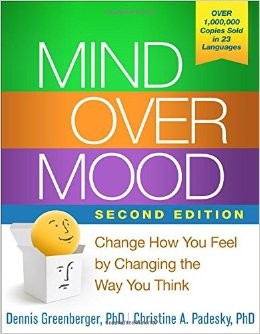 Mind Over MoodDennis Greenberger and Christine A. Padesky
 The Happiness TrapRuss Harris
 The Mindful Way Through DepressionMark Williams, John Teasdale, Zindel Segal, and Jon Kabat-Zinn
 The Dialectical Behavior Therapy Skills WorkbookMatthew McKay, Jeffrey C. Wood, and Jeffrey Brantley
 Stumbling on HappinessDaniel Gilbert


