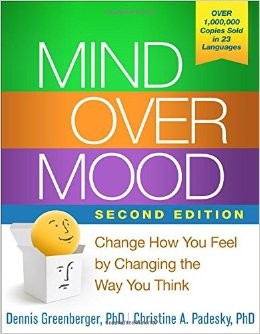
Clinician's guide to Mind over mood
≈ From memoryCognitive Behavioral Therapy (CBT) works not by suppressing negative emotions, but by systematically identifying and restructuring the distorted cognitive processes that maintain them.
In one sentence
The book provides a structured, clinician-focused manual for applying Cognitive Behavioral Therapy (CBT) to treat emotional disorders by teaching patients to recognize, challenge, and replace the "automatic" thoughts that fuel their distress.
Why read this (and who it's for)
This is a practitioner’s manual, not a "pop-psychology" self-help guide. It is designed for mental health professionals—therapists, counselors, and students—who need a systematic way to move a client from "feeling overwhelmed" to "actively analyzing their own mental architecture." After reading this, you will be able to guide clients through the specific mechanics of cognitive restructuring, identify the subtle nuances of different cognitive distortions, and facilitate the transition from emotional reactivity to intentional, evidence-based thinking.
The big idea
The central thesis of Mind over Mood is that our emotional distress is not caused directly by external events, but by the appraisals we make about those events. Padesky argues that while we cannot always control what happens to us, we can develop a "mental muscle" to intervene in the split-second interpretations that lead to depression, anxiety, and anger.
The logic follows a clear trajectory: Situation $\rightarrow$ Automatic Thought $\rightarrow$ Emotion/Behavior. Most people believe the first arrow leads directly to the third. Padesky demonstrates that the second arrow—the thought—is the primary driver of our psychological state. By identifying the "rules" our brains create (schemas) and the "errors" in our logic (distortions), we can break the cycle of negative reinforcement. The book argues that "mind over mood" is achieved through a collaborative, educational process where the therapist teaches the client to become their own scientist.
Key ideas
The Cognitive Model
- What it is — The foundational framework of CBT: our thoughts, feelings, and behaviors are interconnected. A specific situation only becomes "depressing" or "anxious" because of the meaning we assign to it.
- Why it matters — It shifts the patient's locus of control. If the problem is the interpretation of the event, then the solution lies in changing the interpretation, which is something the patient can actually do.
- In the book — Padesky illustrates this by showing how two people can attend the same party; one feels lonely because they think "no one wants to talk to me," while the other feels energized because they think "everyone is so interesting."
Automatic Thoughts (NATs)
- What it is — These are the "pop-up" messages in our heads that occur instantly in response to a stimulus. They are often habitual, reflexive, and rarely questioned.
- Why it matters — Identifying NATs is the first step of "catching" the thoughts before they spiral into full-blown emotional crises.
- In the book — The author emphasizes that NATs are often "hot thoughts"—the specific, stinging words (e.g., "I'm a failure") that occur in the heat of a moment.
Cognitive Distortions
- What it is — Systematic errors in thinking, such as "All-or-Nothing Thinking," "Catastrophizing," or "Mind Reading." These are like "glitches" in our mental software.
- Why it matters — Labeling these distortions helps patients create distance between themselves and their thoughts. It turns a "fact" into a "cognitive error."
- In the book — Padesky provides a comprehensive list of distortions, teaching clinicians how to help clients spot these specific patterns in their daily lives.
Socratic Questioning
- What it is — A method of guided discovery where the therapist asks targeted questions to help the client reach their own conclusions, rather than the therapist simply providing the "correct" answer.
- Why it matters — It builds the client's autonomy and ensures they believe the new perspective because they discovered it themselves, not because they were told to believe it.
- In the book — The author outlines how to use questions like "What is the evidence for this thought?" and "What would you say to a friend in this situation?"
Behavioral Activation
- What it is — The process of identifying and engaging in activities that provide a sense of mastery or pleasure, specifically to counter the withdrawal associated with depression.
- Why it matters — While "mind" (cognition) is vital, "mood" is often sustained by a lack of rewarding experience. Behavioral change can "jumpstart" the cognitive work.
- In the book — Padesky explains how to help clients schedule activities that break the cycle of inactivity and isolation.
The Collaborative Empiricism
- What it is — The therapist and client work together as "co-investigators" to test the validity of the client's beliefs in the real world.
- Why it matters — It treats thoughts as hypotheses rather than facts. The goal is to gather data to see if the thought holds up under scrutiny.
- In the book — This is exemplified by "Behavioral Experiments," where a client might test the thought "Everyone hates me" by intentionally saying hello to a neighbor and observing the actual reaction.
Frameworks & tools
The Thought Record (The Core Tool)
This is the primary "homework" and in-session tool for identifying and challenging NATs.
- Situation: Describe the event (Who, what, where, when).
- Emotion: Identify the feeling (e.g., Sad, Anxious, Angry) and rate the intensity (0–100%).
- Automatic Thought: What was running through your mind? What was the "hot thought"?
- Evidence FOR: What facts support this thought?
- Evidence AGAINST: What facts contradict this thought? (What would a friend say?)
- Alternative Thought: Based on the evidence, what is a more balanced, realistic view?
- Re-rate Emotion: How do you feel now? (Usually, the intensity drops).
The "Three C's" of Cognitive Intervention
When a client presents a distressing thought, use this checklist to guide them:
- Catch It: Help the client identify the NAT as it happens. "What was the first thing you told yourself when that happened?"
- Check It: Evaluate the thought. "Is this a fact or a feeling? What is the evidence?"
- Change It: Replace the thought. "What is a more helpful, realistic way to look at this?"
Memorable examples & stories
The "Mind Reading" Example
A client is worried that their coworkers are judging their performance. Padesky uses this to illustrate how we often assume we know what others are thinking without any actual data. The lesson: We must distinguish between internal interpretations and external evidence.
The "Fortune Telling" Example
A client feels certain they will be fired because of one minor mistake. This illustrates "Catastrophizing." The lesson: We often jump to the worst-case scenario as if it were a guaranteed future, ignoring the myriad of other possible outcomes.
The "Should" Statements
A client feels guilty for not being "perfect" at a hobby. Padesky highlights how "Should" statements (I should be better, I must do this) create unnecessary pressure and shame. The lesson: Identifying "Shoulds" helps lower the internal pressure of perfectionism.
Key quotes
- "The goal of CBT is to help the client become their own therapist." (Paraphrased) Why it matters: It emphasizes that the ultimate success of therapy is the internalisation of tools, not the ongoing reliance on the clinician.
- "Thoughts are not facts; they are mental events." (Paraphrased) Why it matters: This is the core shift required for a client to begin questioning their own internal narrative.
- "We must help clients identify the 'hot' thoughts—the ones that carry the most emotional weight." (Paraphrased) Why it matters: It prevents the client from getting bogged down in trivial thoughts and focuses the work on the primary drivers of distress.
How to apply it
This week
- Identify one "Hot Thought": Whenever you feel a sudden spike in anxiety or sadness, stop and ask: "What did I just tell myself?" Write it down.
- The "Evidence" Test: Take one recurring negative thought (e.g., "I'm incompetent") and write down three pieces of objective evidence that contradict it.
- Label a Distortion: Choose one common distortion (like All-or-Nothing Thinking) and try to "catch" yourself using it in a conversation today.
Ongoing
- The Thought Record: Keep a running log of NATs, the evidence for/against, and a balanced alternative.
- Socratic Inquiry: When you feel a strong emotion, ask yourself: "What is the evidence for this thought? What would I say to a friend who had this thought?"
- Behavioral Experiments: When you feel a "rule" (e.g., "If I go to the gym, everyone will stare"), intentionally test it by going to the gym and observing the actual results.
Common pitfalls
- The "Positive Thinking" Trap: A common mistake is thinking CBT means "just think positive." Padesky clarifies that the goal is accurate thinking, not "happy" thinking. If a thought is true, it must be acknowledged, not ignored.
- Over-Intellectualizing: Clients can sometimes get lost in the "logic" of the thought record without actually feeling the emotional shift. The therapist must ensure the client is connecting the cognitive work to their actual feelings.
- Ignoring Behavior: Some practitioners focus so much on the "Mind" (cognition) that they forget the "Mood" is often maintained by behavioral patterns (like avoiding social situations).
Connects to
- "Feeling Good argues" by David Burns: Provides a more self-help-oriented approach to identifying cognitive distortions.
- "The Happiness Trap" by Russ Harris: Offers an ACT (Acceptance and Commitment Therapy) perspective, which focuses on defusing from thoughts rather than restructuring them.
If you remember only three things
- The Cognitive Model: Situations don't cause feelings; our interpretations of situations do.
- Catch, Check, Change: The fundamental process of identifying, evaluating, and replacing automatic negative thoughts.
- Collaborative Empiricism: The therapist and client are a team of scientists testing the validity of thoughts against the evidence of reality.
Internalize it
- Reflection questions
- When you feel a sudden shift in mood, what was the specific "Automatic Thought" that preceded it?
- If you were to look at your most frequent negative thought as a "hypothesis" rather than a "fact," how would that change your reaction to it?
- What is one "Should" statement you tell yourself daily? What would happen if you replaced it with a "Could" or "Would like to" statement?
- Flashcards Q: What is the difference between a "Hot Thought" and a "Neutral Thought"? A: A Hot Thought is the specific, emotionally charged thought that triggers a significant distress response (e.g., "I'm going to be fired"). Q: What are the three steps of the "Catch, Check, Change" method? A: Catch the automatic thought, Check the evidence for/against it, and Change it into a balanced alternative. Q: What is "Collaborative Empiricism"? A: A therapeutic approach where the therapist and client work together as researchers to test the validity of the client's beliefs through behavioral experiments and evidence gathering. Q: What is a "Cognitive Distortion"? A: A systematic error in thinking, such as Catastrophizing, Mind Reading, or All-or-Nothing Thinking. Q: What is the primary goal of the Thought Record? A: To help clients identify, evaluate, and restructure the automatic thoughts that maintain their emotional distress.
Fidelity note
This summary is grounded in the standard clinical application of Cognitive Behavioral Therapy (CBT) as presented by Christine Padesky. I am highly confident in the core framework (Cognitive Model, NATs, Distortions, Socratic Questioning). Because this is a clinician's guide, some specific "clinician-only" nuances regarding the nuances of how to phrase certain questions in a session may be simplified for the sake of a summary. Readers should refer to the original text for specific scripts and the full list of cognitive distortions.