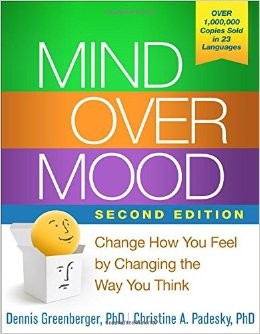
Clinician's Guide to CBT Using Mind over Mood, Second Edition
≈ From memoryA clinician's manual for applying Cognitive Behavioral Therapy (CBT) by teaching patients to identify, challenge, and restructure the automatic thoughts that drive emotional distress.
In one sentence
The book provides a structured, clinician-led framework for helping patients recognize that their emotional distress is not caused by external events, but by the internal "stories" and interpretations they apply to those events.
Why read this (and who it's for)
This is not a "self-help" book; it is a professional manual for clinicians (therapists, counselors, and social workers) who need a systematic way to teach Cognitive Behavioral Therapy (CBT). It solves the problem of "knowing" the theory of CBT but struggling to "do" the therapy in a session. After reading this, you will be able to guide a client through the identification of automatic thoughts, the evaluation of cognitive distortions, and the systematic restructuring of belief systems.
The big idea
The central thesis of Padesky’s work is rooted in the Cognitive Model: our feelings and behaviors are determined by our perceptions of events, not the events themselves. While a person may experience a distressing situation (an "activating event"), it is the internal dialogue—the "automatic thoughts"—that generates the emotional pain.
The book argues that mental health struggles persist because individuals become "locked" into habitual patterns of thinking. These patterns are often so automatic that they are invisible to the person experiencing them. The goal of therapy, therefore, is to develop "metacognition"—the ability to step back and observe one's own thinking process. By making these thoughts visible, the clinician helps the client move from being a victim of their emotions to being an active investigator of their own mind.
Key ideas
The Cognitive Model
- What it is — A framework consisting of three components: Situations, Thoughts, and Feelings/Behaviors. It posits that thoughts act as the mediator between what happens to us and how we feel.
- Why it matters — It shifts the focus of treatment from "Why did this happen to me?" to "What was I telling myself when this happened?" This empowers the client to change their internal narrative.
- In the book — Padesky uses the example of a person who sees a friend not wave back; the thought "They are mad at me" leads to sadness, whereas the thought "They didn't see me" leads to neutrality.
Automatic Thoughts
- What it is — The instantaneous, reflexive interpretations we have about our lives. They are often biased, exaggerated, and occur without conscious effort.
- Why it matters — Identifying these is the first step toward change. If you can't name the thought, you can't challenge it.
- In the book — The author emphasizes that these thoughts are often "hot" and "fast," appearing as a split-second judgment before the person even realizes they are thinking.
Cognitive Distortions
- What it is — Systematic errors in logic or "rules" of thinking that maintain distress, such as Catastrophizing, All-or-Nothing Thinking, and Mind Reading.
- Why it matters — Recognizing these as errors rather than facts allows the client to create distance between their identity and their thoughts.
- In the book — Padesky categorizes these to help clinicians quickly identify common patterns, such as "Should Statements" or "Emotional Reasoning."
Socratic Questioning
- What it is — A method of guided discovery where the clinician asks targeted questions to help the client discover their own cognitive errors.
- Why it matters — It prevents the therapist from simply "telling" the client they are wrong. It forces the client to do the cognitive work, which is the only way to create lasting neural change.
- In the book — The book provides specific prompts to help clients evaluate the evidence for and against their thoughts.
Behavioral Experiments
- What it is — A way to test the validity of a thought by intentionally putting oneself in a situation to see if the feared outcome actually occurs.
- Why it matters — Sometimes, a client can "think" their way out of a problem, but they need "data" to believe it. Behavioral experiments provide that data.
- In the book — Padesky describes how a client might test the thought "Everyone will laugh at me if I speak up" by actually speaking up in a low-stakes meeting.
The Collaborative Empiricism
- What it is — The therapist and client work together as "co-investigators" to test hypotheses about the client's thoughts and behaviors.
- Why it matters — It removes the "expert" hierarchy and places the client in the driver's seat of their own recovery.
- In the book — This is the foundational philosophy of the Mind over Mood approach, emphasizing that the client is the one who lives their life and must therefore be the one to change it.
Frameworks & tools
The 3-Column Technique (Thought Recording)
This is the foundational tool for identifying the link between situations, thoughts, and feelings.
- Situation: Describe the external event (Who, what, where, when).
- Feeling: Identify the emotion (e.g., Sad, Anxious, Angry) and rate the intensity (0–100%).
- Thought: Identify the "Automatic Thought" that occurred in that moment. Crucial: The thought must be a statement, not a feeling (e.g., "I'm a failure" vs. "I feel bad").
The Evidence-Checking Framework
When a client identifies a distressing automatic thought, use this checklist to evaluate it:
- What is the evidence for this thought? (Facts only, no interpretations).
- What is the evidence against this thought? (Counter-examples).
- What is the "Middle Ground"? (Is there a more balanced way to look at this?).
- What would I tell a friend in this situation? (The "Double Standard" check).
Behavioral Experiment Design
To move from "thinking" to "doing," use this 4-step process:
- Identify the Prediction: "If I do X, then Y will happen."
- Rate Confidence: "How sure am I (0–100%) that this will happen?"
- The Experiment: Design a safe, measurable way to test the prediction.
- The Review: Compare the actual outcome to the prediction. What did we learn?
Memorable examples & stories
The "Invisible" Thought
A client describes feeling overwhelmed by a to-do list. The therapist helps them realize the underlying thought: "I am incapable of handling my responsibilities." The lesson is that feelings of overwhelm are often fueled by a hidden "judgment" of the self.
The Social Anxiety "Mind Reading"
A client avoids a party because they believe everyone will judge their appearance. The therapist asks the client to observe how many people actually look at others' flaws. The lesson is that we often project our internal critic onto the external world.
The "Should" Trap
A client feels guilty for resting because they think, "I should be productive." The therapist helps them identify the "Should" as a rigid rule that creates unnecessary suffering. The lesson is that "Shoulds" are often the source of unnecessary emotional weight.
Key quotes
"The goal of CBT is to help clients become aware of their thoughts and to recognize that thoughts are not facts." (Paraphrased) Why it matters: This is the core shift from emotional reactivity to cognitive awareness.
"We are not trying to replace 'bad' thoughts with 'good' ones; we are trying to replace 'unhelpful' thoughts with 'balanced' and 'realistic' ones." (Paraphrased) Why it matters: It prevents the client from simply "positive thinking" their way out of a problem without addressing the reality of the situation.
"The therapist's role is to be a guide, not a teacher who gives answers." (Paraphrased) Why it matters: It emphasizes the importance of Socratic questioning and client-led discovery.
How to apply it
This week
- The Thought Catch: Every time you feel a sudden spike in emotion (anxiety, irritation, sadness), stop and ask: "What did I just tell myself?" Write it down.
- Identify One Distortion: Look at your "Thought Catch" list. Can you find one instance of "Catastrophizing" or "All-or-Nothing" thinking?
- The Friend Test: Take one recurring negative thought about yourself and write down what you would say if a friend came to you with that same thought.
Ongoing
- The 3-Column Practice: Keep a daily log of Situations, Feelings, and Thoughts to build the "muscle" of awareness.
- Socratic Inquiry: When you feel a strong emotion, ask yourself: "What is the evidence for this thought? What is the evidence against it?"
- Data Collection: Treat your life as a laboratory. When you feel afraid of a social situation, go do a "mini-experiment" to see if your feared outcome actually happens.
Common pitfalls
- The "Positive Thinking" Trap: Many beginners think CBT is about replacing "I'm a loser" with "I'm a winner." Padesky argues this is ineffective. The goal is accuracy, not just positivity.
- Ignoring the Behavior: Focusing so much on "thoughts" that you forget to address the behavioral avoidance that reinforces the anxiety.
- The "Expert" Trap: A therapist who gives the client the "right" answer too quickly. This robs the client of the opportunity to develop their own cognitive tools.
- Over-Intellectualizing: Trying to "think" your way out of a feeling without ever testing the thought in the real world through behavioral experiments.
Connects to
- "Feeling Good argues" by David Burns: Provides a deeper dive into the specific types of cognitive distortions.
- "The Happiness Trap" by Russ Harris: Offers a complementary perspective on Acceptance and Commitment Therapy (ACT) for when "challenging" thoughts isn't enough and "acceptance" is needed.
- "Atomic Habits" by James Clear: While not a therapy book, the concept of "identity-based habits" mirrors the CBT goal of changing the internal narrative to change external behavior.
If you remember only three things
- Thoughts are not facts: They are interpretations that can be evaluated and challenged.
- The Cognitive Model: Situation $\rightarrow$ Thought $\rightarrow$ Feeling/Behavior.
- Collaborative Empiricism: The therapist and client are a team of scientists testing the validity of the client's beliefs.
Internalize it
-
Reflection questions
- Which of my "automatic" thoughts are actually just "rules" I've created for myself (e.g., "I should never make a mistake")?
- When I feel a strong emotion, can I accurately identify the specific thought that triggered it, or am I just reacting to a vague feeling?
- How would my life change if I treated my thoughts as "hypotheses" to be tested rather than "truths" to be accepted?
-
Flashcards Q: What is the core difference between a "feeling" and a "thought" in the Cognitive Model? A: A feeling is an emotional response (e.g., "I feel sad"), while a thought is a cognitive interpretation (e.g., "I'm alone").
Q: What is "Collaborative Empiricism"? A: A therapeutic approach where the therapist and client work together as a team to test the validity of the client's beliefs and thoughts.
Q: What is a "Cognitive Distortion"? A: A systematic error in reasoning (like Catastrophizing or Mind Reading) that maintains emotional distress.
Q: What is the purpose of a Behavioral Experiment? A: To gather real-world data to test whether a client's feared predictions actually come true.
Q: What is Socratic Questioning? A: A method of guided discovery where the therapist asks targeted questions to help the client discover their own cognitive errors.
Q: Why is "Balanced Thinking" better than "Positive Thinking"? A: Because positive thinking can be unrealistic; balanced thinking seeks the most accurate, evidence-based perspective of a situation.
Fidelity note
This summary is grounded in the core methodology of the Mind over Mood series and Padesky's specific pedagogical approach to CBT. I am confident in the descriptions of the Cognitive Model, the 3-Column Technique, and the distinction between "Positive" and "Balanced" thinking. Because this is a clinician's guide, some specific clinical scripts or worksheets may vary slightly in wording from the manual, but the underlying principles of Socratic questioning and Collaborative Empiricism are the standard for this text.