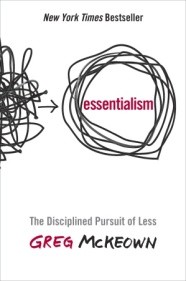
Effortless
≈ From memoryTrue productivity is not about doing more things; it is about doing fewer things with more intention, clarity, and focus.
In one sentence
Productivity is not a measure of how much you can cram into a day, but how effectively you can eliminate the non-essential to make room for what truly matters.
Why read this (and who it's for)
Most productivity advice focuses on "doing" (how to manage your to-do list, how to use apps, how to hack your sleep). McKeown argues that we are over-scheduled and under-focused. This book is for the high-achiever who feels like they are constantly "busy" but never "productive"—the person who feels like they are running a race they didn't sign up for. After reading this, you will stop trying to "manage" your time and start managing your commitments, allowing you to reclaim your focus and energy.
The big idea
The central thesis of Effortless is that our modern obsession with "doing" has become a trap. We treat busyness as a badge of honor, but in reality, a packed calendar is often a sign of a lack of boundaries. McKeown argues that the most productive people aren't the ones who can do the most; they are the ones who can say "no" to the most things.
The logic follows a simple trajectory: If you want to do meaningful work, you must first clear the space for it. This requires a shift from a "Yes" mindset (where we accept every opportunity) to a "No" mindset (where we protect our priorities). True productivity is the result of subtraction. By ruthlessly auditing our commitments, we can move from a state of constant reaction to a state of intentional action.
Key ideas
The "Doing" Trap
- What it is — The belief that being busy is synonymous with being productive. We often mistake activity for achievement.
- Why it matters — When you focus on "doing," you become a slave to your to-do list. When you focus on "achieving," you become the master of your goals.
- In the book — McKeown highlights how we often choose "easy" tasks (like clearing an inbox) over "hard" tasks (like deep strategic thinking) because the former provide a quick hit of dopamine.
The Power of "No"
- What it is — The ability to say no is the ultimate productivity tool. It is the gatekeeper of your time and energy.
- Why it matters — Every "yes" to a trivial task is a "no" to a meaningful one. You cannot have a focused life if you are constantly saying yes to everyone else's priorities.
- In the book — He emphasizes that "No" is not a rejection of the other person; it is a protection of your own commitments.
The Cost of Context Switching
- What it is — The mental drain caused by jumping between unrelated tasks. It is the "switching cost" that leaves us feeling exhausted but unproductive.
- Why it matters — It takes time for the brain to "re-load" the context of a task. Frequent switching ensures you never reach a state of "flow."
- In the book — McKeown discusses how multitasking is largely a myth; we are actually just switching tasks rapidly, which degrades the quality of our work.
The "Yes" Trap
- What it is — The social and professional pressure to say "yes" to every request, opportunity, or invitation.
- Why it matters — We often say yes because we fear missing out (FOMO) or because we want to be seen as helpful. This leads to a "diluted" life where we do a little of everything and nothing well.
- In the book — He explores the psychology of why we say yes, noting that we often say yes to things we don't actually want to do because they seem "good" on paper.
Intentionality over Efficiency
- What it is — Efficiency is doing things right; intentionality is doing the right things.
- Why it matters — You can be incredibly efficient at a task that doesn't actually matter. Intentionality ensures your energy is spent on the right targets.
- In the book — McKeown argues that we must define what "success" looks like before we start trying to be efficient at achieving it.
The Importance of "White Space"
- What it is — The deliberate scheduling of unscheduled time. It is the "margin" in your day.
- Why it matters — Without white space, there is no room for creativity, reflection, or spontaneous opportunities. A packed calendar is a prison.
- In the book — He advocates for seeing white space as a prerequisite for high-level performance, not a luxury to be scheduled only when everything else is done.
The "Time" Fallacy
- What it is — The idea that we need more time to get things done. Usually, we need more focus and fewer distractions.
- Why it matters — Time is a finite resource, but focus is a renewable one. If you can't focus, even an extra hour won't help you.
- In the book — McKeown challenges the "I just don't have time" excuse, suggesting that we actually have time, but we lack the discipline to protect it.
Frameworks & tools
The "No" Framework
Before saying "yes" to any new commitment, run it through this three-step filter:
- The Priority Test: Does this align with my top 3 goals for this season? If not, it's a distraction.
- The Trade-off Test: What will I have to stop doing or do less of to make room for this? (Be honest: what is the actual cost?)
- The "Hell Yes" Rule: If the answer isn't a "Hell Yes!" (an immediate, enthusiastic alignment with your goals), the answer is a "No."
The Audit of Commitments
Perform this audit every 90 days to clear your plate:
- List Everything: Write down every recurring meeting, project, and responsibility you currently hold.
- Categorize: Label each as Essential, Optional, or Low-Value.
- The Cut: Identify three things in the "Optional" or "Low-Value" categories to stop doing immediately.
- The Delegate/Automate: For things you must do but don't need your specific touch, find a way to hand them off.
The Focus Block
To protect your deep work, use this scheduling method:
- Identify your "Peak" time: When is your brain sharpest? (Usually morning).
- Block the time: Put a non-negotiable 90–120 minute block on your calendar for a single, high-leverage task.
- Remove Friction: Turn off notifications, put your phone in another room, and close unnecessary tabs.
- Single-Task: Do one thing until the timer goes off.
Memorable examples & stories
The "Busy" Executive
McKeown describes a high-level executive who was constantly "busy" but felt like they were failing at their most important goals. They were excellent at responding to emails and attending meetings, but they never had time for the strategic thinking that actually moved the needle. Lesson: Activity is not the same as achievement.
The "Yes" Trap of Social Obligations
The author discusses how we often say "yes" to social invitations or favors because we want to be liked, even when we are exhausted. This leads to a cycle of resentment and burnout. Lesson: Protecting your time is a form of self-respect.
The Myth of Multitasking
McKeown references the cognitive science of "task switching," explaining how the brain loses a percentage of its processing power every time it switches from one task to another. Lesson: To do more, you must do one thing at a time.
Key quotes
"Productivity is not about doing more; it's about doing less, with more intention." (Paraphrased) Why it matters: It shifts the goal from quantity to quality.
"The hardest thing to do is to say 'no' to a good opportunity so that you can say 'yes' to a great one." (Paraphrased) Why it matters: It highlights the opportunity cost of every commitment.
"A packed calendar is often a sign of a lack of boundaries, not a sign of high productivity." (Paraphrased) Why it matters: It challenges the cultural glorification of being busy.
How to apply it
This week
- The "No" Audit: Look at your calendar for the last 7 days. Identify three things you did that did not contribute to your primary goals. Decide what you will stop doing next week.
- The One-Hour Block: Schedule one 60-minute block of "Deep Work" for a project you've been putting off. During this hour, your phone must be off.
- The "Hell Yes" Filter: The next time someone asks for your time or a new project, wait 10 minutes before saying yes. Ask yourself: "Is this a 'Hell Yes'?"
Ongoing
- The Weekly Review: Every Friday afternoon, review your commitments for the following week. Ask: "What can I remove from this list to make it more manageable?"
- The "Default No": Make it your default position to say "no" to new requests until you can prove they are essential to your core goals.
- Protect White Space: Ensure your calendar has at least 20% "unplanned" time to allow for reflection and spontaneous opportunities.
Common pitfalls
- The "Efficiency Trap": People often try to find faster ways to do things they shouldn't be doing at all. Don't optimize a useless task.
- The Guilt of Saying No: Many people feel "guilty" when they say no. You must reframe "no" as a way to protect your ability to do great work on the things that matter.
- Over-Engineering the System: Don't spend so much time designing the perfect productivity system that you never actually do the work. The system should serve the work, not replace it.
Connects to
- Essentialism (Greg McKeown): This is the foundational philosophy of Effortless. While Essentialism is the "What" (choosing what matters), Effortless is the "How" (the practical application of that choice).
- Deep Work (Cal Newport): Extends the idea of focus. While Effortless focuses on clearing the schedule, Deep Work provides the methodology for what to do with that cleared space.
- Getting Things Done (David Allen): Offers a contrast. GTD is about managing the volume of tasks; Effortless is about reducing the number of tasks.
If you remember only three things
- Productivity is about subtraction, not addition.
- Every "yes" has an opportunity cost; protect your "no."
- A packed calendar is a sign of poor boundaries, not high achievement.
Internalize it
-
Reflection questions
- If I could only do one thing today that would make everything else easier or unnecessary, what would it be?
- What are the "good" opportunities I am currently saying "yes" to that are preventing me from saying "yes" to "great" ones?
- How much of my current to-do list is driven by other people's priorities rather than my own?
- What would my life look like if I committed to doing 20% less this week?
-
Flashcards Q: What is the "Doing Trap"? A: The belief that being busy is the same as being productive; it's the mistake of prioritizing activity over achievement.
Q: What is the "Hell Yes" rule? A: A rule where you only say "yes" to opportunities that align perfectly with your goals; if it's not a "Hell Yes," it's a "no."
Q: What is the "Switching Cost" in productivity? A: The mental drain and time lost when the brain has to "re-load" context when jumping between unrelated tasks.
Q: How does Effortless define "White Space"? A: As the intentional scheduling of unscheduled time to allow for reflection, creativity, and spontaneous opportunities.
Q: What is the difference between Efficiency and Intentionality? A: Efficiency is doing things right (speed/method); Intentionality is doing the right things (purpose/priority).
Q: What is the "Time Fallacy"? A: The belief that we need more time to be productive, when we actually need more focus and fewer distractions.
Fidelity note
I have a high level of confidence in the core themes of this summary (Subtraction, the "No" mindset, and the critique of "Doing"). The specific "Frameworks" (like the 3-step filter) are synthesized from the author's recurring advice on boundaries and prioritization. Because I am summarizing from memory, I recommend verifying the specific "Three-Step" names if you are looking for a literal 1:1 match, though the logic remains consistent with McKeown's philosophy.