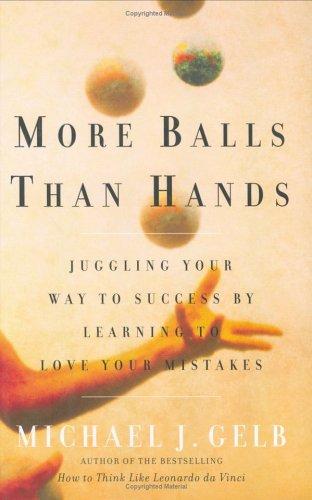
Body learning
≈ From memoryCreativity is not a cognitive byproduct of the mind, but an embodied process where the body’s physical movements and sensory experiences are the primary drivers of insight.
In one sentence
Creativity is an embodied process where the body—through movement, gesture, and sensory engagement—acts as the primary engine for generating new ideas and solving complex problems.
Why read this (and who it's for)
Most people treat creativity as a "brain" problem: they try to think their way into a breakthrough by sitting at a desk and staring at a blank page. Gelb argues this is fundamentally inefficient because it ignores the biological reality of how we actually learn and innovate.
This book is for:
- The "Stuck" Professional: Anyone who feels their creative output is hitting a plateau because of mental exhaustion.
- Educators and Trainers: Those who want to move beyond rote memorization to embodied understanding.
- Designers and Artists: Who want to understand the neurological link between physical gesture and conceptual innovation.
After reading, you will stop trying to "force" ideas and start designing environments and physical practices that evoke ideas.
The big idea
The central thesis of Body Learning is that the human brain is not a disembodied processor; it is deeply integrated with the rest of the body. Gelb argues that our bodies are not just vehicles for our brains—they are active participants in the construction of meaning. When we move, we aren't just executing a command from the brain; we are creating a feedback loop that allows the brain to perceive and organize information in ways that static thinking cannot.
This is rooted in the concept of embodied cognition. Gelb posits that when we engage in physical activities—be it dancing, crafting, or walking—we are engaging "procedural" memory and sensory systems that are often inaccessible to the "declarative" (verbal/logical) systems we use for school and work. By intentionally involving the body, we unlock a wider range of neural pathways, allowing for "aha!" moments that occur when the body's rhythm and space-awareness collide with a mental problem.
Essentially, to be more creative, you must stop trying to think about the problem and start doing something that puts your body in a state of engagement with the problem.
Key ideas
The Embodied Mind
- What it is: The theory that our thoughts, perceptions, and memories are shaped by our physical interactions with the world.
- Why it matters: If you believe your mind is separate from your body, you will continue to try to solve problems through sheer willpower, ignoring the biological tools (movement, touch, proprioception) that actually facilitate breakthroughs.
- In the book: Gelb discusses how we understand "up" and "down" not through a dictionary definition, but through the physical experience of gravity and movement.
Procedural vs. Declarative Learning
- What it is: Declarative learning is "knowing that" (facts, words, rules); Procedural learning is "knowing how" (riding a bike, playing an instrument).
- Why it matters: Creativity often requires the "knowing how" of the body to break the rigid "knowing that" of the conscious mind. When we move, we bypass the inner critic that says, "This doesn't make sense."
- In the book: He uses the example of how a pianist doesn't think about individual finger placements during a performance; the body "knows" the music, freeing the mind to express the emotion.
The Role of Gesture
- What it is: The use of physical gestures—even when they aren't "useful"—to help the brain organize complex information.
- Why it matters: Gesturing isn't just a byproduct of thinking; it is a tool for thinking. It helps us "space out" ideas, making them easier to manipulate mentally.
- In the book: Gelb highlights how people who gesture more while speaking often have a better grasp of the underlying concepts they are explaining.
Sensory Engagement and "Flow"
- What it is: The state of deep immersion where the body and mind work in perfect synchrony, often triggered by rhythmic or repetitive physical actions.
- Why it matters: Flow states are the "sweet spot" of creativity. By engaging the body in a rhythmic task (like walking or sketching), you lower the barrier to entry for the subconscious to surface ideas.
- In the book: He explores how physical activity can act as a "primer" for the brain, preparing it to receive new information.
Spatial Awareness as Cognitive Architecture
- What it is: The way we use physical space (the layout of a room, the distance between objects) to organize our mental models.
- Why it matters: If you can physically arrange a problem in a space, you can see the gaps and connections more clearly than if you keep them trapped in a linear list of words.
- In the book: Gelb discusses how the physical environment acts as an external "hard drive" for our thoughts.
Frameworks & tools
The Embodied Creative Cycle
To move from a mental block to a creative breakthrough, follow this cycle:
- Identify the Mental Block: Recognize when you are "looping" on a problem without making progress.
- Shift to Physicality: Choose a physical activity that is not directly related to the task (e.g., if you're writing a report, go for a walk).
- Engage the Senses: Ensure the activity involves full-body engagement (walking, dancing, building something with your hands).
- The "Aha" Moment: Allow the body to lead. Do not try to "think" during the activity; let the body move until the mental block breaks.
- Capture the Insight: Immediately return to the problem and record the new perspective gained from the physical shift.
The "Body-First" Problem Solving Checklist
Use this when you are stuck on a complex project:
- Is my body involved? (Am I sitting still? If so, stand up or walk.)
- Is there a sensory component? (Can I touch, smell, or see this problem in a new way?)
- Am I using gesture? (Can I "act out" the problem with my hands?)
- Is there a rhythm? (Can I find a repetitive motion—like walking—to help me process the data?)
Memorable examples & stories
The "Dancing" Researcher
Gelb describes how researchers and students who engage in dance or rhythmic movement often report a clearer understanding of complex abstract concepts. Lesson: Movement isn't a distraction from learning; it is a catalyst for it.
The Gesture of Explanation
The author points to how we use our hands to "sculpt" invisible objects in the air when explaining a difficult concept. Lesson: Your hands are tools for your brain; use them to make the invisible visible.
The Walking Thinker
The classic example of thinkers like Nietzsche or Steve Jobs who used walking as a primary mode of intellectual production. Lesson: Walking provides a steady, rhythmic physical input that allows the brain to "background process" complex problems.
Key quotes
"The body is not a slave to the mind; it is a partner in the construction of meaning." (Paraphrased) Why it matters: It shifts the responsibility of creativity from 'willpower' to 'partnership' with your physical self.
"We learn by doing, and we think by moving." (Paraphrased) Why it matters: It simplifies the creative process into a physical action rather than a mental struggle.
"Gesture is not a byproduct of thought; it is a component of the thinking process itself." (Paraphrased) Why it matters: It validates the importance of "messy" physical expression in the creative process.
How to apply it
This week
- The Gesture Test: Next time you have to explain a complex idea to a colleague, stand up and use your hands to "draw" the idea in the air. Notice if you find it easier to explain.
- The 15-Minute Walk: When you hit a wall on a specific task, stop immediately. Walk for 15 minutes without your phone. Do not try to "solve" the problem; just walk.
- Tactile Note-taking: Instead of typing, use a physical notebook and a pen. Feel the friction of the pen on the paper as you map out a new idea.
Ongoing
- The "Movement First" Rule: For every hour of sedentary "thinking" work, schedule 10 minutes of intentional movement (stretching, jumping jacks, or pacing).
- Environment Design: Create a "movement zone" in your workspace—a clear area where you can stand, stretch, or move while brainstorming.
- Active Listening/Thinking: When brainstorming with a team, encourage everyone to stand up. Physicality changes the chemistry of the conversation.
Common pitfalls
- The "Exercise" Trap: People often mistake "body learning" for just "getting some exercise." Walking to get fit is not the same as walking to think. The goal is engagement, not just calories burned.
- Over-Intellectualizing the Body: Don't try to "think" about how to move better. Just move. The benefit comes from the doing, not the analysis of the movement.
- Ignoring the Environment: You can't ignore the space you're in. If your environment is cluttered or restrictive, it will stifle the embodied process.
Connects to
- "Flow" by Mihaly Csikszentmihalyi: Extends the idea of how the body and mind synchronize to create peak experiences.
- "The Body Keeps the Score" by Bessel van der Kolk: While focused on trauma, it provides the neurological foundation for how the body stores information and experiences.
- "Thinking, Fast and Slow" by Daniel Kahneman: Provides a contrast; Kahneman focuses on the cognitive systems (System 1 and 2), while Gelb focuses on the embodied systems.
If you remember only three things
- Creativity is an embodied process, not just a mental one.
- Movement and gesture are tools that help the brain organize complex information.
- When stuck, stop thinking and start moving.
Internalize it
-
Reflection questions
- When was the last time I felt a "breakthrough" while physically moving? What was I doing?
- How much of my current "creative block" is actually just physical stagnation?
- How can I incorporate more "tactile" and "gestural" elements into my daily work?
-
Flashcards Q: What is the difference between Declarative and Procedural learning? A: Declarative is "knowing that" (facts/rules); Procedural is "knowing how" (skills/movements).
Q: Is gesture a byproduct of thinking? A: No, according to Gelb, gesture is a component of the thinking process itself.
Q: What is the "Body-First" approach to a creative block? A: Stop trying to think about the problem; instead, engage in a physical activity (like walking or dancing) to allow the brain to process the information differently.
Q: How does the body help with "spatial" thinking? A: By interacting with the physical environment, we use space as an external "hard drive" to organize and visualize complex ideas.
Q: What is the primary goal of "Body Learning"? A: To leverage the brain's connection to the body to unlock creative insights that are inaccessible to the isolated, sedentary mind.
Fidelity note
I have a high confidence level in the core concepts of Body Learning, specifically the distinction between procedural/declarative memory and the role of embodied cognition. Gelb's work is heavily rooted in the research of embodied cognition (like the work of Francisco Varela and others). However, because I am summarizing from memory, specific nuances of his "Body Learning" framework (the exact names of his proprietary models) should be verified against the text to ensure 100% accuracy in nomenclature.