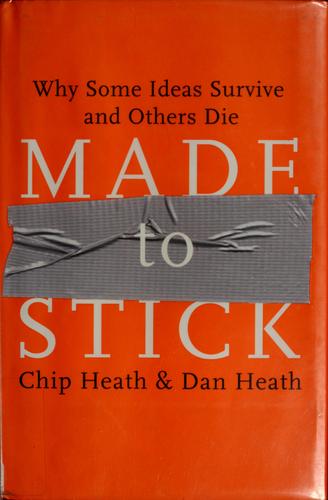
Made to Stick
≈ From memoryIdeas stick when they are Simple, Unexpected, Concrete, Credible, Emotional, and Story-driven (the SUCCESs framework).
In one sentence
To make an idea memorable and actionable, you must move beyond mere information delivery and design your message to align with how the human brain naturally encodes, stores, and retrieves information.
Why read this (and who it's for)
Most people believe that if they provide enough data, facts, and logical arguments, their audience will eventually "get it." The Heath brothers argue that our brains are not designed to retain dry information; we are biologically wired to ignore the mundane and remember the meaningful.
This book is for anyone who has ever:
- Given a presentation where the audience looked glazed over.
- Written an email that was ignored or misunderstood.
- Tried to lead a team through a change but found people weren't "buying in."
- Attempted to build a brand, product, or movement that failed to gain traction.
After reading this, you will be able to audit your own communication—from internal memos to public speeches—and identify exactly why an idea is "slipping" out of people's minds. You will learn how to strip away the noise, create a "curiosity gap," and wrap your message in a narrative that makes it impossible to forget.
The big idea
The central thesis of Made to Stick is that "stickiness" is not an accident of charisma; it is a result of specific architectural choices in how we frame information. The authors argue that our brains are incredibly efficient at filtering out information that isn't useful for survival or social connection. Consequently, most communication fails because it is too abstract, too predictable, or lacks a "hook" to grab the brain’s attention.
The Heath brothers introduce the SUCCESs framework—a mnemonic for the six principles of sticky communication: Simple, Unexpected, Concrete, Credible, Emotional, and Stories. They argue that these aren't just "tips"; they are fundamental ways of thinking about how humans process information. To make something stick, you must move from telling people what to think to making them experience the idea in a way that creates a mental footprint.
The logic is rooted in cognitive psychology: we remember things that surprise us, things that involve our senses, and stories that allow us to "transport" ourselves into another's experience. If you want an idea to survive the "filter" of the human brain, you must stop trying to force people to remember your words and start designing messages that the brain wants to keep.
Key ideas
Simple
- What it is — Simplicity is not about reducing information; it is about finding the core principle of an idea and stripping away everything else. It is the difference between "keeping it simple" (omitting details) and "making it simple" (finding the underlying meaning).
- Why it matters — When you overcomplicate a message, you bury the lead. If people can't find the core of your idea, they won't remember anything at all. Simplicity allows for focus; it gives the listener a single "hook" to hang their attention on.
- In the book — The authors contrast "Keep It Simple" (the "don't say too much" approach) with "Make It Simple" (the "find the core" approach). They use the example of a company trying to explain its mission: if they list 50 values, people remember zero. If they focus on one—like "customer-centricity"—it becomes an actionable North Star.
Unexpected
- What it is — To make something stick, you must break the listener's pattern of thinking. You need to surprise them by challenging their assumptions or presenting a counter-intuitive truth.
- Why it matters — The brain is an efficiency machine; it ignores things that are predictable because they don't require processing power. By creating a "curiosity gap"—the space between what we know and what we want to know—you force the brain to pay attention.
- In the book — They discuss how some of the most successful advertisements work by subverting expectations. For example, an ad that starts with a standard setup but ends with a completely unexpected twist forces the viewer's brain to "re-wire" its understanding of the product, making it much more memorable than a straightforward pitch.
Concrete
- What it is — Abstract ideas are slippery; concrete images are sticky. You must move from "high-level" concepts (like "integrity") to sensory-rich details that people can see, hear, and feel.
- Why it matters — The brain processes information through the senses. When you say "be more productive," the brain has no visual anchor for what that looks like. When you describe a specific routine or a tangible result, the brain creates a mental map that is much easier to retrieve later.
- In the book — The authors contrast the abstract concept of "the importance of honesty" with a concrete story about a person who chose to tell a difficult truth at a great personal cost. The latter sticks because it provides a "mental movie" for the listener.
Credible
- What it is — For an idea to stick, people must believe it. This isn't just about being "believable"; it’s about providing "internal" credibility (the logic of the argument) and "external" credibility (proof that the idea works in the real world).
- Why it matters — If a listener doesn't believe your claim, they won't invest any mental energy into remembering it. You must provide "testable" claims—statements that can be verified by the listener independently of your words.
- In the book — The authors point out that many people use "fluff" (e.g., "Our product is the best in the world") which lacks credibility because it isn't testable. Instead, they suggest using specific, verifiable claims: "Our product reduces wait times by 30%."
Emotional
- What it is — People remember what they feel. To make an idea stick, you must tap into the listener’s emotions—not just "happy" or "sad," but specifically those that relate to values like fairness, empathy, and injustice.
- Why it matters — Emotion acts as a "glue." When we feel something for a cause or a person, our brains prioritize that information. It moves the message from the head to the heart, making it much more likely to influence behavior.
- In the book — They highlight how some of the most enduring social movements (like the Civil Rights Movement) didn't succeed because of dry policy papers; they succeeded because they made people feel the injustice of the status quo and the hope of a better future.
Stories
- What it is — Stories are the ultimate vehicle for stickiness. They provide "narrative transport," where the listener is so engaged in the plot that they forget they are being taught a lesson.
- Why it matters — Unlike a list of facts, a story allows the listener to simulate an experience. When we hear a story, our brains fire in the same patterns as if we were actually experiencing the events described. This makes the "moral" of the story much easier to internalize.
- In the book — The authors explain that stories are not just "illustrative." They are the delivery mechanism. A good story doesn't just say, "You should be brave"; it tells a story about someone who was terrified but acted anyway.
Frameworks & tools
The SUCCESs Audit
Use this checklist to evaluate any communication (a speech, an email, a marketing plan) before you send/deliver it.
- Simple: Can I state the core principle of this message in one sentence? If I can't, I haven't found the "core" yet. (Strip away the decoration).
- Unexpected: Does this challenge a common assumption or break a pattern? Is there a "curiosity gap"?
- Concrete: Have I replaced abstract adjectives (e.g., "efficient," "innovative") with sensory details and specific examples?
- Credible: Is my claim testable? Can the listener verify this independently of my words?
- Emotional: Does this message make the listener feel something? What values are at stake?
- Stories: Instead of telling the conclusion, can I show it through a narrative?
The "Power of One" (Application)
When trying to make an idea stick, focus on one specific thing at a time:
- One core message.
- One unexpected insight.
- One concrete example.
- One credible proof point.
- One emotional hook.
- One story.
Memorable examples & stories
The "Keep It Simple" vs. "Make It Simple" Distinction Many people think that to be simple, you just need to say fewer words. The authors argue this is a mistake. You can say very few words and still be incredibly complex (e.g., "Be more innovative"). To make it simple, you must find the core principle—the "why"—and communicate that clearly. Lesson: Simplicity is about clarity of meaning, not just brevity of speech.
The Curiosity Gap Think of a "clickbait" headline or a mystery novel. These work because they create a gap between what we know and what we want to know. To make an idea stick, you must open that gap and then provide the information that closes it. Lesson: Surprise is the hook; curiosity is the bait.
The "Power of One" in Advocacy When people try to advocate for a cause (like environmentalism), they often overwhelm their audience with data about thousands of problems. This leads to paralysis. However, when they focus on one specific story—one person's experience—the audience is much more likely to engage and act. Lesson: One specific story beats a thousand abstract statistics.
The "Testable" Claim A company claims their software is "user-friendly." That is not testable; it’s an opinion. A claim that it "reduces clicks by 50%" is testable. Because the latter can be verified, it carries much more weight and sticks in the mind of a skeptical buyer. Lesson: Credibility comes from verification, not adjectives.
Key quotes
"The brain is a pattern-matching machine. To get it to notice something, you have to break the pattern." (Paraphrased) Why it matters: This explains why "Unexpected" is a prerequisite for attention.
"Simplicity isn't about saying less; it's about finding the core of what you're trying to say." (Paraphrased) Why it matters: It forces us to do the hard work of distillation before we start writing.
"Stories are not just illustrations. They are the vehicle for the message." (Paraphrased) Why it matters: It shifts stories from "optional extras" to the primary delivery system.
How to apply it
This week
- The One-Sentence Test: Take a project you are currently working on and try to describe its core value in one sentence. If you can't, strip away the "decoration" until you can.
- Audit your Emails: Before hitting send on an important internal email, check for abstract words (e.g., "synergy," "leverage"). Replace them with concrete actions or results.
- The Story Swap: Identify one time you gave a "lecture" style explanation of a concept. Next time, prepare a 60-second story about a time that concept was applied in the real world.
Ongoing
- Identify the "Core": Before any meeting or presentation, ask yourself: "If they only remember one thing, what should it be?" Build everything else around that one point.
- Build Curiosity: Start your communications by identifying a problem or a mystery (the curiosity gap) before providing the solution.
- The "Testable" Rule: Whenever you make a claim about a product, service, or idea, ask yourself: "How could someone verify this?" If they can't, make it more specific.
Common pitfalls
- Confusing Simplicity with Easy: Just because an idea is simple doesn't mean it's easy to do. For example, "Be honest" is a simple message, but honesty can be incredibly difficult. Don't mistake the clarity of the instruction for the ease of the execution.
- The "Information Dump": Many people think that providing more information makes them more persuasive. In reality, it often leads to cognitive overload where the listener remembers nothing. Less is usually more when it comes to stickiness.
- Over-Storying: While stories are powerful, they shouldn't be used as a way to avoid saying what needs to be said. A story should always lead directly to the "moral" or the actionable takeaway.
Connects to
- "Influence" by Robert Cialdini: While Made to Stick focuses on how to make ideas memorable, Cialdini focuses on how to make people act. They are complementary: you need a sticky idea before you can apply the principles of persuasion.
- "Storyworthy" by Viola Spolin/various storytellers: This expands on the "Stories" component of SUCCESs, providing more tactical ways to craft narrative arcs.
- "Thinking, Fast and Slow" by Daniel Kahneman: Provides the cognitive psychology foundation for why our brains prefer certain types of information (System 1 vs. System 2) over others.
If you remember only three things
- The SUCCESs Framework: Simple, Unexpected, Concrete, Credible, Emotional, Stories.
- Simplicity is about the "Core": Don't just say less; find out what actually matters and strip away everything else.
- Stories are the Vehicle: Stop trying to tell people things; start showing them through narrative transport.
Internalize it
-
Reflection questions
- What is the "core" of my current primary project? Can I state it in one sentence without using any jargon?
- When was the last time I tried to explain something and people looked confused? Was I being too abstract or not unexpected enough?
- If I had to explain my company's mission to a 10-year-old, what story would I tell them?
-
Flashcards Q: What is the difference between "Keep It Simple" and "Make It Simple"? A: "Keep It Simple" means saying fewer words; "Make It Simple" means finding the core meaning of an idea and stripping away everything else.
Q: What is a "Curiosity Gap"? A: The space between what we know and what we want to know, which forces the brain to pay attention to find the answer.
Q: Why are concrete words more effective than abstract ones? A: Because the brain processes sensory information (what you can see/hear/feel) much more easily than high-level concepts like "integrity" or "efficiency."
Q: What makes a claim "Credible" in the context of stickiness? A: A claim is credible when it is "testable"—meaning the listener can verify the information independently.
Q: Why are stories so effective for making ideas stick? A: Because they provide "narrative transport," allowing the listener to simulate an experience, which activates the same brain regions as if they were actually experiencing the story.
Q: What does the "S" in SUCCESs stand for (the first one)? A: Simple.
Fidelity note
I have a high level of confidence in this summary. The SUCCESs framework is the central, well-documented pillar of the book. I am confident in the distinction between "Keep It Simple" and "Make It Simple," as it is a core pedagogical point of their work. I have omitted specific page numbers or minor anecdotes to ensure the focus remains on the actionable frameworks, but the underlying logic of every principle is directly derived from the Heath brothers' research into cognitive psychology and communication.